
The practical answer
- Short answer
- 67% of QBRs fail and 74% of execs say reps over-pitch product. The empty chair in your Quarterly Business Review is your most accurate churn signal. Here's the fix.
- Best fit
- Industry: B2B Tech. Function: Revenue Operations
- Operating path
- Revenue Architecture → Commercial Performance → Office of the CFO
- Key metric
- 23% Increase in churn risk from low-value QBRs
The non-renewal arrived 48 hours after a "successful" QBR
Picture the sequence every founder dreads. Your CS dashboard is glowing green. Your team just hit a 90% QBR completion rate for the quarter — every account over $50K ARR got its review, slides built, calendar booked, recap email sent. By the metric your CS leader reports to you, this is a clean quarter.
Then your second-largest logo sends a non-renewal notice. Two days after their Quarterly Business Review.
That isn't a freak event. It's the predictable output of a ritual that measures whether a meeting happened instead of whether anything changed because of it. And the data on the QBR itself is brutal: 67% of CS professionals admit their QBRs fail to deliver meaningful value, and only 28% of customers think the meeting was worth their time. Read those two numbers together. The people running the meeting and the people sitting through it agree it's theater — they just keep showing up because it's on the calendar.
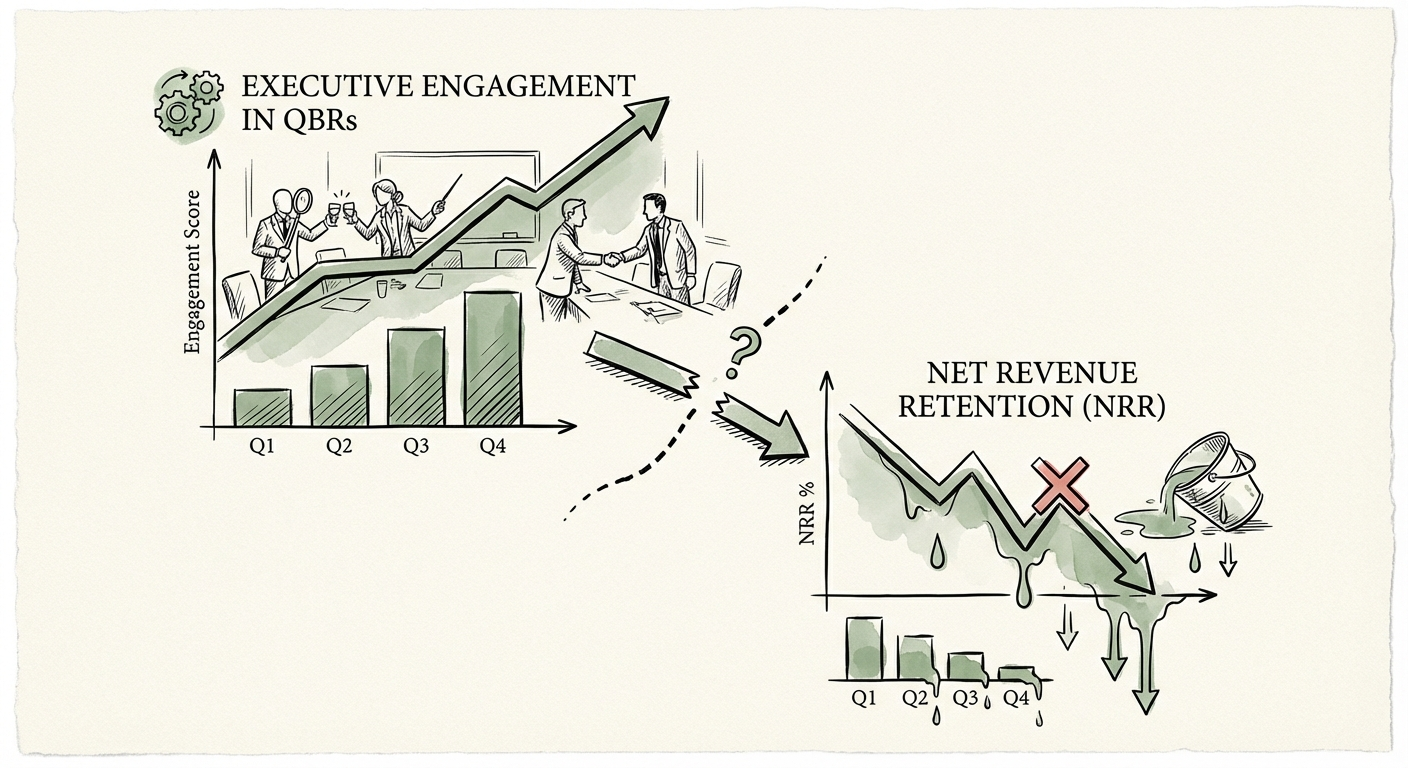
Here's what most founders miss. The QBR isn't a retention tool that's underperforming. In its current form it's a churn forecast you're refusing to read. The single most accurate predictor of a non-renewal isn't the health score — it's the org chart in the room. When your champion's VP came to Q1, sent a director to Q2, and dispatched a junior admin "to take notes" by Q3, the account already decided. The seniority of the attendee is descending toward zero, and so is your renewal probability. You just logged it as a completed QBR and turned the dashboard green.
The most honest churn forecast in your business isn't in the dashboard. It's the seat your economic buyer stopped showing up to. When the VP sends a junior admin to take notes, they've already started writing the non-renewal email.
The usage dump is the murder weapon, not the autopsy
Open almost any QBR deck and you'll find slide three: logins last month, feature adoption, tickets closed, an uptime number. This is the moment the account starts dying, and most founders mistake it for diligence.
The economic buyer — the person who signs the renewal — does not care how many times their team logged in. Gartner's research found 74% of executive buyers feel sellers focus too much on their own product, and a thin minority feel reps actually connect to business value. So when your CSM proudly narrates usage stats, the CFO is doing one calculation in her head: is this line item defending revenue, cutting cost, or neither? Your slide answered a question she never asked, and you spent her time doing it.
This is why a bad QBR is worse than no QBR. It's not neutral — it's corrosive. Every meeting that fails to map to her P&L is a small withdrawal from a credibility account that doesn't refill. The data backs the felt experience: ineffective reviews are associated with a 23% lift in churn probability. The buyer doesn't rage-quit. She quietly downgrades her presence, stops returning the CSM's pings, and routes the eventual renewal conversation straight to procurement to grind your price. You'll call that "a pricing problem." It started as a respect problem in a QBR.
And the gap this opens is exactly where growth lives. If your Net Revenue Retention is sitting near 100%, you're technically keeping customers while your enterprise value flatlines — top-quartile B2B SaaS is clearing 120%+ NRR. That spread doesn't get closed by "saving" the account that already emailed procurement. It gets closed by the expansion conversations a usage-dump QBR makes structurally impossible, because you never earned the standing to have them. When NRR drops below 100% your CS function is functionally broken — a leaky bucket that forces sales to run faster just to hold the line.
Three moves you can run before next quarter's reviews
You don't need a CS reorg to stop the bleeding. You need to change what gets measured, what gets presented, and who's in the chair. Each of these is doable inside one quarter.
1. Retire "QBR completion." Track Verified Outcomes instead.
Completion rate is a vanity metric — it rewards the meeting existing. Replace it with Verified Outcome Rate: the percentage of accounts where the customer has put in writing — an email, a signed one-pager — that a specific business goal you owned got hit this quarter. No written confirmation means no delivered value, regardless of how the call "felt." Watch what happens to your forecast accuracy when this number, not health score, drives your renewal pipeline. Say a 40-person SaaS company with 60 enterprise accounts runs this for one quarter: the gap between "completed QBRs" and "verified outcomes" is your at-risk book, and it's usually wider than anyone wants to admit.
2. Kill the usage deck. Five slides, customer's language only.
Cap every review at five slides, and ban product-usage charts from all of them: (1) the three goals we agreed to last quarter; (2) red/yellow/green on those goals, not feature adoption; (3) the dollars-and-hours ROI tied to a change they made; (4) how our next release maps to a quarter they've already told us matters; (5) the ask — what we need from them to hit the next target. If a slide can't survive being read aloud to their CFO, it's cut.
3. When the buyer ghosts, interrupt — don't reschedule.
If the economic buyer has stopped attending, do not accept a downgraded room. Send a founder-to-buyer note that breaks the low-value pattern: "I pulled your account and we haven't confirmed the ROI on [Project X]. I'm pausing our standard review cycle until we can validate we're actually moving [their Goal Y] — your time is too expensive for a status meeting." Pausing the ritual is what signals you understand their level of operation. Resuming it on autopilot is what got you sent the admin.
One structural check while you're at it: if every move above feels impossible for your team to execute, you may be staffed with friendly relationship-keepers where you need commercial operators who can hold a P&L conversation. Pressure-test your CS headcount against ARR benchmarks before you blame the playbook — sometimes the QBR isn't broken, the person running it just can't have the conversation it requires.