
The practical answer
- Short answer
- Grandfathered accounts paying 2019 rates quietly cap your valuation. Here's the cohort-by-cohort framework for raising prices in 2025 without losing the customers worth keeping.
- Best fit
- Industry: B2B Tech. Function: Revenue Operations
- Operating path
- Revenue Architecture → Commercial Performance → Office of the CFO
- Key metric
- 11.4% Avg. B2B SaaS Price Increase (2025)
The renewal you keep "not getting to"
There is a contract in your CRM you have been avoiding. It belongs to one of your first twenty customers. They signed in 2019 at a rate you would be embarrassed to put in a deck today, and every year since, the renewal has auto-processed at that same number while you quietly hoped no one on the finance team would notice. You tell yourself they're a reference account, a logo, a relationship. What they actually are is a slow leak in your enterprise value.
Almost every founder-led company between $10M and $50M ARR has at least a dozen of these. You traded margin for logos in the early days, handed out "grandfathered" pricing to get the case studies that unlocked your Series B, and it was the right call at the time. But your costs have moved since then. You're now paying for senior engineers, SOC 2 audits, and an enterprise support tier none of those early accounts existed to fund. Your revenue per legacy customer has stayed frozen in 2019 while everything underneath it inflated.
The fear that keeps the renewal untouched is specific and visceral: raise the price and they walk. But run the actual numbers. In 2025, B2B SaaS prices rose by an average of 11.4%, roughly four times general inflation. Your grandfathered accounts are already absorbing increases from Salesforce, AWS, Slack, and every other line item in their stack without a second thought. If you are the one vendor still charging six-year-old rates, you are not signaling loyalty. You are signaling that your product hasn't gotten more valuable since the year they signed.
The lever you keep ignoring
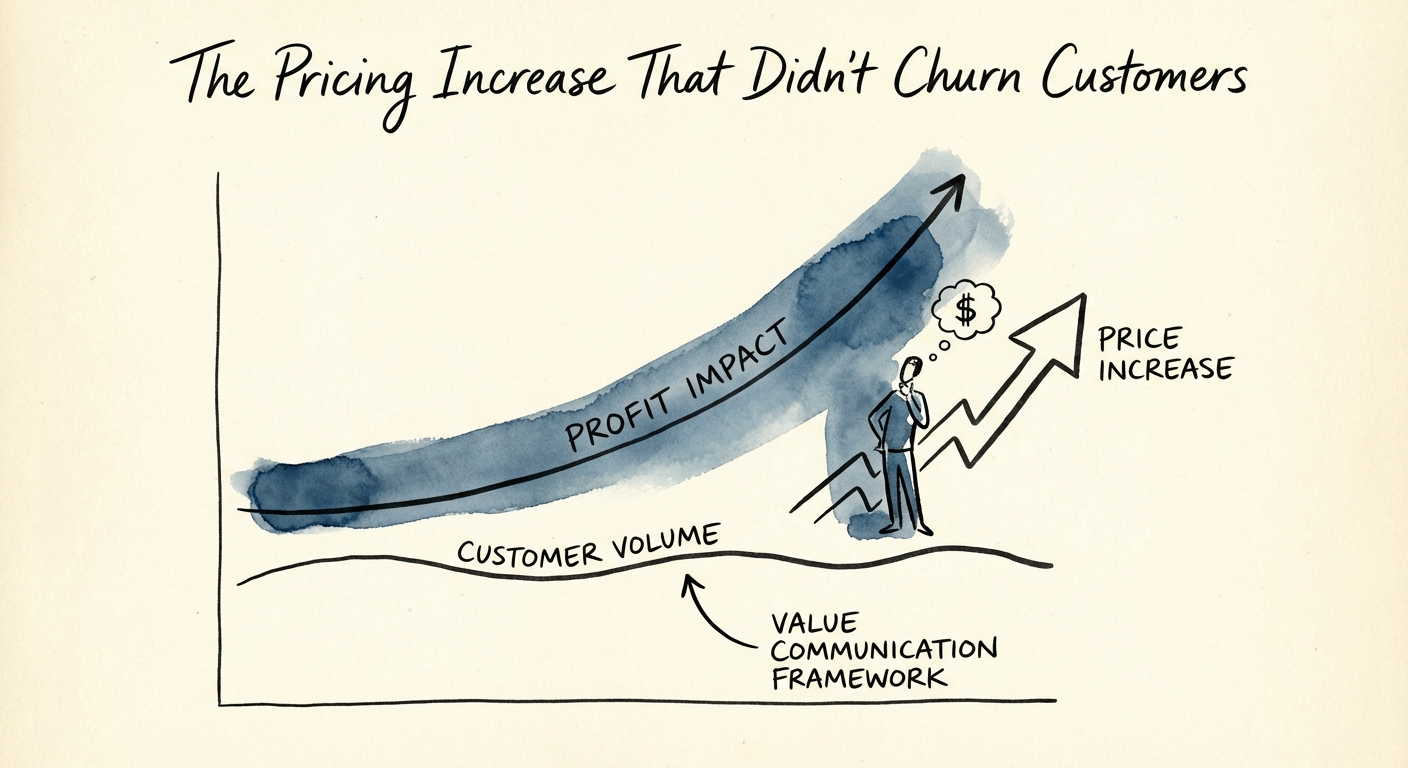
ProfitWell and McKinsey found that a 1% improvement in price monetization produces a 12.7% lift in profitability. A 1% improvement in acquisition volume yields 3.3%. By leaving the legacy book untouched, you've chosen the hardest possible route to EBITDA growth: out-selling your own margin compression with new logos instead of repricing the value you already deliver. The goal here is to get you off apologetic, across-the-board hikes and onto a repricing motion you can run cohort by cohort.
A 1% improvement in price monetization results in a 12.7% increase in profitability. Acquisition only yields 3.3%. Pricing is the strongest lever you have.
Sort the book before you send a single email
A blanket "we're adjusting for inflation" note is the worst thing you can do to a grandfathered base. It tells procurement that nothing about your product changed, only your invoice, and it hands them a reason to go shop. Pricing power isn't uniform across your customers, so your repricing can't be either. Before you touch the renewal queue, sort every account into one of three buckets.
The accounts that will actually leave
Low usage, net revenue retention sliding under 100%, support ticket volume that outweighs their spend. These customers bought a promise and never got the value out, grandfathered rate or not. Raise their price and they don't just churn, they churn loudly. Do not reprice them yet. Fix the customer success gap first, or decide deliberately that you're willing to lose them. A price increase here functions as a resignation letter you wrote on their behalf.
The accounts that quietly tolerate a "give-get"
They use the core product, they're satisfied, they've never expanded. They have moderate leverage, which means you reprice and hand them something in the same breath. "We're moving your base to $50K, and we're including the Advanced Reporting module — previously a $10K add-on — at no additional cost." Their average revenue per account goes up; they feel like they came out ahead. That's not a trick, it's a fair trade you happened to design.
The accounts that should have been repriced years ago
These are the ones woven into critical workflows, where ripping you out would cost more than three years of any increase you could justify. They are paying 2021 rates for a 2026 product and they know it. Don't apologize — show your work. "Since you came on, we've shipped 40 major releases and held uptime at 99.99%. To keep investing at that level, we're bringing your contract to current market rates." The switching cost is your leverage; the feature history is your evidence.
One number tells you if it's safe yet
The industry median for B2B churn runs around 3.5% annually. If your churn is already north of 7%, a price increase without product improvement first is reckless — you'll accelerate a problem you already have. But if you're under 3% and haven't repriced in two years, that gap between your rates and the market is unrealized enterprise value sitting in a spreadsheet you're afraid to open.
The renewal conversation, scripted
Whether the contract renews or cancels usually comes down to the narrative, not the number. So never lead with your costs. Your customer does not care about your AWS bill or your audit fees — they care about the outcome they're getting. Build the message in four moves:
- Frame it as standardization, not a hike: "We're aligning our commercial agreements across the customer base to reflect the platform's current value."
- Prove the value moved: "Over the last 24 months we've shipped [specific capability], [compliance milestone], and [performance gain], which drove [their measurable result]."
- State the number plainly: "Your renewal on [date] will reflect a new annual rate of $X."
- Anchor against new-logo pricing: "As a long-standing partner, this still lands 15% under what we quote new customers today."
When they push back — and a fifth will
Expect roughly one in five to negotiate. That's a healthy signal; the silent ones often mean they've already mentally left. Arm whoever owns the conversation with a concession menu that never touches the headline price. Trade on terms instead: a multi-year lock that holds the rate flat if they sign for three years, Net 60 payment terms instead of Net 30, or a one-time block of training or service credits. Each of these costs you almost nothing and lets the customer win something without you reopening the number you just set.
What this is worth, concretely
Run it on a hypothetical $20M ARR company. A 10% increase across 80% of the base, modeling 5% of those accounts churning from the move, nets roughly $1.5M in pure profit. At a 15x EBITDA multiple, that's about $22.5M in enterprise value created by a sequenced email campaign — not a new product, not a funding round, an email campaign.
Start Monday by pulling your three oldest renewal dates and dropping each account into one of the three buckets above. That single exercise tells you which conversations to have first and which to fix before you ever have them. Then check your EBITDA margins: if they aren't best-in-class for your ARR band, your grandfathered pricing is almost certainly the first reason why. Stop apologizing for value you've already delivered. If the product works, it's worth the market rate. If it doesn't, a frozen price was never going to save it.