
The practical answer
- Short answer
- Operational Due Diligence (ODD) is killing 30% of deals in 2025. Here is the COO's guide to preparing your data room, documenting processes, and passing the 'Quality of Operations' audit.
- Best fit
- Industry: B2B Tech & Services. Function: Operations
- Operating path
- Exit Readiness → Operational Excellence → Transaction Advisory Services
- Key metric
- 90 Days to Close (Avg) for Deals with Ops Issues
The 'Growth at All Costs' Era is Dead. Welcome to the Era of Operational Efficiency.
For the last decade, you could sell a messy company if the top-line growth graph looked like a hockey stick. Private Equity firms were flush with cheap capital and willing to fix your broken back-office post-close. That era is over. According to Bain & Company's 2025 Global Private Equity Report, the average buyout multiple has stabilized, but the scrutiny has intensified. The market has shifted from financial engineering to operational engineering.
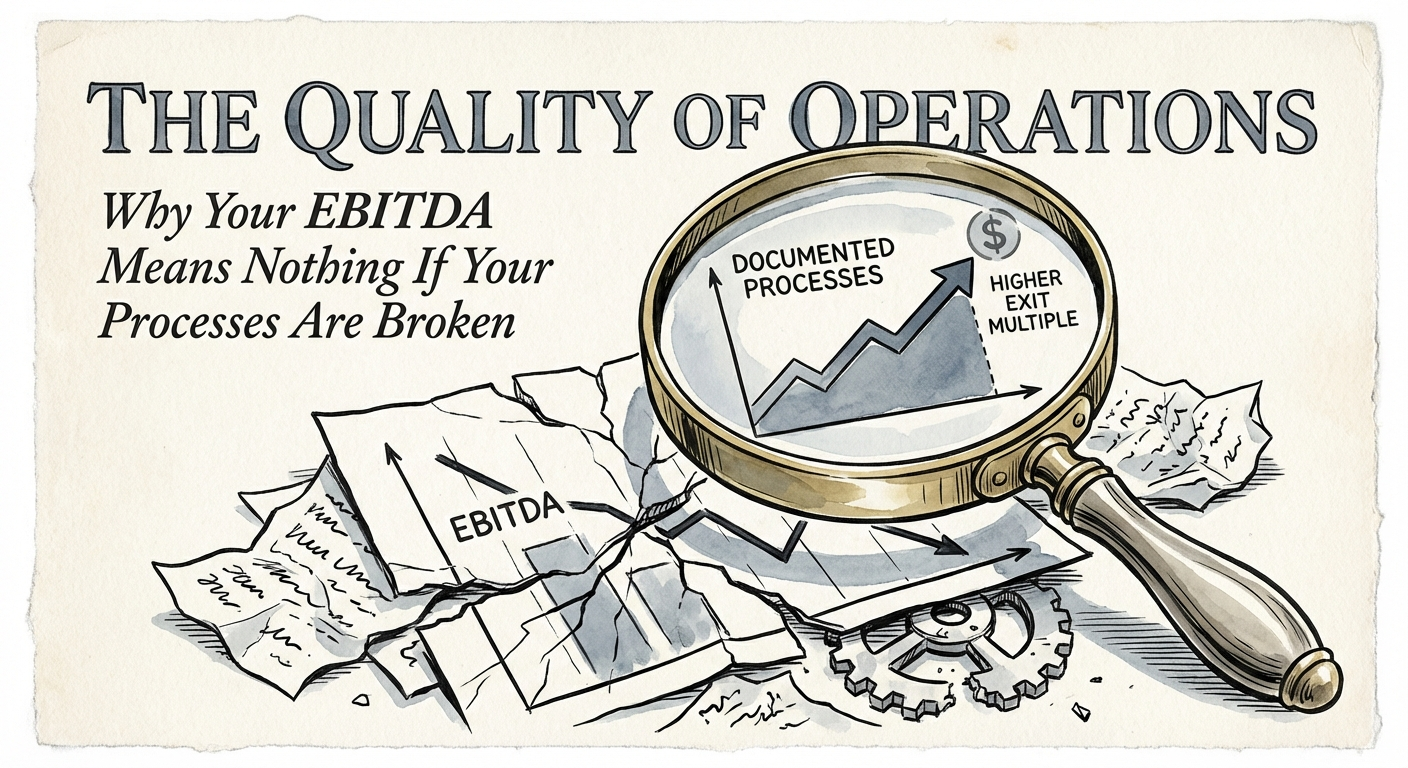
In 2026, buyers aren't just looking at your Quality of Earnings (QofE); they are aggressively auditing your Quality of Operations (QofO). They are asking: Can this business scale 2x without breaking? If the answer is "only if the founder works 80 hours a week," you have a valuation problem.
We are seeing a massive shift in deal timelines. In 2021, lower-middle market closings often happened 45 days after LOI. Today, due to intensified Operational Due Diligence (ODD), timelines have stretched to 60-90 days. Why? Because buyers are deploying third-party forensic teams to dig into your tech stack, your supply chain, and your cybersecurity posture before they wire a single dollar. If you wait until the LOI is signed to organize your operations, you have already lost deal value.
Value creation that incorporates margin expansion alongside revenue growth proves increasingly critical. Driving outperformance isn't just about achieving top-line growth — it's about how efficiently that growth is achieved.
The 3 Red Flags That Kill Deals in Due Diligence (2025 Data)
You might have $10M in EBITDA, but if your operations are a black box, buyers will discount that cash flow—or walk away entirely. Recent data indicates that nearly 30% of deals now experience significant delays or failures due to issues uncovered during operational diligence. Here are the three specific killers we see in the data room:
1. The 'Heroics' Dependency (Key Person Risk)
If your revenue forecast accuracy depends on your VP of Sales manually adjusting spreadsheets at 2 AM, you don't have a process; you have a person. In ODD, this is flagged as a "Single Point of Failure." PE firms are now using Human Capital Audits to quantify this risk. If 80% of your institutional knowledge lives in the heads of three people, your multiple contracts immediately.
2. Technical Debt & Cybersecurity 'Check-the-Box' Compliance
It used to be enough to say you were "working towards SOC 2." Not anymore. With supply chain attacks rising, buyers are demanding evidence of active vulnerability management and rigorous vendor risk assessments. A generic policy document won't survive a 2026 technical audit. They want to see the logs, the patch cadence, and the disaster recovery test results.
3. The 'Franken-Stack' of Disconnected Systems
Scaling companies often stitch together HubSpot, Salesforce, NetSuite, and three random spreadsheets. In diligence, this looks like an integration nightmare. If your data doesn't flow automatically from Lead to Cash, the buyer sees a massive post-close integration cost (often estimated at 3-5% of deal value) and will deduct that straight from your purchase price.
The 90-Day ODD Prep Playbook
You cannot fix a broken operation overnight, but you can package it for sale in a quarter. This is the exact playbook we use to prep services firms for exit.
Step 1: The 'Red Team' Operational Audit (Days 1-30)
Don't wait for the buyer to find your skeletons. Conduct an internal "Red Team" assessment. Audit your own processes as if you were a hostile buyer. Where is the documentation missing? Which key reports require manual intervention? Identify the top 5 risks and fix the low-hanging fruit immediately.
Step 2: Document the 'Unwritten' SOPs (Days 31-60)
Tribal knowledge is an asset that walks out the door every evening. Convert it into intellectual property. We call this the Transferability Premium. Document the critical path workflows: Client Onboarding, Incident Response, and Financial Close. A buyer will pay a premium for a business that comes with an instruction manual.
Step 3: Build the 'Ops Data Room' (Days 61-90)
Most founders build a Financial Data Room. You need an Operational Data Room. Populate it with:
- IT Asset Inventory: Every piece of software and hardware you own.
- Vendor Contracts: With change-of-control clauses highlighted.
- Org Chart & Succession Plan: Showing who takes over when the founder leaves.
- Cybersecurity Evidence: Last penetration test, SOC 2 report, and incident logs.
Operational diligence is not a pop quiz; it's a final exam. You have the questions in advance. There is no excuse for failing.