
The practical answer
- Short answer
- In PE buy-and-build strategies, inconsistent customer contracts cost 9.2% of annual revenue. Here is the diagnostic playbook for post-merger contract harmonization.
- Best fit
- Industry: Private Equity. Function: Legal & Operations
- Operating path
- Migration & Integration → Turnaround & Restructuring → Transaction Advisory Services
- Key metric
- 73% Percentage of PE deals that were 'add-ons' in 2023, increasing the prevalence of fragmented contract portfolios.
The Buy-and-Build Hangover
In the current private equity landscape, the "platform" strategy reigns supreme. According to recent data, 73% of all PE deals in Europe were add-ons, a trend mirrored globally as firms seek to build density in fragmented markets. But this aggregation strategy creates a silent killer in the portfolio: the "Frankenstein" contract ecosystem.
When you acquire four regional MSPs to build a national player, you aren't just acquiring revenue; you are acquiring four different definitions of "net 30," four contradictory indemnification clauses, and four divergent approaches to annual price increases. While your investment thesis relies on synergies and centralized operations, your commercial reality is trapped in a patchwork of legacy paper. This isn't just a legal headache; it is a valuation risk.
The cost of this chaos is quantifiable. Research from the World Commerce & Contracting (WorldCC) association reveals that organizations lose an average of 9.2% of annual revenue due to poor contract management. In complex post-merger environments, where "business as usual" friction prevents active governance, this leakage often exceeds 15%. This revenue isn't lost to competitors; it evaporates through missed renewal windows, unapplied CPI increases, and scope creep that isn't captured in billing.
In buy-and-build strategies, the 'Frankenstein' contract portfolio is the silent killer of exit multiples. You can't scale a platform if every customer is playing by a different set of rules.
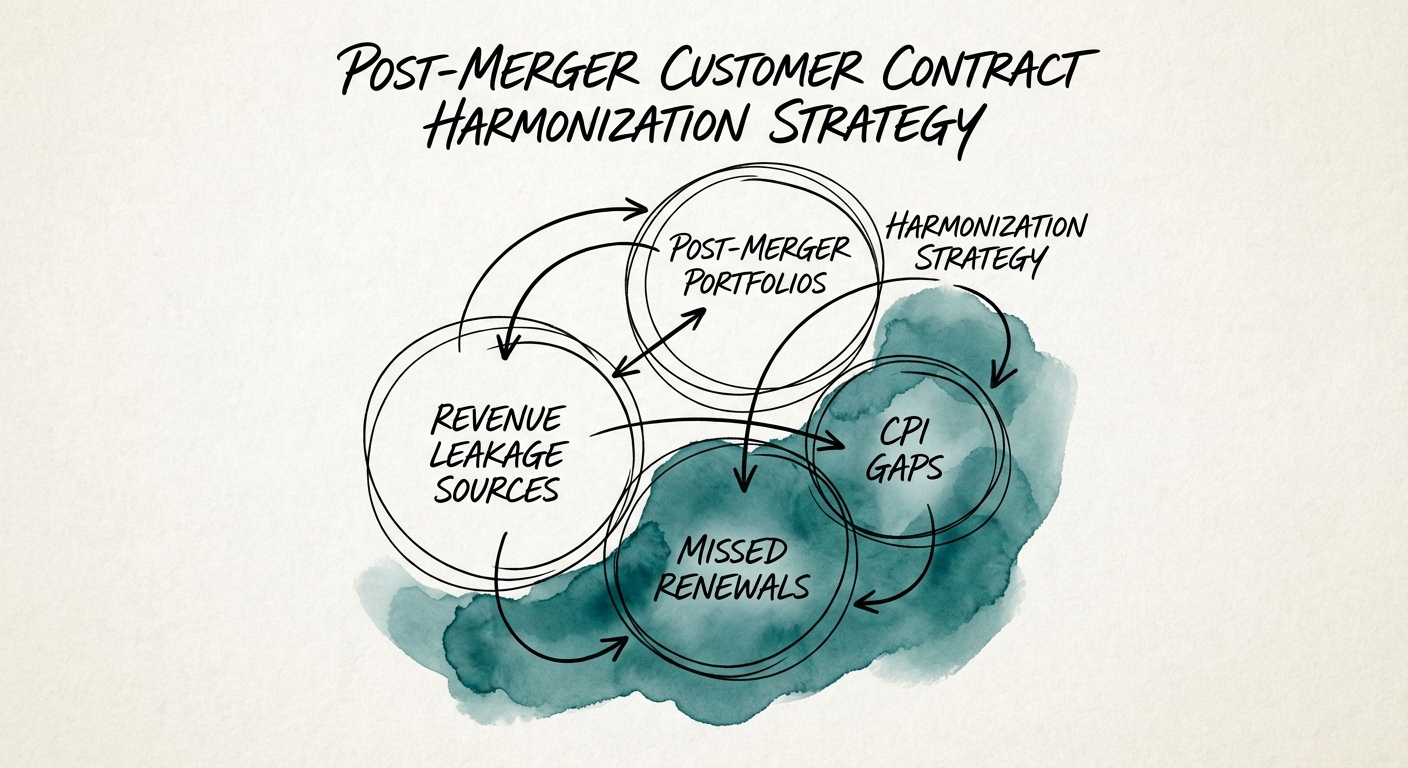
Where the 9.2% Leaks: The Three Silent Killers
Most Operating Partners view contract harmonization as a "Year 2" project—something to tidy up once the ERP migration is complete. This is a mistake. The leakage begins on Day 1, and it compounds with every auto-renewal that locks in legacy terms.
1. The CPI Gap
In a buy-and-build scenario, you will often find that the platform company has a robust 5% annual escalator, while the three add-ons have fixed-price multi-year agreements or silence on inflation. If you acquire a $50M revenue stream with no CPI protection during an inflationary period, you are effectively accepting a 3-4% EBITDA margin compression annually. Harmonizing the "Price Variation" clause isn't administrative; it is defensive margin management.
2. Renewal Roulette
Legacy contracts often contain "evergreen" clauses that auto-renew for 12 months unless notice is given 90 days prior. Without a centralized contract lifecycle management (CLM) process, these dates slip by. Conversely, you may acquire contracts that require affirmative renewal, which, if missed, converts the customer to a month-to-month arrangement—the most dangerous status for valuation because it is considered "at-risk" revenue in a future Quality of Earnings (QofE) report.
3. The Liability Asymmetry
We recently analyzed a platform merger where the acquirer carried a $5M cyber insurance policy, but one of the acquired bolt-ons had signed customer contracts with unlimited liability for data breaches. A single incident in the acquired entity could have wiped out the equity value of the entire platform. Harmonization is risk containment.
The 100-Day Harmonization Playbook
You cannot simply "repaper" 500 customers in the first week. Attempting to force a new Master Services Agreement (MSA) on a legacy base often triggers a procurement review that leads to churn. Instead, execute a tiered harmonization strategy.
- Phase 1: The Triage (Days 1-30). Do not read every word. Use AI-driven contract analysis to extract five key metadata fields: Renewal Date, CPI Clause, Termination for Convenience, Liability Cap, and Payment Terms. Flag the "Red Accounts"—those with unlimited liability or negative gross margins due to scope creep.
- Phase 2: The "Commercial" Harmonization (Days 31-90). Leave the legal terms alone for now. Focus on harmonizing the commercial mechanics. Move all customers to a standard billing cycle (e.g., quarterly in advance). Enforce a standard policy for travel and expense reimbursement. These changes rarely require a full contract re-signature but immediately impact working capital and EBITDA.
- Phase 3: The Renewal Event (Ongoing). Do not wake the sleeping dog. Wait for the natural renewal event to introduce the new "Standard Platform MSA." Position it as a benefit: "As part of our upgraded capabilities, we are moving you to our Enterprise SLA, which comes with updated terms." This couples the administrative pain of repapering with a value-add narrative, reducing the risk of churn.
The goal is not legal perfection; it is commercial predictability. Every month you delay harmonization is another month you leak 0.7% of your revenue to inefficiency.