
The practical answer
- Short answer
- Poor API architecture creates a $150k/year 'Integration Tax' per connection. Learn the 5-point diagnostic to assess platform scalability and protect deal value.
- Best fit
- Industry: B2B Technology. Function: Engineering & Product
- Operating path
- Technical Debt → Turnaround & Restructuring → Transaction Advisory Services
- Key metric
- 57% Of organizations experienced a data breach caused by API exploitation in the last 24 months (Traceable AI).
The "Platform" Premium vs. The Monolith Reality
In Private Equity, we pay a premium for "Platforms." A platform implies leverage: an ecosystem that scales without linear headcount growth, enables rapid third-party integrations, and commands a higher exit multiple (often 8x-12x revenue) compared to a point solution (4x-6x). But in 2026, the definition of a platform has shifted from "features" to "interoperability."
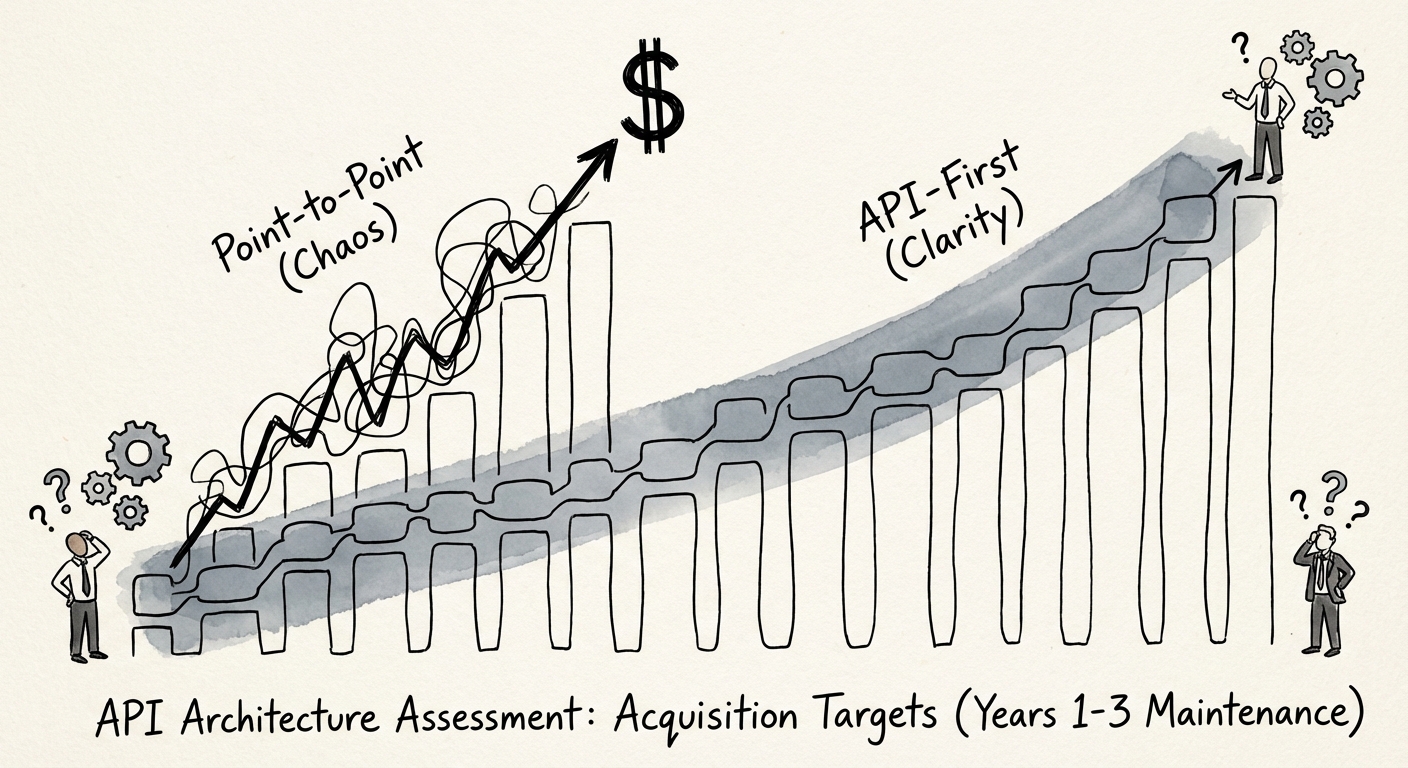
Too often, due diligence confirms the existence of an API without assessing its consumability. The target's CTO points to a list of 50 integrations as proof of a robust ecosystem. However, a technical deep dive frequently reveals these aren't scalable API connections—they are brittle, point-to-point hardcodings maintained by a team of "integration engineers" who are effectively highly paid plumbers. This is the Spaghetti Tax.
Recent data indicates that maintaining a single custom, non-standardized integration costs between $50,000 and $150,000 annually in engineering and support overhead. If your target has 20 such "integrations," you aren't acquiring a platform; you are inheriting a $3M annual EBITDA drag masked as R&D. Furthermore, the rise of Agentic AI—autonomous software agents that consume APIs at machine speed—has made legacy API architectures obsolete. According to the 2025 Postman State of the API Report, 51% of developers now cite unauthorized AI agent activity as a top security concern. If your target's API cannot handle authenticated, rate-limited, machine-to-machine traffic, its "moat" will evaporate within 24 months.
If you can't meter, monitor, and monetize the API usage, you don't own a platform—you own a leaky database with a web interface.
The 5-Point API Architecture Diagnostic
To avoid the Spaghetti Tax, we apply a rigorous diagnostic framework during the technical due diligence phase. We are not just looking for code quality; we are looking for architectural leverage.
1. Documentation as Truth (The "Swagger" Test)
Does the API have a live, auto-generated specification (e.g., OpenAPI/Swagger)? In "spaghetti" shops, documentation is a static PDF updated manually by a junior developer. This guarantees that the documentation is out of sync with the code, leading to integration failures. Red Flag: Any API documentation that requires a login to a Wiki rather than a public developer portal.
2. The "Agentic Readiness" Check (Rate Limiting & Throttling)
Legacy APIs were built for humans clicking buttons. Modern APIs must serve AI agents making thousands of requests per second. Does the architecture support granular rate limiting by tenant, user, and endpoint? Without this, a single customer's AI agent can unintentionally DDoS the entire platform, causing cascading outages. This is a scalability ceiling that requires a complete re-platforming to fix.
3. Security Posture (AuthN vs. AuthZ)
With 57% of organizations reporting API-related data breaches in the last two years, security is a valuation driver. We test for Broken Object Level Authorization (BOLA). Can User A simply change an ID in the URL to see User B's data? This is the most common API vulnerability and a deal-killer for enterprise buyers. If the target relies on simple API keys without OAuth2 or OIDC flows, you are buying a security liability.
4. Versioning Strategy (The "Breaking Change" Risk)
Ask for the policy on deprecating endpoints. A mature platform supports multiple versions simultaneously (e.g., v1, v2) to allow partners to migrate gracefully. A "move fast and break things" target will force breaking changes on customers, destroying trust and churning the partner ecosystem. Lack of versioning is a leading indicator of high future churn.
5. Observability (The "Black Box" Test)
Can the engineering team tell you, right now, which customer is generating the most API traffic and which endpoints are the slowest? If they have to "run a query" or "check the logs," they are lacking operating visibility. You cannot bill for usage or optimize performance without real-time observability.
Turning Technical Debt into Margin Expansion
Identifying these issues doesn't always mean killing the deal. It means repricing it and building a Value Creation Plan (VCP) focused on API Productization.
First, quantify the remediation cost. Moving from a monolithic, hard-coded integration model to an API-First architecture is typically a 12-18 month project. Price this into your working capital adjustments or holdbacks. Use the Technical Debt Quantification Framework to present a dollar-value argument to the seller.
Second, pivot the engineering roadmap immediately post-close. Stop building new features on the old stack. The goal is to reach API-First Maturity, where the API is the product. Companies that achieve this generate significantly higher revenue from their ecosystems; Postman's data shows that API-first organizations are 2x more likely to generate significant revenue from their APIs directly.
Finally, align this with your M&A strategy. If you are executing a bolt-on or platform play, a standardized API layer is the only way to avoid the Integration Synergy Trap. Without it, every acquisition adds exponential complexity. With it, you can integrate new assets in weeks, not quarters, unlocking the true arbitrage of the platform model.