The practical answer
- Short answer
- Heavily customized Jira instances are killing M&A deal value. Learn how to quantify technical debt in Atlassian environments (ScriptRunner, Custom Workflows) before signing the LOI.
- Best fit
- Industry: B2B Technology. Function: Engineering Operations
- Operating path
- Technical Debt → Turnaround & Restructuring → Transaction Advisory Services
- Key metric
- 100% Cloud App Billing (All Users)
The "Operating System" of R&D is Broken
In 90% of technical due diligence reviews, the Atlassian stack (Jira, Confluence) is treated as a commodity line item—checked off as "standard tooling" alongside Slack and Zoom. This is a multi-million dollar mistake. For software companies, Jira is not just a ticketing system; it is the operating system of the R&D function. When that operating system is fractured by years of "customization," it doesn't just annoy developers—it creates a structural barrier to post-acquisition integration.
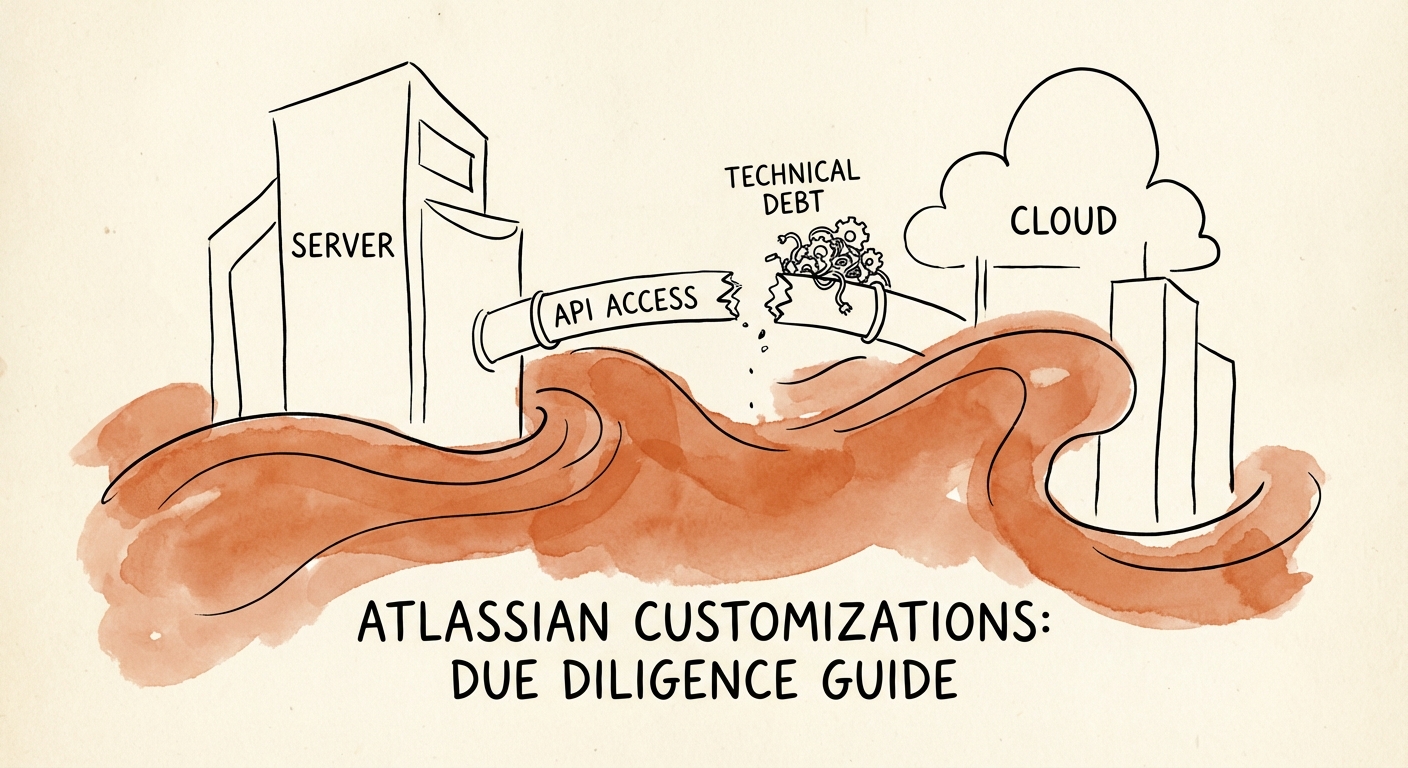
The root of the problem lies in the "Server to Cloud" migration cliff. With Atlassian Server support officially ending on February 15, 2024, companies staying on self-hosted instances are now paying a massive premium for Data Center licenses or, worse, running unpatched, insecure Server versions. But moving them to the cloud isn't a simple "lift and shift."
We have observed a 3.4x remediation cost multiplier for heavily customized instances. If a target company pays $100k/year in Atlassian licensing but has relied on deep server-side customizations (ScriptRunner, custom Java plugins, direct database access), the cost to migrate them to a compliant Cloud environment is typically $340k+ in services, not including the productivity drag on the engineering team. This is not "maintenance"; it is a quantifiable technical debt liability that must be deducted from Enterprise Value.
A 'highly customized' Jira instance is usually just a graveyard of good intentions and bad code. In due diligence, we treat ScriptRunner heavily reliant environments as a $250k deduction until proven otherwise.
The ScriptRunner Trap and The "Groovy Gap"
The single biggest indicator of Atlassian technical debt is the presence of ScriptRunner with a high volume of custom scripts. On-premise Jira allowed administrators to write Groovy scripts that interacted directly with the Java API. This empowered teams to build incredibly complex, automated workflows—automatic transitions, field calculations, and cross-project synchronizations.
Here is the due diligence trap: Those scripts do not work in the Cloud.
Atlassian Cloud architecture prevents direct API access for security reasons. Every single server-side script must be rewritten to interact with a REST API, often asynchronously. This creates a "functional gap" where the target company's workflow literally cannot exist in the modern cloud environment without a six-figure re-engineering effort.
The "All-User" Billing Landmine
Beyond code, there is a financial landmine in the Cloud licensing model. On-premise, you could buy a plugin for a specific tier. In Atlassian Cloud, most apps bill for the entire user base of the instance. If your target company has 5,000 users but only 10 people use a niche "Gantt Chart" plugin, you will pay for 5,000 licenses of that plugin in the Cloud. In one recent diligence assessment, this billing nuance inflated the projected IT OPEX by $450k annually post-migration.
The 5-Point Atlassian Diligence Checklist
To prevent a post-close margin surprise, operating partners must conduct a specific audit of the Atlassian environment during the technical due diligence window. Do not accept a screenshot of the license page.
- 1. The Custom Field Ratio: Ask for the total number of custom fields. Anything over 1,000 implies a "inactive" configuration that degrades performance and complicates migration.
- 2. App Utilization Audit: Request a list of installed apps vs. active users. If they have 10 apps with < 5% utilization, you are looking at a future 20% savings opportunity—or a massive billing liability if not rationalized before migration.
- 3. The ScriptRunner Export: Request the raw count of active ScriptRunner scripts. If the number is >50, you need a dedicated line item in the integration budget for "Workflow Re-engineering."
- 4. Workflow Standardization: How many unique workflows exist? If the ratio of Workflows to Projects is > 0.5 (e.g., 50 workflows for 100 projects), the engineering culture is fragmented, and process integration will be painful.
- 5. Instance Consolidation Risk: If buying a platform company, assess the feasibility of merging instances. Atlassian Cloud-to-Cloud migrations are notoriously difficult. Often, it is cheaper to keep instances separate than to pay the "Conflict Resolution Tax" of merging them.