
The practical answer
- Short answer
- Why your target's 'custom' Adobe implementation is a liability. A PE guide to assessing technical debt in AEM and Adobe Commerce before you buy.
- Best fit
- Industry: Private Equity. Function: Technology
- Operating path
- Technical Debt → Turnaround & Restructuring → Transaction Advisory Services
- Key metric
- 2.2x Cost multiplier of building/maintaining custom AEM components vs. using Core Components.
The 'Frankenstein' Discount in Adobe Deals
In the world of enterprise software, Adobe Experience Cloud (AEM, Commerce/Magento, Marketo) is the Ferrari of the fleet. It implies sophistication, scale, and high-value customers. But for Private Equity acquirers, an Adobe implementation is just as likely to be a distressed asset as a strategic one. The problem isn't the software; it's the implementation philosophy.
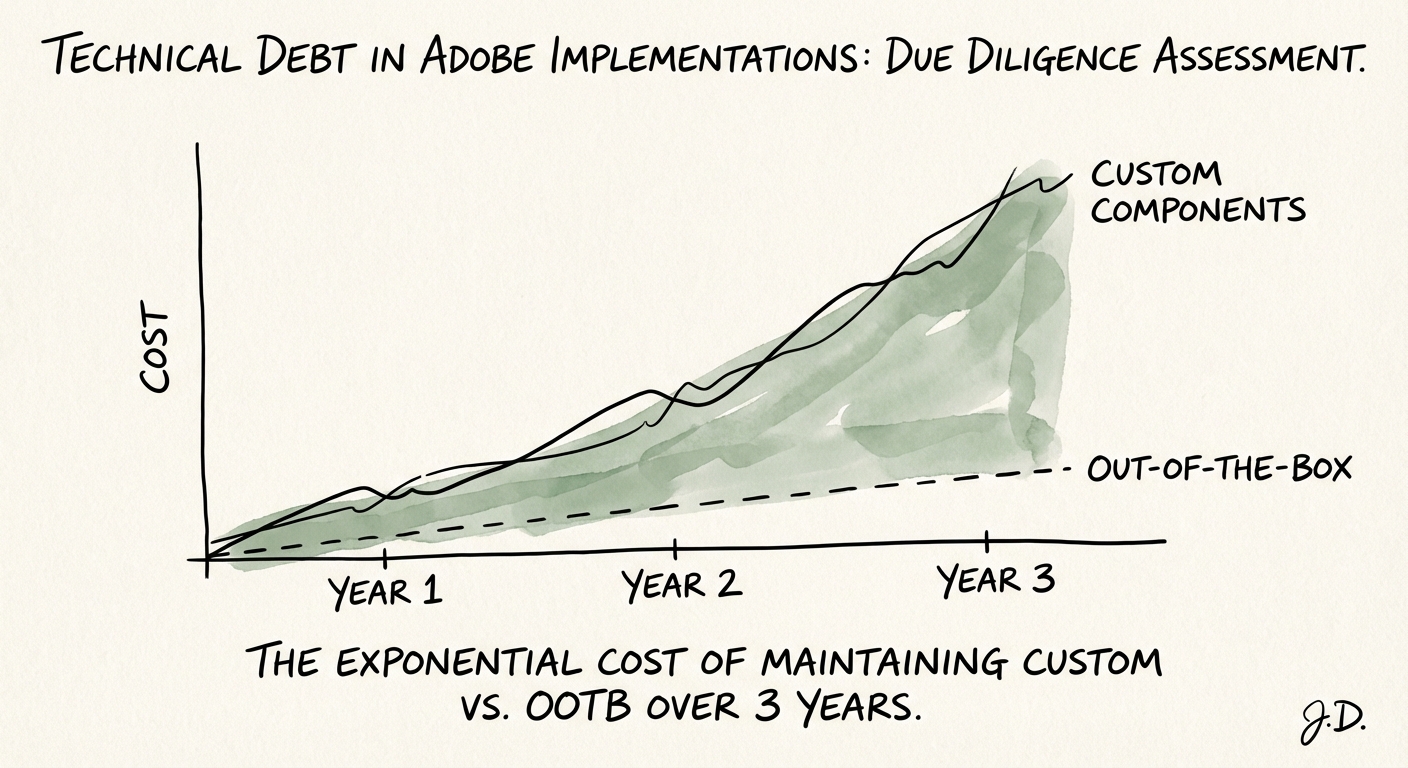
We call it the Adobe Paradox: The more 'customized' the implementation, the lower its transferable value. While the target's CTO will frame their custom React front-end and heavily modified OSGi bundles as 'intellectual property' or 'competitive advantage,' the data suggests otherwise. Research indicates that developing and maintaining custom components costs 1.5 to 2.2 times more than leveraging Adobe's Core Components, creating a permanent tax on EBITDA.
This isn't just about code maintenance; it's about Operational Rigidity. A highly customized AEM or Magento instance often becomes so brittle that it blocks standard value creation levers. Want to swap the ERP? You can't, because the commerce integration is hard-coded. Want to implement dynamic pricing? You can't, because the caching logic is custom-built and fragile. The asset you're buying isn't a platform; it's a frozen monolith that will require a $2M+ 'refactoring event' before it can support your growth thesis.
A platform isn't 'good' or 'bad' in a vacuum. It's risky if it can't bend to the new owner's strategic pivots. A platform that blocks them isn't a tech asset. It's EBITDA erosion waiting to happen.
The 5-Point Adobe Due Diligence Diagnostic
When auditing an Adobe estate, you are looking for the gap between 'configuration' and 'customization.' The former is an asset; the latter is a liability. Here is the framework for assessing the damage.
1. The Core Component Ratio
Open the code repository. In a healthy AEM implementation, at least 70% of the components should extend Adobe's Core Components (WCM Core). If you see a library where 80% of components are built from scratch, you aren't buying a CMS; you're buying a proprietary application built on top of a CMS. This code will break with every quarterly upgrade, forcing your engineering team to spend 30% of their cycles on 'keeping the lights on' rather than shipping features.
2. The 'Overlay' Trap
Check
for modifications in the /libs path (in older versions) or heavy use
of 'overlays' that copy-paste entire component logic rather than extending it via
Sling Resource Merger. This is the hallmark of a 'lazy' implementation partner.
It means that when Adobe patches a security vulnerability in the core product, your
custom overlay will not receive the patch. You are effectively
freezing the security posture of the application at the date of implementation.
3. The Cloud Service Readiness Gap
If the target is still on-premise or utilizing Adobe Managed Services (AMS), ask for their Cloud Service Readiness Report. Moving to AEM as a Cloud Service (AEMaaCS) is not a simple 'lift and shift'; it often requires a complete rewrite of the backend logic to become stateless. We consistently see 'Cloud Migration' estimates of $200k balloon into $1.5M capital projects once the code is actually analyzed. If the target hasn't run the Best Practices Analyzer (BPA), assume the code is incompatible.
4. The Magento 'Module Jungle'
For Adobe Commerce (Magento) targets, the risk lies in third-party extensions. A healthy store might have 10-15 trusted extensions. A distressed store will have 50+, many of which are conflicting, unpatched, or modifying core files directly. This 'Module Jungle' creates a dependency web where updating one payment gateway breaks the shipping calculator. In due diligence, ask for a list of all installed modules and their last update date. If >30% are over a year old, you have a security latent risk.
Quantifying the 'Refactoring CapEx'
You cannot fix Adobe technical debt with opex; it requires a capital injection. To protect your deal model, you must quantify this cost before signing the LOI. The math is brutal but necessary.
If the target has a high degree of customization (Low Core Component usage, heavy overlays), apply the 2.2x Maintenance Multiplier to their engineering headcount allocation. If they claim 5 developers maintain the system, the reality of a 'clean' state would require 2, but the debt demands 5. The difference (3 FTEs) is the annual 'Debt Service' payment you are inheriting.
Furthermore, if the platform is not yet on AEM as a Cloud Service, budget a minimum of $500,000 to $1.5M as a 'Day 1' technical debt paydown. This is not an 'upgrade'; it is a remediation of the custom code that prevents the upgrade. If the seller pushes back, use the 'Operational Rigidity' argument: a platform that cannot be easily updated is a platform that cannot support the speed of Private Equity value creation.
Do not accept the narrative that 'custom equals better.' In the Adobe ecosystem, custom equals cost. Your goal is to acquire a marketing engine, not a software development burden. Price the remediation into the enterprise value, or structure an escrow holdback tied to a successful Cloud Service migration post-close.