The practical answer
- Short answer
- HubSpot technical debt kills post-acquisition value. Learn why 43% of forecasts fail and how to spot 'Franken-Spot' implementations in due diligence.
- Best fit
- Industry: Private Equity. Function: Technology
- Operating path
- Technical Debt → Turnaround & Restructuring → Transaction Advisory Services
- Key metric
- 22% Annual decay rate of B2B contact data, turning databases into liabilities.
The 'Franken-Spot' Reality: When Ease of Use Becomes Liability
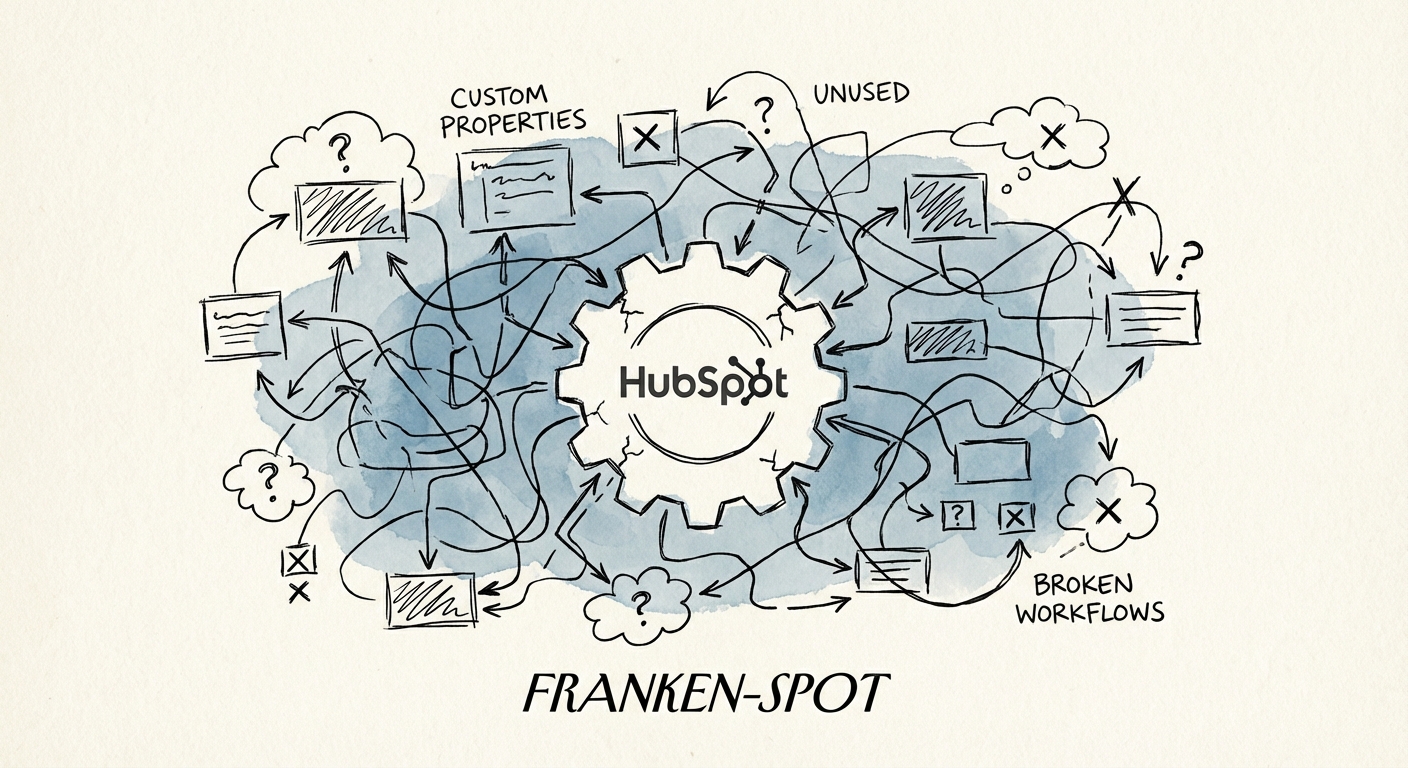
HubSpot’s greatest strength—its ease of use—is often the primary cause of value erosion in a portfolio company. Unlike Salesforce, which typically requires an admin to break things, HubSpot allows founder-led sales teams to create their own chaos. We call this the 'Franken-Spot' phenomenon: a CRM instance stitched together with good intentions and bad architecture.
In due diligence, you aren't looking for 'bugs' in the code; you are looking for process ossification. Our audits consistently find that companies scaling from $5M to $20M ARR accumulate 'low-code' technical debt that directly impacts EBITDA. The most common culprit? Custom properties. It is not uncommon to find 400+ custom contact properties in a Series B company, with less than 15% utilization. This isn't just clutter; it's a drag on productivity.
The Cost of 'Just Add a Property'
Every unused field represents a broken process. When a sales rep has to scroll past 50 irrelevant fields to log a call, they stop logging calls. This creates a data vacuum that destroys your ability to measure unit economics. More critically, these ad-hoc customizations break the native data model required for advanced reporting. You think you're buying a data-driven sales organization; you're actually buying a team that runs on spreadsheets because their CRM is unusable.
You don't buy a software company for its code; you buy it for its customer data. If that data is trash, you bought an empty shell.
The Data Hygiene Tax: Why Your Forecast Is a Hallucination
If you cannot trust the data entering the system, you cannot trust the forecast coming out of it. Recent benchmarks from Xactly’s 2024 Sales Forecasting Report indicate that 43% of sales organizations miss their targets by 10% or more, largely due to data quality issues. In a PE context, this variance is the difference between a covenant breach and a successful quarter.
Data decay is the silent killer of deal value. Research shows that B2B contact data decays at approximately 22% annually. If the target company hasn't run automated hygiene processes in two years, nearly half of their 'marketable database' is dead weight. This has two immediate impacts on your investment thesis:
- CAC Inflation: Marketing budgets are spent targeting ghosts, artificially inflating Customer Acquisition Cost.
- The 'Ghost Pipeline': Opportunities are weighted based on stages that no longer reflect reality. A 'Verbal Commit' from a contact who left the company six months ago is not a deal; it's a liability.
We recently audited a portfolio company where the CRM data was lying about pipeline health to the tune of $3.5M. The 'weighted pipeline' collapsed the moment we verified the primary contacts.
The Integration Cliff: Why 'Plug and Play' is a Lie
The standard operating procedure for many add-on acquisitions is 'migrate to the platform in 90 days.' In reality, merging dirty HubSpot instances takes 2x to 3x longer than projected. The issue is rarely the API; it is the semantic mismatch of data. Company A defines 'Customer' as someone who signed a contract; Company B defines 'Customer' as someone who paid an invoice. Merging these two fields without remediation corrupts your retention metrics instantly.
The AI Readiness Gap
Every Investment Committee deck in 2026 includes a slide on 'AI Leverage.' Here is the uncomfortable truth: You cannot layer AI on top of dirty data. Generative AI tools require structured, clean inputs to provide accurate insights. If your HubSpot instance is riddled with duplicate records and unstructured notes, your 'AI Strategy' will simply accelerate the production of bad decisions.
Before you sign off on a RevOps implementation timeline, demand a 'Schema Audit.' If the target company cannot produce a data dictionary, assume your integration costs will double. The cost of remediating this debt post-close is not just financial; it is the opportunity cost of a blinded leadership team unable to steer the ship.