
The practical answer
- Short answer
- Don't inherit a 'Franken-Suite.' Learn how to quantify technical debt in NetSuite customizations, identify SuiteScript red flags, and adjust your deal valuation.
- Best fit
- Industry: Private Equity. Function: Technology
- Operating path
- Technical Debt → Turnaround & Restructuring → Transaction Advisory Services
- Key metric
- 30-50% Premium paid to remediate bad ERP implementations vs. scoping it right the first time.
The 'Standard' ERP Myth
In the CIM, the CFO claims they run "Standard NetSuite." They tout the scalability of their cloud ERP and how it's ready to integrate with your platform add-on. In my experience auditing dozens of mid-market SaaS and services firms, "Standard NetSuite" is a lie we tell ourselves to feel safe.
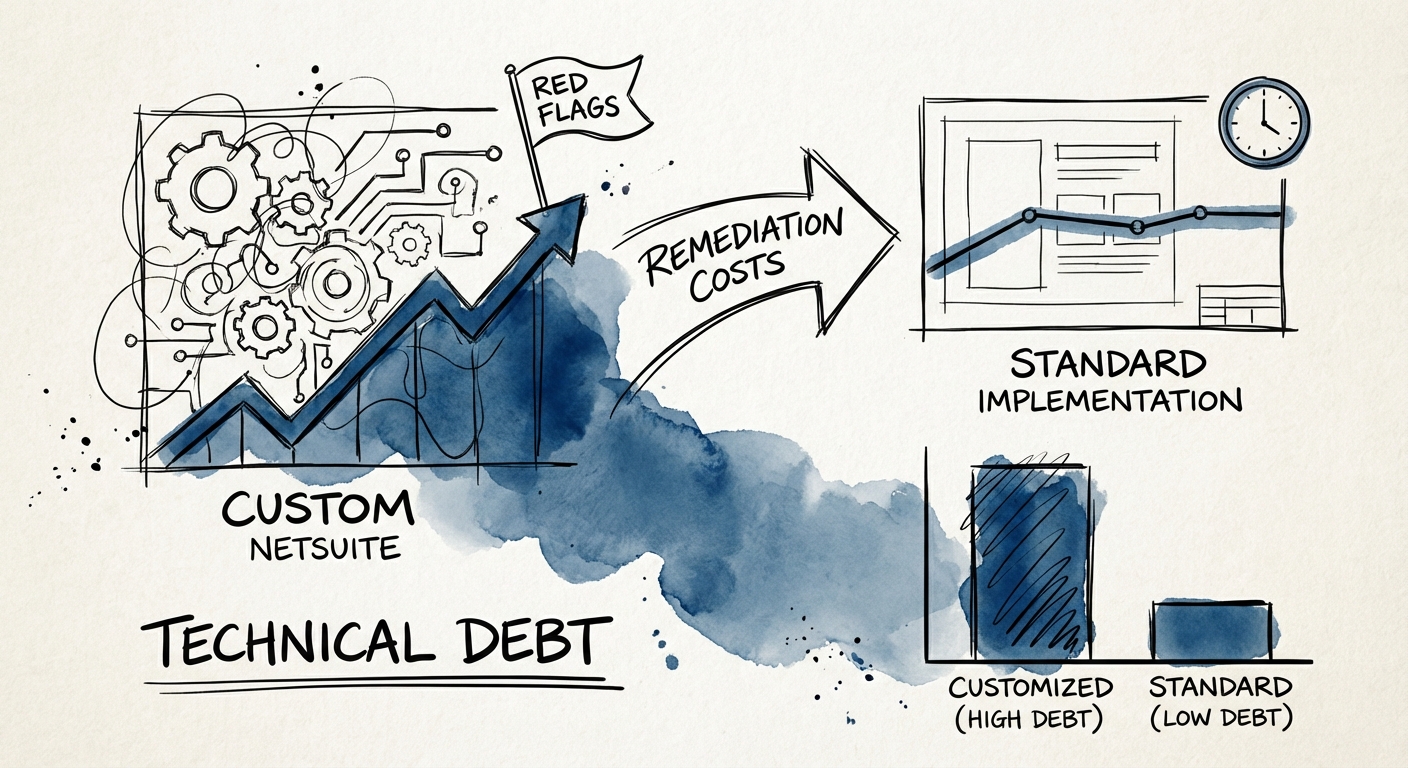
The reality is often a Franken-Suite: a fragile ecosystem of hardcoded scripts, deprecated workflows, and point-to-point integrations built by a rotating cast of low-cost freelancers over five years. This isn't just an engineering annoyance; it is a financial liability. Technical debt in ERP systems behaves exactly like high-interest financial debt. It compounds silently, and when you try to integrate a new acquisition or change a pricing model, the balloon payment comes due.
We recently diligenced a $40M ARR services firm. On the surface, their margins were healthy. Under the hood, their NetSuite instance relied on 400+ active SuiteScript 1.0 files—a deprecated language standard that Oracle NetSuite is actively discouraging. To modernize this estate for the buyer's intended cross-sell strategy would require a $400,000+ remediation project (approx. 2,000 engineering hours). That is not "IT maintenance"; that is a direct hit to your post-close free cash flow.
We don't look for 'clean code'—that doesn't exist. We look for the $500,000 liability hiding in a folder called 'Custom Scripts'.
The 5-Point NetSuite Red Flag Checklist
You don't need to be a developer to spot a high-risk implementation. Ask for a "Bundle List" and a "Script Performance Log" in the Data Room. Here is what you are looking for:
1. The SuiteScript 1.0 Trap
NetSuite introduced SuiteScript 2.0 years ago to support modern asynchronous processing and modular architecture. If you see a high volume of SuiteScript 1.0 files, you are buying a legacy system. These scripts often fail under high transaction volume (like the kind you plan to drive post-acquisition). Remediation is manual, expensive, and risky.
2. Hardcoded Internal IDs
In a healthy environment, scripts
reference objects dynamically. In a "quick and dirty" environment, developers
hardcode Internal IDs (e.g., if customer_id == '1543'). This is the
"Fragility Index." The moment you try to migrate data or merge this instance
with another, every single one of those scripts will break. This is a leading indicator
of deal-killing
technical debt.
3. The Workflow vs. Script Imbalance
NetSuite offers "SuiteFlow" (visual workflows) for simple logic. Bad implementations use heavy custom scripting for things that should be simple workflows. If you see 50+ User Event Scripts firing on a simple Sales Order save, expect 5-10 second save times. This kills sales rep productivity and destroys adoption.
4. 'Unmanaged' Bundles
Check the "Installed Bundles" list. If you see dozens of "Unmanaged" bundles or custom bundles created by "[Name of Freelancer] 2019," you have zero upgrade path. You are inheriting unsupported code.
Valuation Adjustments: Pricing the Fix
Technical debt must be priced into the deal, not just noted in a report. If we identify significant "spaghetti code," we calculate the Remediation CapEx and deduct it from the Enterprise Value or request a specific escrow.
The math is straightforward. Industry benchmarks suggest that refactoring a complex, legacy-scripted environment costs approximately 30-50% more than the original implementation because you are fixing the plane while flying it. If the target company spent $500k implementing NetSuite over the last 3 years, and 60% of it is non-compliant custom code, you are looking at a minimum $250k bill to stabilize it before you can even think about integrating it with your platform.
Do not accept the "it works fine for us" defense. It works because they aren't changing anything. You are buying them to change everything—to scale, to integrate, to accelerate. That fragility is a tax on your future growth rate. Quantify it, price it, or walk away.