The practical answer
- Short answer
- A highly customized Zendesk instance is a hidden liability. Learn how to audit triggers, private apps, and API debt before you sign the LOI.
- Best fit
- Industry: Private Equity. Function: Technology
- Operating path
- Technical Debt → Turnaround & Restructuring → Transaction Advisory Services
- Key metric
- 700 Standard API requests per minute allowed on Enterprise plans. Hitting this limit often indicates poor integration architecture, not actual scale.
The 'Lightweight' Platform That Became a Heavyweight Liability
In the hierarchy of technical due diligence, the Customer Support stack rarely makes it to the top of the risk register. Investors rigorously audit the core product codebase, scrutinize cloud infrastructure bills, and stress-test the ERP. Zendesk, by contrast, is often waved through as a standard SaaS utility—a simple ticketing system with a predictable per-seat cost.
This is a dangerous oversight in 2026. For scaling B2B SaaS and marketplace companies, Zendesk has evolved from a help desk into a shadow ERP. With the introduction of Zendesk Sunshine (custom objects) and the Apps Framework, engineering teams often use Zendesk to patch holes in their core product architecture. They build complex data models, hard-code business logic into triggers, and write private apps to bridge integration gaps.
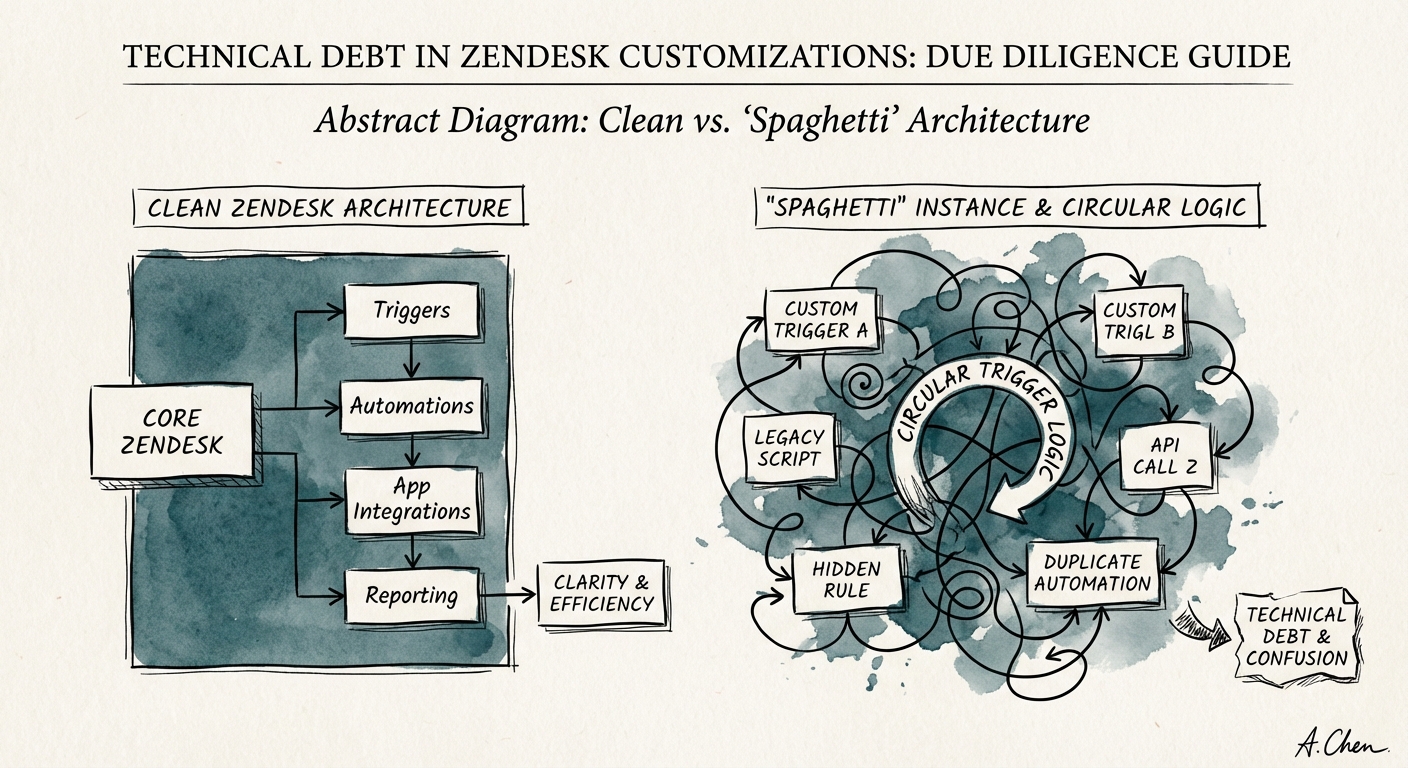
The result is a "Spaghetti Instance": a brittle, undocumented logic layer that fails under load. We recently audited a Series C marketplace where the Zendesk instance contained 800+ active triggers and 15 undocumented private apps. The remediation cost wasn't just the subscription fees; it was a $1.8M re-platforming project required to decouple critical business logic from a support tool that was never designed to host it.
Zendesk is not a database, and it is not an ERP. When you find a portfolio company treating it as one, you aren't just buying a support tool—you're buying a $2M migration project masked as opex.
The 3-Point Zendesk Audit for Due Diligence
When evaluating a target, do not accept a screenshot of the "Admin" panel. You need to dig into three specific areas where technical debt accumulates silently.
1. The Trigger & Automation Count (>300 is a Red Flag)
Triggers are the "if this, then that" logic of Zendesk. In a healthy instance, they are used for routing and basic notifications. In a debt-ridden instance, they are used to enforce business rules that should live in the product.
The Metric: If a company has more than 300 active triggers, you are looking at a maintenance nightmare. We frequently see "Trigger Cycles"—loops where one trigger updates a ticket, causing another trigger to fire, eventually hitting Zendesk's safeguard limits and failing silently. This results in lost tickets and "ghost" churn.
2. The API Rate Limit "Tax"
Zendesk imposes strict API rate limits (standard Enterprise allows ~700 requests per minute). Poorly written integrations—often built by junior developers or outsourced teams—poll the API inefficiently. When the company scales, they hit these limits (Error 429), causing integrations to break during peak traffic.
The Check: Ask for the "High Volume API Add-on" status. If the target is paying for this add-on (pushing limits to 2,500/min) but has less than 100 agents, they aren't paying for scale; they are paying a tax on bad code. They are brute-forcing inefficient integrations rather than fixing them.
3. The "Private App" Black Box
Zendesk allows companies to upload "Private Apps"—custom code running inside the agent interface. These are often built by developers who left the company two years ago.
The Diagnostic: Ask to see the Git repository for every Private App installed. In 60% of cases, the repository does not exist. The source code lives only in the minified, compiled version uploaded to Zendesk. If that app breaks (e.g., due to a Zendesk API update), you cannot patch it. You must rewrite it from scratch.
Calculating the Remediation Cost
Technical debt in Zendesk isn't just an annoyance; it's a drag on EBITDA. When an instance is over-customized, agent efficiency (AHT) drops because the interface is slow and cluttered with broken apps. Onboarding new agents takes 3x longer because the "tribal knowledge" of how the triggers work isn't documented.
The Valuation Adjustment:
- Code Remediation: If private apps are undocumented, budget $150k per critical app for rewriting.
- Logic Decoupling: Moving business logic from Zendesk triggers back to the core product/database is a 6-month engineering project. Budget 2 FTE engineers ($400k).
- Data Migration: If "Zendesk Sunshine" custom objects are used as a primary data store, you face a complex migration to a proper data warehouse (Snowflake/Redshift) to make that data usable for BI.
Before signing the LOI, use this data to adjust your integration budget. A $50M target with a broken Zendesk instance effectively has a $2M lien on its future efficiency.