The practical answer
- Short answer
- Heavily customized Dynamics 365 implementations are a valuation trap. Learn the benchmarks, the "One Version" risks, and how to calculate the purchase price adjustment.
- Best fit
- Industry: Private Equity. Function: Technology
- Operating path
- Technical Debt → Turnaround & Restructuring → Transaction Advisory Services
- Key metric
- 131% Average ROI of standard Dynamics implementations (Nucleus Research)
The "One Version" Risk
If you are looking at a target company running Microsoft Dynamics 365, the CTO will inevitably tell you that their "highly customized" environment is a competitive advantage. They will claim their workflows are so unique that standard software couldn't possibly support them.
In 2026, this is not an asset by default. It is deferred maintenance that needs to be priced into the deal.
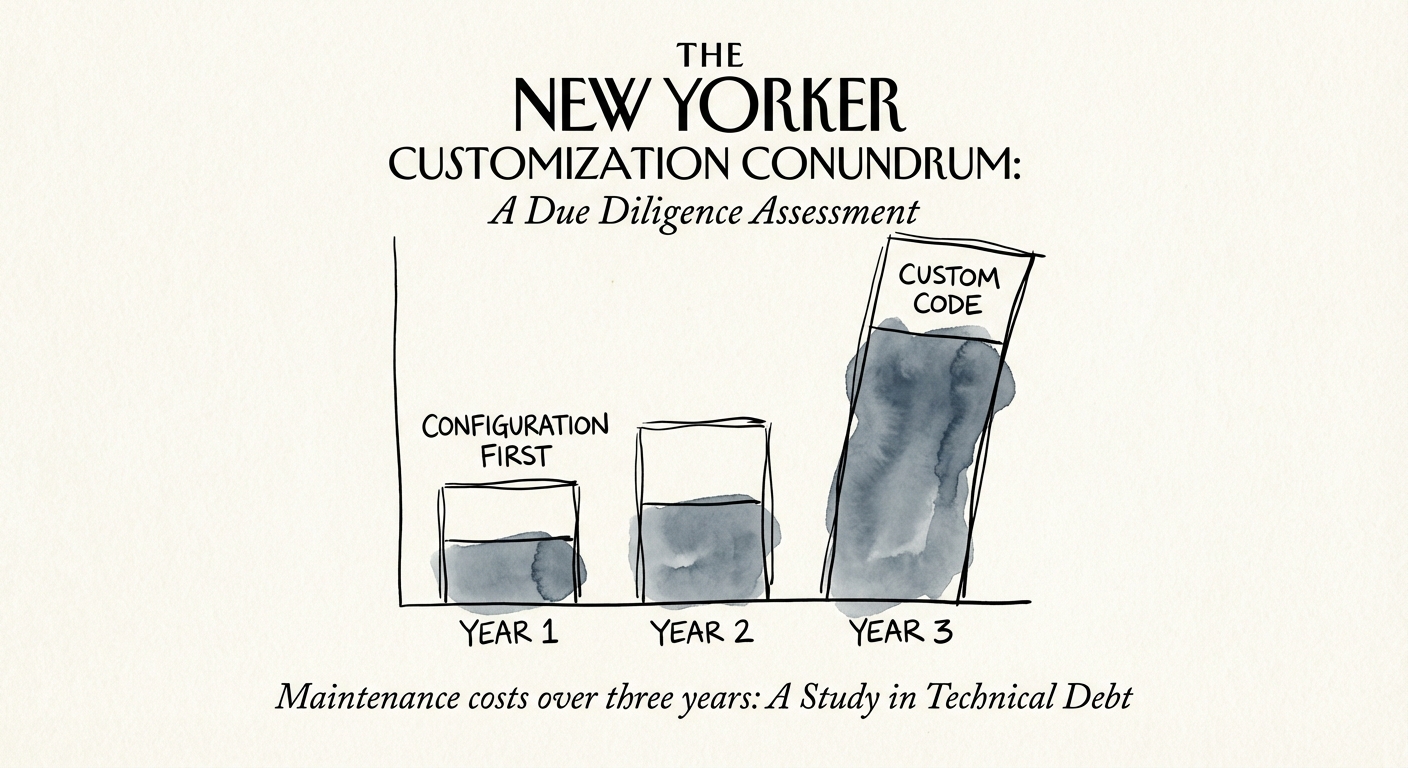
Here is the reality of the ecosystem: Microsoft’s "One Version" policy forces 2 to 8 automatic updates per year. In a standard, configuration-first environment, these updates are seamless. In a heavily customized environment, every single update is a potential "stop-ship" event requiring weeks of regression testing and code refactoring.
When a target company has modified core logic—overriding standard entities like SalesOrder or building custom plugins where Power Automate flows should exist—they have effectively opted out of the SaaS model. They are paying SaaS subscription fees for what is essentially a legacy on-premise application hosted in the cloud. Red flags in technology due diligence often hide in plain sight, but this one is visible quickly.
The data supports this skepticism. Research indicates that 70% of ERP transformation failures are now attributed directly to underestimating legacy complexity and technical debt. If you don't price this remediation into the deal, you will be paying for it out of your first 100-day EBITDA.
In a SaaS world, 'highly customized' doesn't mean 'tailored to fit.' It means 'incompatible with the future.'
The 5-Day Diagnostic Framework
You do not need a 4-week code audit to spot the risk. You need three specific data points during the exclusivity period to quantify the risk.
1. The Solution Checker Report
Demand the output of the Power Apps Solution Checker. This is a standard Microsoft tool that analyzes customizations against best practices. Do not accept a summary; ask for the raw export.
- Green Flag: 0 Critical issues, <5 High issues.
- Yellow Flag: Usage of deprecated code (e.g., SOAP endpoints, synchronous workflows).
- Red Flag: Any "Critical" violation. This indicates code that will break in the next Microsoft update wave. This is immediate remediation CapEx.
2. The Custom-to-Standard Ratio
Ask for a count of Custom Entities vs. Standard Entities. In a healthy mid-market implementation, this ratio should be under 20%. If your target has 300 custom tables and ignores the standard Sales and Service data models, they haven't implemented Dynamics; they've built a custom application on top of Dynamics. This destroys the dollar value of the platform because you cannot easily integrate ISV solutions or use Microsoft's emerging AI Copilot features, which rely on standard data schemas.
3. The "Update Block" History
Ask the VP of Engineering: "How many times in the last 18 months have you had to pause or delay a Microsoft Service Update due to regression test failures?"
If the answer is "every time" or "we are three versions behind," you are not buying a software platform; you are buying a refactoring project. Calculate the cost of 2 FTEs permanently assigned to "keeping the lights on" and deduct that from your synergistic projections.
Converting Technical Debt into Deal Terms
Once you have identified the debt, you must monetize it. This is not about scolding the founder; it is about protecting your exit multiple.
If the Solution Checker reveals critical architectural violations, you are facing a Remediation Project. We typically see these projects costing between $150,000 and $500,000 for mid-sized implementations to return to a "supported" state. This is a direct working capital adjustment.
Furthermore, consider the operational drag. A "clean" Dynamics environment requires 0.5 FTE for administration. A "customized" one requires 1 Developer + 1 QA engineer just to survive the update cadence. That is a $250k/year EBITDA hit purely for maintenance.
Your move? Structure a Special Indemnity or a Specific Performance clause requiring the seller to remediate Critical Solution Checker violations prior to close. Alternatively, increase the holdback to cover the inevitable systems integrator bill. Do not let their "unique competitive advantage" become your post-close operating burden.