
The practical answer
- Short answer
- A guide for PE sponsors and CTOs on assessing legacy .NET codebases during due diligence. Benchmarks for migration costs, salary premiums, and valuation impacts.
- Best fit
- Industry: Private Equity. Function: Technology
- Operating path
- Technical Debt → Turnaround & Restructuring → Transaction Advisory Services
- Key metric
- 60% Higher infrastructure costs for legacy .NET apps compared to cloud-native modern equivalents.
The 'Modern' SaaS That Isn't
In the current vintage of deal flow, Private Equity sponsors frequently encounter a specific profile of target: a B2B SaaS platform with \$10M-\$50M ARR, low churn, and a stable customer base. The CIM describes the technology stack as "Microsoft Stack" or "Azure Cloud." To the non-technical investment committee, this sounds enterprise-grade and secure. However, beneath the surface often lies a 15-year-old ASP.NET WebForms application that hasn't seen a significant architectural update since 2012.
We call this the .NET Trap. The risk isn't just that the code is old; it's that the underlying frameworks—specifically .NET Framework 4.5.2, 4.6, and 4.6.1—reached their End of Support on April 26, 2022. Even more concerning, .NET 6 (a supposedly 'modern' version) reached its End of Life in November 2024. When you acquire these assets, you are not just buying revenue; you are acquiring a liability that requires immediate, expensive remediation.
The financial impact of this technical debt is measurable. Recent benchmarks indicate that maintaining legacy .NET Framework applications costs 15-20% more year-over-year due to a combination of talent scarcity and inefficient infrastructure. While modern cloud-native applications leverage auto-scaling and serverless architectures to optimize margins, legacy .NET apps often require dedicated Virtual Machines (VMs) that run 24/7, resulting in 40-60% higher infrastructure costs. In a leverage environment where debt service depends on EBITDA efficiency, this OpEx bloat directly erodes the asset's debt capacity.
When you buy a legacy .NET shop, you aren't just buying code; you're buying a staffing crisis. The premium you pay for 'stability' is often erased by the premium you must pay to retain developers willing to maintain it.
The Talent Premium: Why 'Maintenance Mode' is a Myth
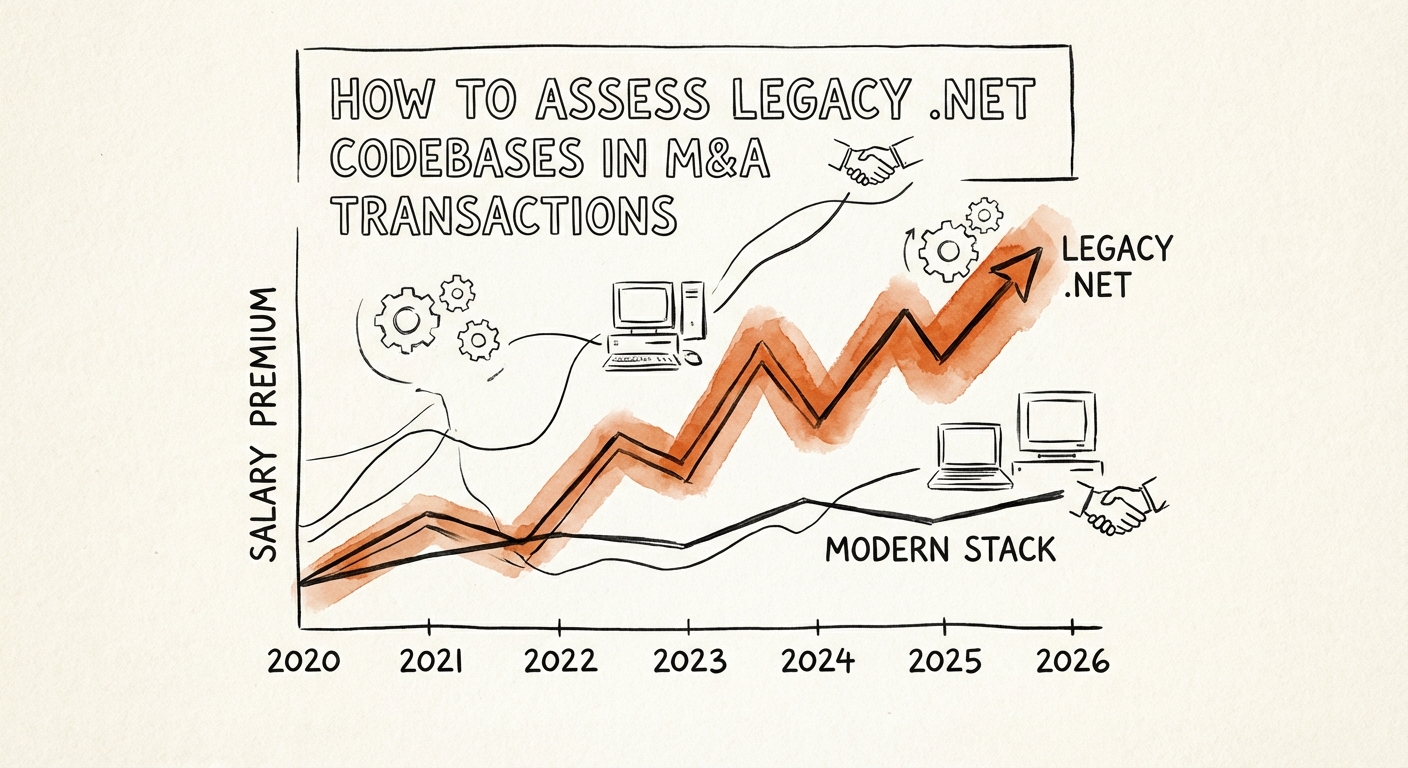
A common misconception in the Operating Partner's Guide to Technology Decisions is that legacy platforms can be put into "maintenance mode" with low-cost offshore resources. In 2026, this strategy is failing. The talent market has bifurcated: developers skilled in modern .NET 8/9 command high rates because they drive innovation, while developers willing to maintain legacy WebForms or WCF (Windows Communication Foundation) applications command a 20-40% salary premium simply because nobody else wants to do the work.
This "boredom tax" is compounded by attrition. When a portfolio company forces a modern engineering team to maintain a legacy monolith, turnover spikes. Replacing a senior engineer who holds the "tribal knowledge" of a 15-year-old codebase costs approximately 2.5x their annual salary in recruitment fees, ramp time, and lost productivity. During due diligence, you must assess not just the code, but the willingness of the current team to support it post-close.
The Migration CapEx Shock
If the plan is to modernize, the capital requirements are often underestimated by a factor of three. Migrating from .NET Framework 4.8 to .NET 8 is not an "upgrade"; it is often a porting exercise that breaks dependencies. Third-party libraries (NuGet packages) used in 2015 may no longer exist or support modern runtimes. Our data suggests that for a typical mid-market enterprise application, a "lift and shift" migration to modern .NET requires:
- Small Business Apps: \$30,000 - \$70,000 (3 months)
- Mid-Market Platforms: \$250,000 - \$500,000 (9-12 months)
- Enterprise Monoliths: \$1.5M+ (18-24 months)
These costs must be factored into the 100-Day Value Creation Plan. If they aren't, they will appear as unexpected EBITDA adjustments in Year 1, damaging the relationship between the sponsor and the management team.
The 5-Point Diagnostic for the Data Room
You don't need to be a code architect to spot the warning signs of a .NET liability in the data room. Ask your technical diligence lead to check these five specific indicators:
- The Global.asax File: If this file is heavily modified with business logic, it indicates a monolithic architecture where application lifecycle events are tightly coupled, making it nearly impossible to decouple into microservices without a rewrite.
- WCF Services: References to
System.ServiceModelor "WCF" are a red flag. This technology is deprecated in modern .NET. Replacing it requires rewriting the entire communication layer of the application, often a six-month project. - 'Add Reference' vs. NuGet: Check the project files. If you see references to local DLLs (e.g.,
C:\Projects\Lib\MyLibrary.dll) instead of NuGet packages, the dependency chain is broken. This "DLL Hell" prevents automated CI/CD pipelines, slowing deployment velocity to a crawl. - Database Logic in Code: Look for "Stored Procedures" carrying heavy business logic. While performant, this creates a "vendor lock-in" to Microsoft SQL Server, preventing a move to cheaper, open-source databases like PostgreSQL, which is a key lever in Technical Debt Remediation.
- The .NET Version: Simply ask for the
targetFrameworkversion in the.csprojfiles. If it saysv4.5,v4.6, orv4.6.1, the application is running on an unsupported framework with known security vulnerabilities.
The Strategic Fix: The Strangler Fig
If you identify these risks, the deal isn't necessarily dead—but the valuation must adjust. The most effective remediation strategy is not a "Big Bang" rewrite, but the Strangler Fig Pattern. This involves building new features in modern .NET 8/9 alongside the legacy application, gradually routing traffic to the new system until the old one can be decommissioned. This approach allows you to realize value from new features immediately, rather than waiting two years for a rewrite that may never finish.