
The practical answer
- Short answer
- New 2026 data reveals a $7.13 AWS partner multiplier, yet 30% of GenAI pilots fail. A diagnostic guide for AWS Partners to escape 'PoC Purgatory' and build profitable Agentic AI practices.
- Best fit
- Industry: Cloud Services / SaaS. Function: GTM / Product Strategy
- Operating path
- GTM Execution → Commercial Performance → Performance Improvement
- Key metric
- $7.13 The AWS Partner Ecosystem Multiplier for every $1 of AWS spend in 2026 (Omdia).
The 'PoC Purgatory' That Kills Series B Valuations
By now, you’ve seen the Omdia headline: The AWS Partner Ecosystem Multiplier has hit $7.13 for every $1 of AWS spend in 2026.
If you are a founder of a $20M ARR cloud consultancy or SaaS platform, that number likely feels like a hallucination. You aren’t seeing a 7x drag on your billings. You’re seeing margin compression, stalled pilots, and a sales pipeline bloated with "innovation labs" that never convert to production revenue.
Here is the reality the headline hides: According to Gartner, 30% of GenAI projects are abandoned after Proof of Concept (PoC). The market is bifurcating. On one side, "Generalist AI" shops are racing to the bottom, billing hourly for Python scripts that yield no recurring value. On the other side, vertical specialists are building Agentic AI workflows on Amazon Bedrock that command sticky, high-margin revenue.
If you are still selling "AI Strategy" or generic "LLM Implementation," you are walking into a trap. The 2025 data from Mavvrik is damning: 84% of enterprises report gross margin erosion due to unmanaged AI infrastructure costs. When you sell a pilot that burns cash without delivering immediate workflow automation, you aren't a partner; you're a liability.
The "Pilot" is the Enemy of the "Product"
For founders, the danger is existential. You cannot scale a service delivery organization on 3-month pilots. You need recurring revenue. The "PoC Purgatory" exists because partners are selling technology (Models, RAG, Vectors) instead of outcomes (Claims Processing Agents, Compliance Bots).
You need to audit your pipeline today. If a "Pilot" has been active for more than 90 days without a signed production contract, it is not a pipeline opportunity. It is a hobby. Kill it or convert it.
If a pilot has been active for more than 90 days without a signed production contract, it is not a pipeline opportunity. It is a hobby.
The Bedrock Advantage: From Chatbots to Agentic Workflows
The era of the "Chatbot" is over. 2026 is the year of the Agent. Gartner predicts that by the end of this year, 40% of enterprise applications will feature task-specific AI agents, up from less than 5% in 2025. This is your exit ramp from the consulting services trap.
AWS Bedrock is no longer just a model garden; it is the operating system for these agents. Your opportunity isn't to resell Claude or Titan tokens—there is no margin in pass-through inference costs. Your opportunity is to build the orchestration layer.
The "Agentic" Revenue Model
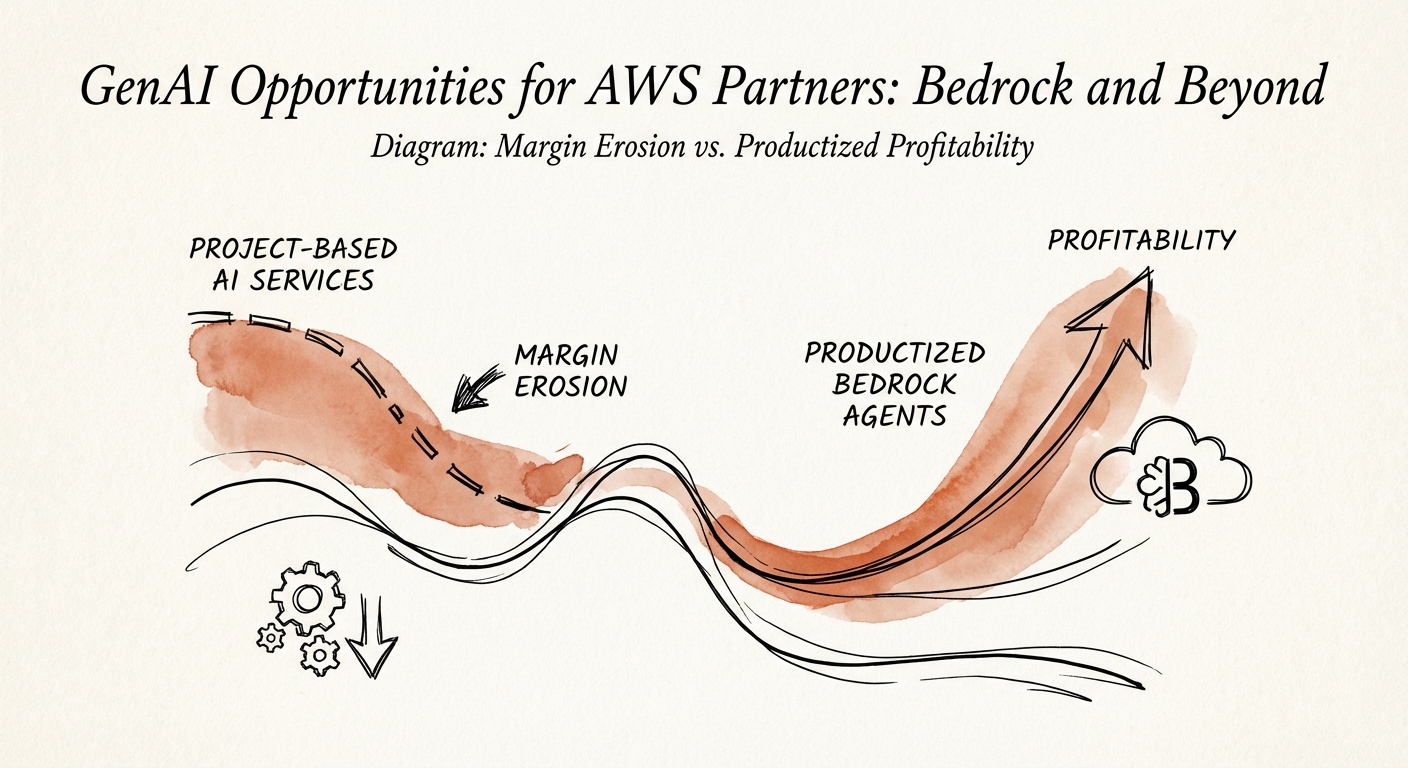
Successful AWS partners in 2026 are productizing their IP. Instead of billing 500 hours to build a custom customer service bot, they are deploying pre-built "Bedrock Agents" for specific verticals.
- Don't Sell: "We will build you a GenAI solution for legal."
- Do Sell: "We have a pre-configured Bedrock Agent for Contract Review that reduces paralegal hours by 40%. It costs $5,000/month plus consumption."
This shift protects you from the "Infrastructure Tax." As we discussed in Cloud Migration Cost Overruns, inference costs can spiral quickly. If you price your services on a fixed-fee basis without accounting for the variable nature of Agentic AI, you will bleed EBITDA. You must decouple your pricing from your hours and align it with the value of the automated task.
Execution: Verticalize or Die
The "Generalist" AWS Partner is a dying breed. The $7.13 multiplier is not evenly distributed. It is concentrated in partners who possess deep vertical IP. A generic "AWS AI Competency" badge gets you a meeting; domain expertise gets you the contract.
We warn founders often about when to pivot their GTM strategy. If your win rates on AI deals are below 20%, you are likely competing on rate rather than value. You are a commodity.
The 90-Day Pivot Plan
- Pick ONE Vertical: You cannot be the expert in FinTech, Healthcare, and Retail. Pick the one where you have the most successful case studies.
- Package the "Agent": Stop writing custom proposals. Create a "Product" (even if it's services-heavy backend) that solves one expensive problem using AWS Bedrock Agents.
- Change the Metric: Stop reporting "AI Pipeline" to your board. Report "AI Production ARR." As detailed in The Project Revenue Trap, project revenue is worth 1x; recurring revenue is worth 6x-12x.
The market is waiting for operators who can deliver outcomes, not just science experiments. The technology is ready. The question is: Is your business model?