
The practical answer
- Short answer
- Stop overpaying for bad revenue. A data-backed B2B SaaS sales compensation plan template, including 2025 benchmarks for OTE, accelerators, and clawbacks.
- Best fit
- Industry: B2B SaaS. Function: Sales Operations
- Operating path
- GTM Execution → Commercial Performance → Performance Improvement
- Key metric
- 5:1 Target Quota-to-OTE Ratio for Series B/C SaaS
The "Empty Calorie" Revenue Crisis
If you are a Series B or C founder, you are likely looking at a sales dashboard that is lying to you. Your top rep just hit 110% of their quarterly number, triggering a massive accelerator payout. Everyone is celebrating. But six months from now, 30% of that revenue will churn because the customers were poor fits, sold on roadmap promises that don't exist, or locked into terms that destroy your gross margin.
We call this "Empty Calorie" revenue. It looks like growth on the P&L today, but it manifests as a cash flow crisis tomorrow. In 2025, the median quota attainment for SaaS reps has dropped to roughly 31%, yet sales compensation costs as a percentage of revenue are rising. Why? Because most compensation plans pay for bookings, not revenue quality.
You are likely overpaying for customer acquisition while inadvertently incentivizing churn. The standard "10% flat commission" model is a relic of the on-premise software era. In a recurring revenue model, paying full commission upfront for a customer who leaves in 90 days is mathematically indistinguishable from setting cash on fire. You need a compensation architecture that aligns the rep's wallet with the company's valuation levers: retention, margin, and cash collection.
If a rep closes a deal that churns in 90 days, and you paid them commission on it, you didn't acquire a customer. You acquired a liability.
The 3-Lever Compensation Framework
Effective SaaS compensation isn't about being stingy; it's about being surgical. Your plan must balance hunger with hygiene. We use the "3-Lever Framework" to align incentives with unit economics.
Lever 1: The Ratio (5:1 Rule)
Your Quota-to-OTE (On-Target Earnings) ratio dictates the efficiency of your sales team. In 2025, the median ratio is 4.2x, but for efficient scaling, you should aim for 5:1. This means if an AE has an OTE of $200,000, they must deliver $1,000,000 in ARR. Anything below 3:1 is a venture capital subsidy, not a business model. If you are paying $200k for $600k in bookings (3:1), your CAC payback period will likely exceed 18 months, killing your ability to raise your next round.
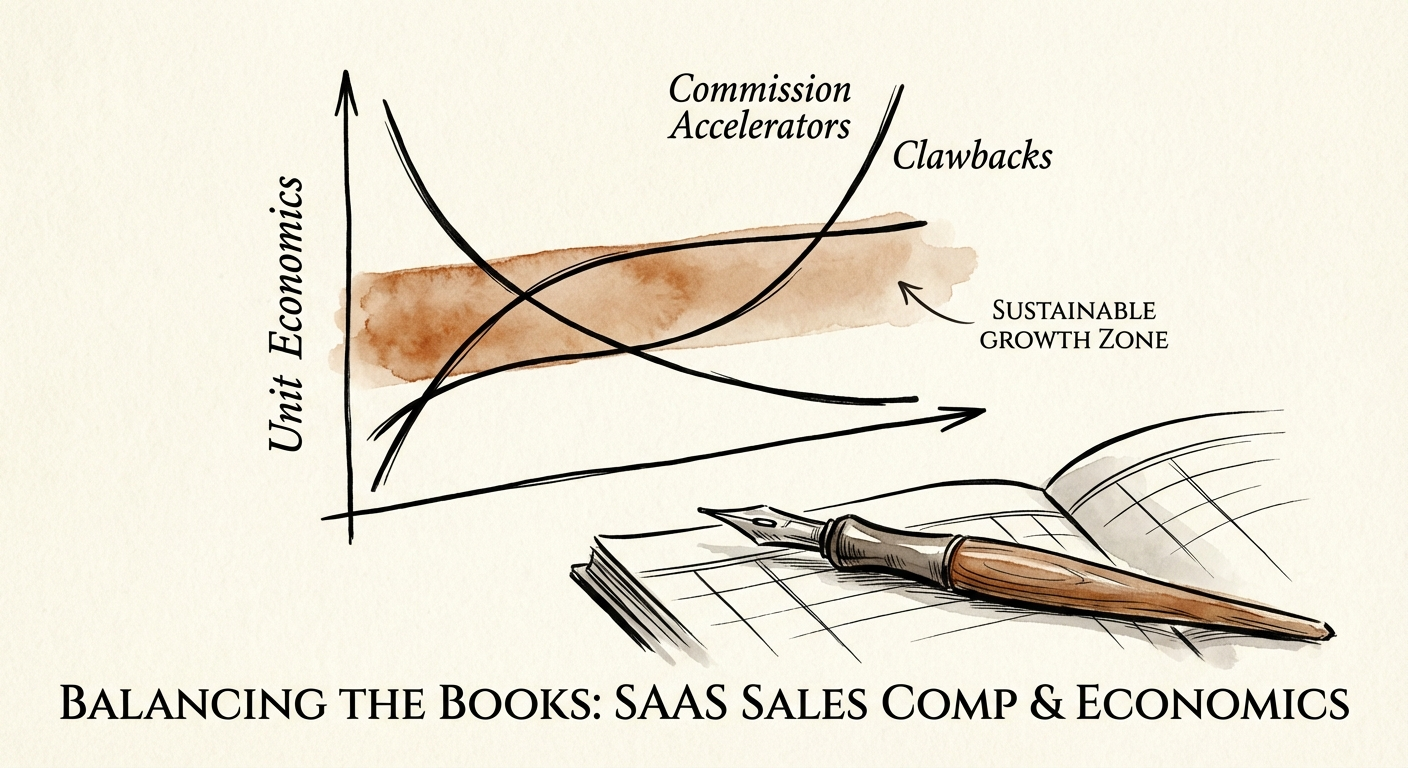
Lever 2: The Accelerator (The 1.5x Cliff)
Linear commission rates (e.g., flat 10%) create "lifestyle reps" who hit 80% of quota and coast. You want a plan that punishes mediocrity and rewards excellence disproportionately. A standard structure for 2025:
- 0-100% of Quota: 10% Base Commission Rate
- 100%+ of Quota: 15% (1.5x Multiplier)
Some aggressive plans use a "Gate" where commission is lower (e.g., 5-8%) until the rep hits 50-60% of quota. This ensures you aren't paying full freight for reps who are failing.
Lever 3: The Safety Valve (Clawbacks)
This is non-negotiable. If a customer churns within 90 days, 100% of the commission must be clawed back. If they churn within 180 days, 50% is clawed back. Without this, your sales team is effectively stealing from your future cash flows. You must also align payment timing with cash collection; do not pay commissions on bookings that haven't paid their first invoice.
Diagnostic: Is Your Plan Broken?
Before rolling out a new plan, run your current structure through this diagnostic to spot the "Valuation Killers."
- The "Loss Leader" Check: Calculate your effective commission rate on your bottom 20% of reps. If you are paying them more than 25% of the ACV they bring in (due to base salary weight), you need a faster termination policy or a higher variable split (move from 50/50 to 40/60).
- The "Discounting" Check: Does your rep take a commission hit for discounting? If a rep discounts a deal by 20% to close it, their commission should drop disproportionately (e.g., by 25%). If it doesn't, you are incentivizing them to give away your margin to hit their number.
- The "Multi-Year" Trap: Are you paying upfront on multi-year deals that are billed annually? Never pay commission on Year 2 or Year 3 revenue upfront. Pay it upon renewal or cash collection of subsequent years.
A comp plan is not just an HR document; it is the most powerful signal of what you value. If you value growth at all costs, your plan will deliver churn. If you value sustainable revenue, build the incentives that drive unit economics. For more on structuring your revenue engine, review the critical difference between RevOps and SalesOps to ensure you have the data to enforce these rules.