
The practical answer
- Short answer
- Stop using 'Average Revenue per Rep.' It's a vanity metric hiding your efficiency problem. Here is the ramp-adjusted productivity formula for Series B/C CEOs.
- Best fit
- Industry: B2B SaaS. Function: Sales Operations
- Operating path
- GTM Execution → Commercial Performance → Performance Improvement
- Key metric
- 41.3% Average quota attainment for Mid-Market AEs in 2025, down from 64% in 2009.
The "Headcount Fallacy" That Destroys Forecasts
If you are a Series B CEO explaining a missed quarter to your board, you likely pointed to one of two culprits: not enough leads or not enough reps. But if you look at your P&L, you’ll see the real ghost in the machine.
Most companies calculate sales productivity using The Vanity Formula: Total Revenue ÷ Total Sales Heads.
This math is comfortable. It is also a lie. It treats a rep who started last week the same as a three-year veteran. It masks the drag of attrition. And worst of all, it convinces you that hiring more bodies will linearly increase revenue. In 2025, that linear relationship is broken.
The reality of the current market is brutal: Mid-Market AE quota attainment has dropped to 41.3%. If you are modeling your 2026 growth plan on the assumption that 70% of your reps will hit quota, you are building a hallucination, not a budget. You don't have a capacity problem; you have a productivity gap.
The Productivity Gap Defined
The gap represents the difference between your theoretical capacity (Total Quota × Headcount) and your actual street performance. In healthy companies, this gap is 15-20%. In stalled Series B firms, we consistently see gaps exceeding 60%.
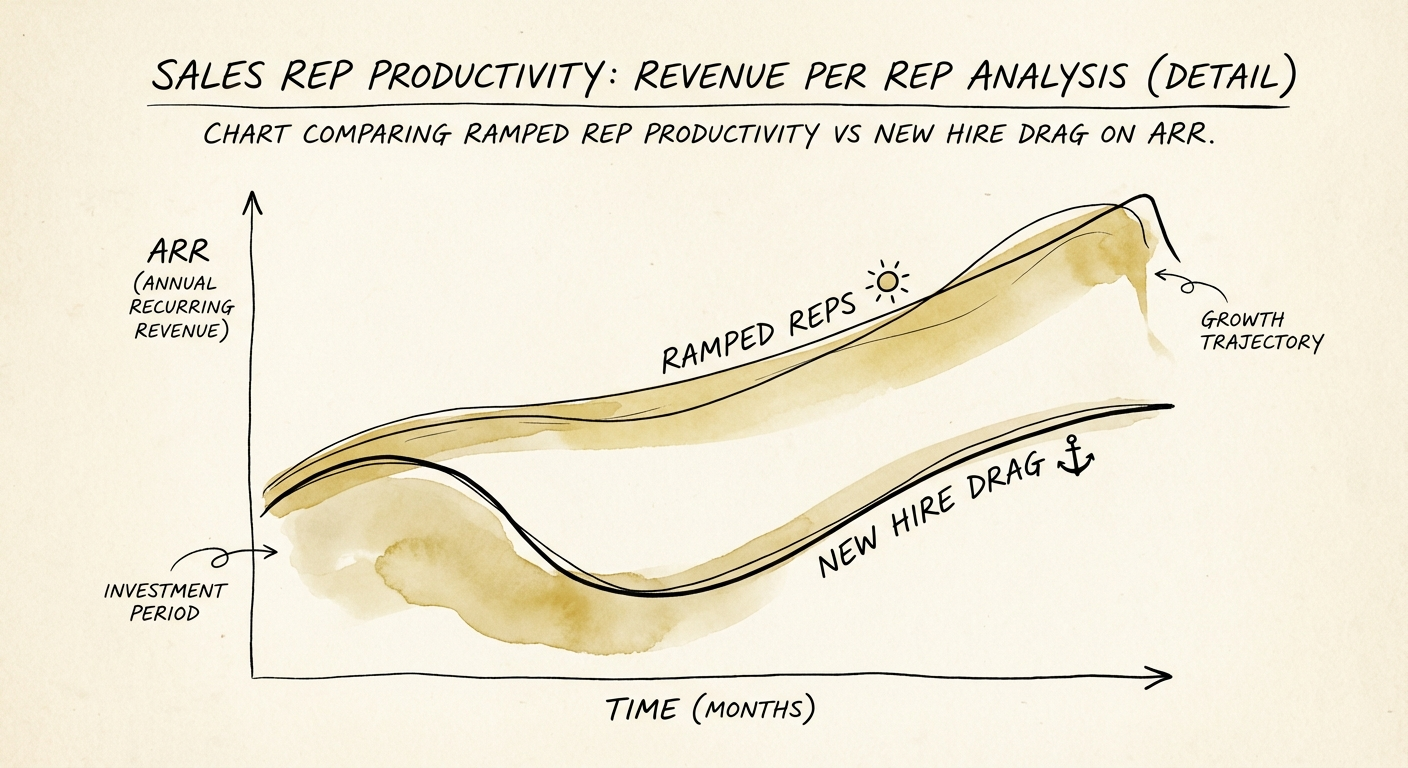
Why? Because you are carrying "ghost capacity"—reps who are fully ramped on paper but performing like rookies in practice. Until you measure productivity based on Ramped Rep Months rather than headcount, you lack the operating visibility to steer.
If your average rep isn't covering their OTE by 3x, you don't have a sales problem; you have a business model problem.
The True Revenue Per Rep Calculator
To get a number you can actually bet your runway on, you need to strip out the noise. We use the Ramp-Adjusted Productivity (RAP) Model. Here is the step-by-step diagnostic to run on your own data.
Step 1: Calculate Ramped Rep Months (RRM)
Stop counting heads. Count productive months. A rep in month 1 is 0% productive. A rep in month 4 might be 50% productive.
- Define Ramp: For Mid-Market B2B, the benchmark is 5.7 months to full productivity.
- Assign Weighting:
Month 1-3: 0.0 FTE
Month 4-6: 0.5 FTE
Month 7+: 1.0 FTE - Calculate: If you have 10 reps, but 4 were hired 2 months ago, you don't have 10 reps. You have 6.0 productive rep equivalents.
Step 2: Isolate "Hunter" Revenue
Do not credit your reps with revenue they didn't earn. Strip out:
- Bluebirds (Inbound demo requests that closed in <10 days)
- Expansion revenue handled by CS
- House accounts
What remains is True Generated Booking Value.
Step 3: The Efficiency Ratio
Finally, divide True Generated Booking Value by Ramped Rep Months. Compare this to their On-Target Earnings (OTE).
The Golden Ratio: In a healthy SaaS model, a ramped rep should generate 4x-5x their OTE in Annual Recurring Revenue (ARR).
The Danger Zone: If your ratio is below 3x, your unit economics are underwater. You are paying $1 to buy $0.80 of revenue.
Fixing the Machine Before You Add More Parts
Once you run this calculation, the instinct is often to "fire the bottom 10%." While performance management is necessary, low productivity is usually a systemic failure, not a personnel one. If your average ramped rep is sitting at 2.5x OTE, firing the bottom won't fix the middle.
1. Shrink the Territories
Counter-intuitively, stalled reps often have too much territory, not too little. They skim the surface of 500 accounts instead of working 50. Data from the Bridge Group and others suggests that narrowing focus increases depth of engagement. Force your reps to disqualify faster.
2. Audit the "Selling Time"
We recently audited a portfolio company where reps spent 14 hours a week on internal Slack messages and CRM admin. That is 35% of their capacity evaporated. You cannot coach a rep to be more productive if they are only selling 20 hours a week. Operations must clear the path.
3. The "Middle 60" Strategy
Your top 20% will hit quota regardless of your systems. Your bottom 20% likely shouldn't be there. The battle is won in the Middle 60%. Moving this group from 45% attainment to 65% attainment is the single highest-ROI activity a VP of Sales can undertake. This requires shifting from inspection to coaching.
Stop hiring more reps to solve a productivity problem. It’s like pouring water into a leaking bucket—you don't need more water; you need to plug the holes.