The practical answer
- Short answer
- Nearly 50% of PE CFOs fail within 18 months. This 100-day diagnostic plan focuses on the 13-week cash flow, working capital, and data integrity to ensure survival.
- Best fit
- Industry: Private Equity. Function: Office of the CFO
- Operating path
- Financial Infrastructure → Commercial Performance → Valuations
- Key metric
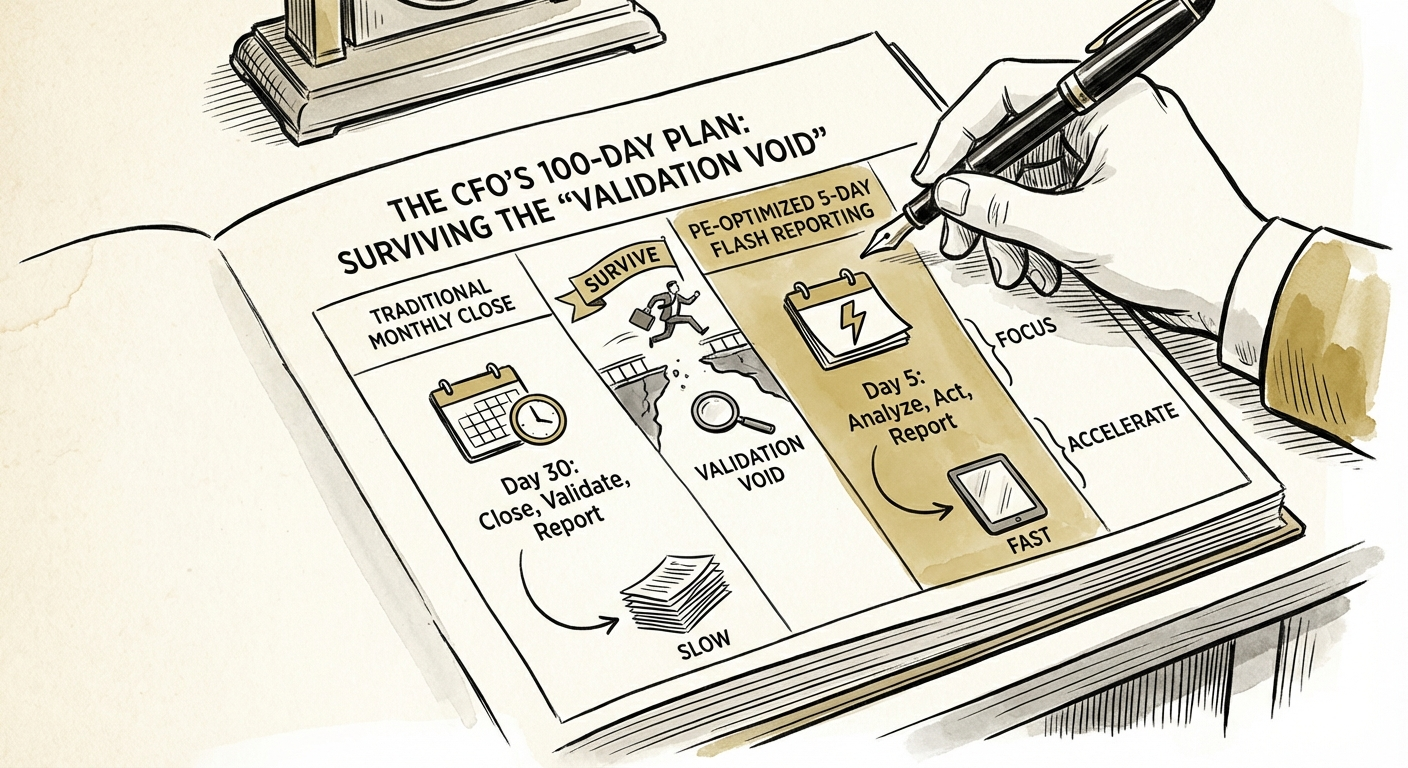
- 5 Days Target timeline for monthly financial close to ensure board data is relevant.
The "Validation Void": Why the First 30 Days Are About Cash, Not Strategy
The average tenure of a portfolio company CFO is currently 2.5 years, with nearly 50% departing within the first 18 months. This churn isn't a recruitment failure; it's an onboarding failure. Most incoming CFOs—especially those from corporate backgrounds—mistake the first month for a "listening tour." In a levered environment, you do not have time to listen. You have time to validate.
Your first 30 days must solve the "Validation Void"—the dangerous gap between the CIM (Confidential Information Memorandum) presented during the deal and the operational reality of the bank account. The primary instrument for closing this gap is not the annual budget, but the 13-Week Cash Flow Forecast.
The 13-Week Lie Detector
We treat the 13-week forecast as a lie detector for the entire organization. It exposes:
- Sales Optimism: If the sales team forecasts $5M in bookings but collections flatline in Week 6, the pipeline is soft.
- OpEx Bloat: If "Run Rate" expenses in the board deck don't match the weekly wire batches, you have unauthorized spend.
- Working Capital Leaks: If DPO (Days Payable Outstanding) is shrinking while DSO (Days Sales Outstanding) expands, you are funding your customers' growth with your sponsor's equity.
Benchmark: By Day 30, your 13-week forecast must be within 5% accuracy on a rolling weekly basis. If you are still relying on the "Indirect Method" (backing into cash from Net Income), you lack the operating visibility to steer. Switch to the "Direct Method" immediately: track receipts and disbursements. If you cannot predict cash availability 90 days out, you cannot have a strategic conversation with your Operating Partner.
In a levered environment, you do not have time to listen. You have time to validate. The 13-week cash flow isn't a report; it's a lie detector.
The "Systems Sprint": Days 31-60
Once liquidity is visible, the focus shifts to data integrity. The most common friction point between a portfolio CFO and the PE sponsor is the Monthly Close. In 2025, the standard for a "Good" close is no longer just accuracy; it is velocity. A 20-day close cycle is a governance failure. It means the board is reviewing data that is effectively a month old.
The 5-Day Close Mandate
Your goal for Day 60 is to chart a path to a 5-day hard close. This typically requires breaking the "Excel dependency" that plagues lower-middle-market firms.
Diagnostic Questions for Day 45:
- Reconciliation Lag: Are bank recs happening daily or at month-end? Automate this immediately.
- Accrual Automation: Are you manually calculating revenue recognition (ASC 606) in spreadsheets? This is the #1 cause of Quality of Earnings (QofE) adjustments at exit.
- The "Flash" Report: Can you produce a reliable "Flash" P&L by Day 3? If not, your chart of accounts is likely too complex. Simplify it to align with the sponsor's reporting template.
We often see CFOs inherit a Controller-led finance function that prioritizes tax compliance over operational insight. You must pivot the team's focus. If your Controller cannot explain why gross margin dipped 200 bps without three days of analysis, you have a talent gap, not just a systems gap. 10 Signs You Need a Fractional CFO Instead of a Controller outlines this distinction clearly.
The "Value Vector": Days 61-90
With cash visible and reporting accelerated, the final month of your 100-day plan focuses on EBITDA expansion. This is where you earn your equity. In the current high-interest environment (even with 2025 rate cuts), holding periods have stretched to nearly 6 years. You cannot rely on multiple arbitrage; you must manufacture margin.
Working Capital as a Valuation Lever
Working capital optimization is the fastest way to fund the Value Creation Plan (VCP) without asking the sponsor for a capital injection. Our data across 150+ portfolio companies suggests that the average middle-market firm has 5-10% of revenue trapped in inefficient working capital cycles.
- Receivables: Implement strict credit holds. Stop paying sales commissions on booked deals; pay on collected cash.
- Payables: Renegotiate terms. If you are paying vendors in 30 days but collecting in 60, you are a bank, not a business. Push critical vendors to net-60 and cut non-critical spend.
- Inventory: Identify the "Inactive Inventory"—SKUs that haven't moved in 6 months. Liquidate them to free up cash and warehouse space.
Day 1 Exit Readiness
Finally, begin building the Virtual Data Room (VDR) structure now. Do not wait for the exit process to start in Year 4. Organize your contracts, cap tables, and IP assignments as if you were selling the company next quarter. This "Day 1 Exit Readiness" mindset signals to your Operating Partner that you understand the game: we are here to build a sellable asset, not a comfortable one. For more on this, review How to Create a Data Room That Impresses PE Buyers.