
The practical answer
- Short answer
- Stop comparing hourly rates. Our 2026 TCO analysis reveals the true cost of in-house vs. outsourced development, including the $306k/year technical debt risk.
- Best fit
- Industry: B2B SaaS. Function: Engineering / CTO
- Operating path
- Technical Debt → Turnaround & Restructuring → Transaction Advisory Services
- Key metric
- 2.7x The 'Fully Loaded' multiplier for US in-house developers vs. base salary (2025).
The Sticker Price vs. The True Cost of Ownership
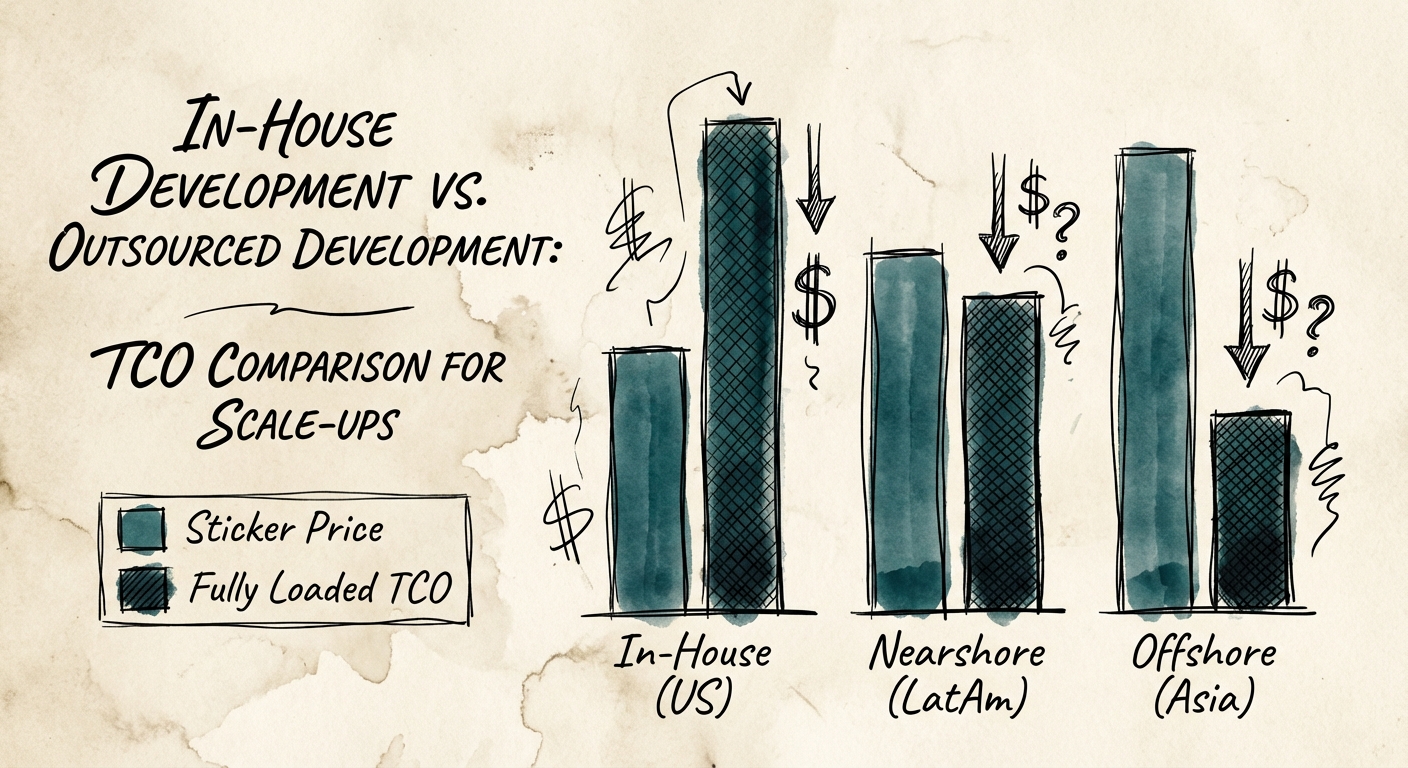
For a Series B CTO under pressure to ship features faster than the burn rate allows, the math often looks simple: A Senior Engineer in San Francisco costs $180,000 a year. A Senior Engineer in Eastern Europe or LatAm costs $60 an hour ($120,000 a year). The savings seem obvious. But this napkin math is the primary driver of Technical Debt in scaling organizations.
To understand the real trade-off, we must look at the Fully Loaded Cost. In 2025, the multiplier for a US-based in-house engineer has risen to 2.56x to 2.7x of their base salary. That $180k developer actually costs your P&L roughly $460,000 once you factor in:
- Equity & Benefits: 25-30% of base.
- Recruitment & Onboarding: $28k-$35k per hire (often amortized).
- Equipment & Overhead: $12k-$15k annually.
- Severance & Risk: Accrued liability.
Conversely, the outsourced "$60/hour" resource has their own hidden multiplier, typically 1.4x to 1.6x, driven by the "Management Tax." Data from Pelpr's 2025 hiring guide indicates that you need one internal engineering manager for every 5-8 outsourced developers to maintain quality standards. If you skip this management layer to save money, you aren't saving—you are borrowing against your future code quality.
Outsourcing is not a cost-saving strategy; it is a velocity strategy. If you use it to save money, you will pay the difference in technical debt interest. If you use it to move faster, the cost is justified.
The "Interest Rate" of Outsourcing: Technical Debt as a Service
The most dangerous line item in the "Build vs. Buy" TCO model is one that never appears on a vendor's invoice: Technical Debt Remediation. When you outsource core product development to teams incentivized by velocity rather than long-term maintainability, you are effectively taking out a high-interest loan.
Recent research by SonarSource quantified this cost: The average impact of technical debt is $306,000 per year for every 1 million lines of code. This cost manifests in three ways that kill Series B exits:
1. The Communication Latency Tax (15-25%)
Distributed teams operating across time zones introduce a 15-25% delay in development cycles due to asynchronous communication lags. Every clarification ticket that sits overnight is downtime. In a high-velocity scale-up, this latency compounds, turning a 2-week sprint into a 3-week slog.
2. The Attrition "Brain Drain"
Outsourced agencies often rotate talent to optimize their margins, not your product stability. When a vendor developer leaves, they take their domain knowledge with them. Unlike in-house attrition, where you retain the institutional culture, vendor attrition leaves you with "black box" code that no one internally understands. As detailed in our cost of bad hiring diagnostic, replacing this knowledge is often more expensive than the original build.
The Hybrid Framework: Core vs. Commodity
The binary choice between "In-House" and "Outsourced" is a false dichotomy. The highest-performing Series B companies in 2026 deploy a Hybrid Core Strategy. They view development not as a monolithic cost center, but as a portfolio of risks.
Keep In-House (The "Moat"):
- Core IP & Architecture: Never outsource the logic that defines your valuation.
- Security & Compliance: With data breach costs averaging $4.88 million, ownership of security protocols must remain internal.
- Product Management: The translation of business goals into technical specs is a high-context activity that fails across organizational boundaries.
Outsource (The "Velocity"):
- Commodity Integrations: Building connectors to Salesforce or HubSpot (see our build decision framework).
- QA & Testing Automation: High-volume, repetitive tasks where process beats context.
- Legacy Maintenance: Ring-fencing older codebases to free up your core team for innovation.
By treating outsourcing as a capacity lever rather than a cost-savings strategy, you protect your technical debt benchmarks while maintaining the velocity needed to reach Series C.