
The practical answer
- Short answer
- Agentforce and Data Cloud are reshaping Salesforce partner valuations. Discover why traditional SIs face a 30% discount and how to pivot your portfolio for an AI-ready exit.
- Best fit
- Industry: Private Equity. Function: Operations
- Operating path
- Exit Readiness → Operational Excellence → Transaction Advisory Services
- Key metric
- 6x-8x Compressed EBITDA multiple for traditional T&M Salesforce shops (down from 10-12x).
The Death of the 'Billable Hour' Arbitrage
For the last decade, the private equity playbook for Salesforce System Integrators (SIs) was simple: acquire a firm with 40% growth, layer on a sales team to utilize the bench, and sell to a strategic at 12x EBITDA. That playbook relied on a fundamental inefficiency: Salesforce was hard to configure, hard to test, and hard to deploy. You sold bodies to solve complexity.
That arbitrage is dead. With the release of Agentforce and the shift to autonomous agents, Salesforce is aggressively automating the very tasks that generated 60% of your portfolio company’s billable hours. Configuration, testing, and deployment—once the bread and butter of the "staff augmentation" model—are becoming automated features of the platform.
If your portfolio company is still billing Time & Materials (T&M) for basic configuration, you are holding a depreciating asset. Valuation multiples for pure-play service firms are compressing from the historic 10x-12x range down to 6x-8x. Buyers—especially strategic acquirers like Accenture or Deloitte—are no longer paying premiums for capacity. They are paying for IP and Vertical Specialization. If your revenue mix is >70% T&M, you aren't a platform partner; you're a staffing agency with a cloud logo, and you will be priced accordingly.
If your revenue is 80% time-and-materials, you aren't a platform partner; you're a staffing agency with a Salesforce logo. The market has already priced this in.
Apex is the New Asbestos
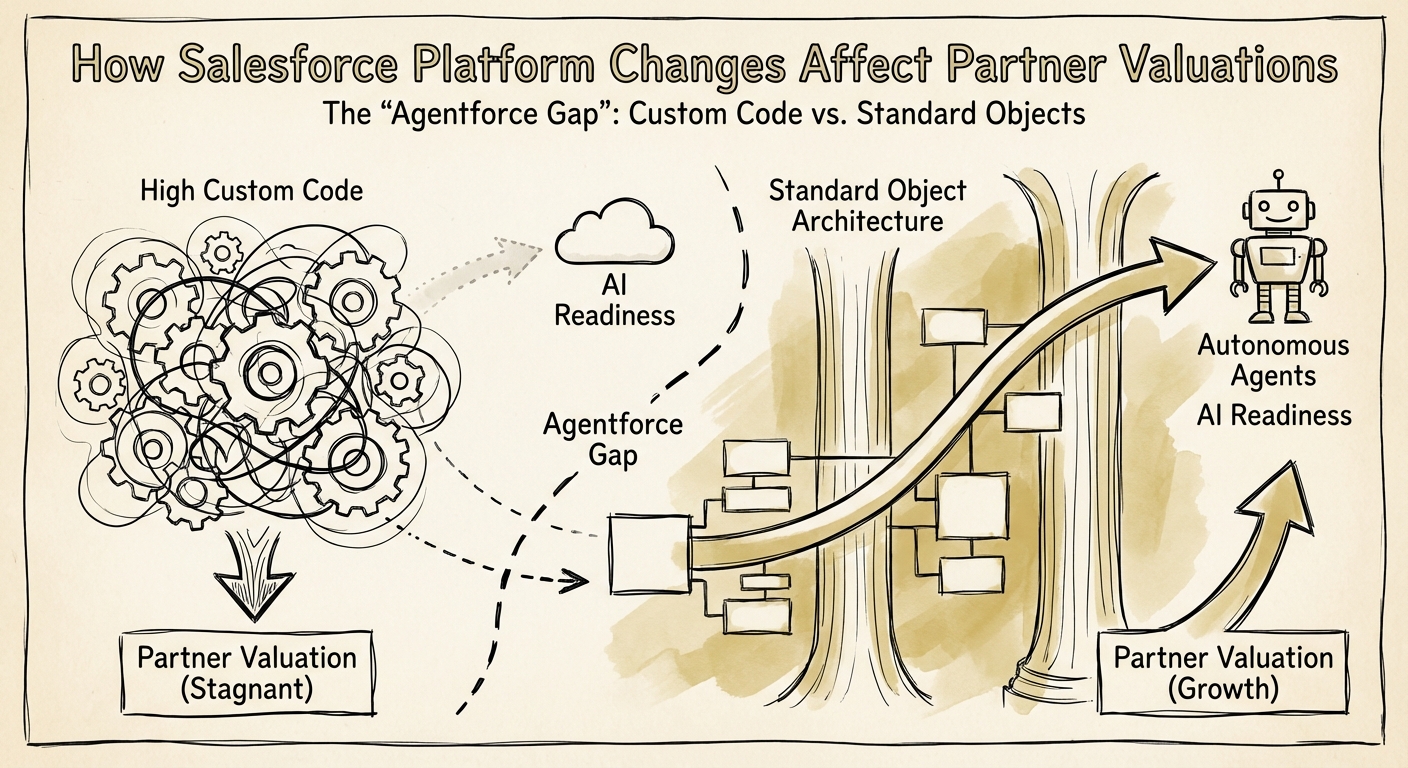
In 2020, a highly customized Salesforce Org with thousands of lines of Apex code was a sign of "stickiness." In 2026, it is a liability. We are seeing deals stall in technical due diligence not because the code is broken, but because it is "AI-Blind."
Agentforce and Einstein operate best on standard objects and Flows. They struggle to navigate the spaghetti logic of legacy Apex triggers and Visualforce pages. When a strategic acquirer evaluates your portfolio company’s client base, they are running an "AI Readiness" audit. If your clients require a massive re-platforming project just to turn on Agentforce, your firm owns that technical debt. You are effectively selling a customer base that is locked out of the platform’s future.
We recently saw a term sheet retraded down by 25% because the target firm’s "proprietary framework" was actually just accumulated technical debt that blocked Data Cloud ingestion. The acquirer calculated the "refactoring tax"—the cost to migrate those clients to standard implementation—and deducted it from the Enterprise Value. Stop calling custom code "IP." Unless it is a managed package on the AppExchange, it is likely just an anchor dragging down your multiple.
The Pivot: From Bodies to 'Outcomes-as-a-Service'
To restore the 12x multiple before exit, you must fundamentally restructure the revenue quality. The market is moving toward Consumption-Based Services to align with Salesforce’s own pricing models. You need to pivot from selling "hours of configuration" to selling "Agentic Outcomes."
1. Productize the 'Data Cloud' Wedge
Data Cloud is the prerequisite for Agentforce. Your firm must package a fixed-price "Data Harmonization" offering that is high-margin and repeatable. This proves you have IP. Revenue recognition here is cleaner and perceived as higher quality than open-ended consulting.
2. Verticalize or Die
Generalist SIs are commodities. The premium multiples in 2025/2026 are going to firms that own a specific vertical (e.g., "Agentforce for MedTech" or "Data Cloud for Regional Banking"). You need documented accelerators—pre-built flows, prompt templates, and data models—that reduce implementation time by 50%. This paradoxically increases your margins because you sell the value of the outcome, not the hours it took to build.
3. The 'Managed Agent' Retainer
Replace the dying "Managed Services" (support tickets) with "Agent Optimization" packages. AI agents drift; they need tuning, prompt engineering, and governance. This is the new recurring revenue stream that PE buyers are salivating over. It’s sticky, high-skill, and defensible.