
The practical answer
- Short answer
- New data reveals how technical certifications impact M&A valuations. Learn why FedRAMP commands a premium while lack of SOC 2 drives a 30% discount.
- Best fit
- Industry: Private Equity. Function: Operations
- Operating path
- Exit Readiness → Operational Excellence → Transaction Advisory Services
- Key metric
- $2.5M Estimated cost savings for an acquirer buying a target with existing FedRAMP High authorization.
The Shift from "Risk" to "Revenue Asset"
For decades, private equity viewed technical compliance as a binary switch in due diligence: Red Flag or Green Light. You either had your SOC 2, or we added a remediation line item to the post-close budget. In 2026, that model is dead. Compliance is no longer just a risk mitigation strategy; it is a tangible asset class that directly influences valuation multiples.
We are seeing a bifurcation in the market. On one side, companies with generic, "check-the-box" compliance postures are facing retrading events where purchase prices are slashed by up to 15% during the Quality of Earnings (QofE) phase due to "undisclosed technical liabilities." On the other side, firms with "Elite" certifications—specifically FedRAMP High, HITRUST, and specialized ISO standards—are commanding premiums because they offer the acquirer immediate access to gated markets.
According to recent analysis of M&A value destruction, technology issues—including compliance gaps and technical debt—account for approximately 30% of value destruction in transactions. When a buyer looks at your compliance stack, they aren't just checking for security; they are calculating the Time-to-Revenue in regulated verticals. If you have FedRAMP, you are saving them 18 months and $2 million in OpEx. That savings is directly capitalizable into your exit price.
Certifications only create deal value when they reduce buyer risk. If diligence still finds unpatched vulnerabilities, the badge becomes marketing, not transferable assurance.
The "Unbuyable" Discount: SOC 2 as Table Stakes
Let’s be clear: SOC 2 Type II is no longer a differentiator; it is the floor. In the current deal environment, lacking a SOC 2 Type II doesn't just lower your valuation—it often removes you from the target list of Tier 1 PE firms entirely. The risk is simply too high. Data from Black Duck audits reveals that 96% of transactions uncover unpatched open-source vulnerabilities, and without a rigorous compliance framework (like SOC 2) to manage these, the acquirer inherits a latent risk.
The valuation hit comes in the form of the "Remediation Holdback." If technical due diligence reveals that your compliance is merely a paper tiger—documents exist, but processes aren't followed—buyers will typically demand 10% to 20% of the deal value be held in escrow for 12 to 24 months to cover potential breaches or fines. This effectively turns an all-cash exit into an earnout dependent on your security team's past performance.
The "Transferability" Trap
A critical, often overlooked aspect of valuing compliance is transferability. Does your compliance program live in a GRC tool, or does it live in the head of a founder-dependent CISO? If the latter, the asset value is zero. Acquirers are increasingly auditing the "key person dependency" of compliance programs. If the departure of one individual collapses your audit readiness, you do not own a compliant company; you employ a compliant person. This distinction can cost millions in enterprise value.
The "Moat" Premium: FedRAMP and HITRUST
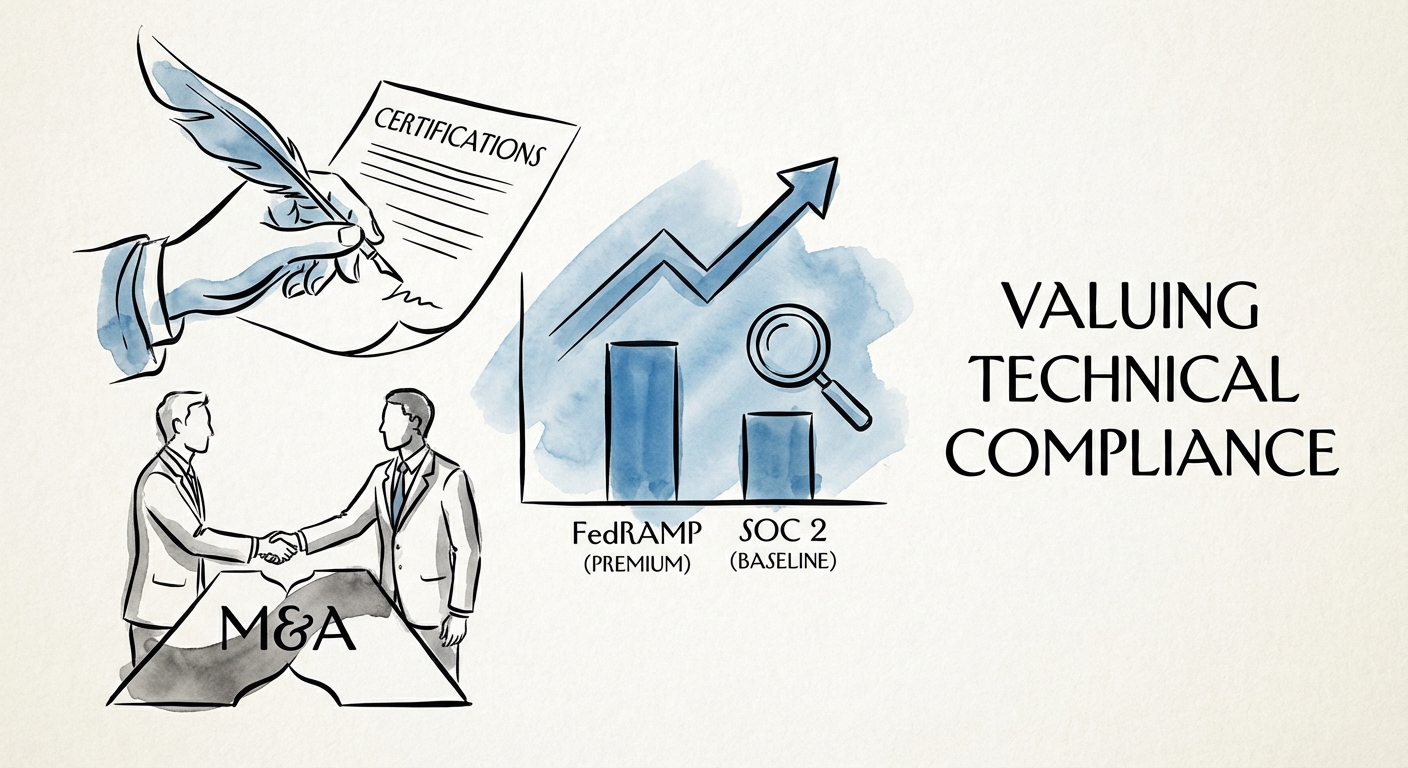
While SOC 2 prevents a discount, elite certifications create a premium. The most significant multiplier in 2026 is FedRAMP Authorization. Achieving a FedRAMP Moderate or High authorization is a brutal process, typically costing between $1 million and $2.5 million and taking 18 to 24 months. For an acquirer, buying a company that has already crossed this desert is incredibly attractive.
We advise portfolio companies to position these certifications not as "security achievements" but as "market access licenses." A FedRAMP High authorization isn't just a badge; it is a monopoly license to sell to the Department of Defense and other high-security federal agencies. In valuations, this translates to a higher revenue multiple because the Total Addressable Market (TAM) instantly expands by billions of dollars, with a competitive moat that takes competitors two years to bridge.
The math is simple: If an acquirer has to spend $2M and 2 years to get your product into the federal market, they will discount your price. If you hand them the keys to that market on Day 1, you capture that value. For further reading on how federal specialization impacts valuation, see our analysis on The Federal Fortress Premium.