
The practical answer
- Short answer
- Why generalist ServiceNow partners stall at $15M. A diagnostic guide on ITOM vs. CSM vs. HRSD specialization strategies to maximize EBITDA and exit valuation.
- Best fit
- Industry: Tech Services. Function: Strategy
- Operating path
- GTM Execution → Commercial Performance → Performance Improvement
- Key metric
- 95% YoY increase in demand for specialized consulting (2024-2025)
The $15M Ceiling is Real, and It’s Made of ITSM
If you are a ServiceNow partner hovering between $10M and $20M in revenue, you are likely suffering from "Generalist Fatigue." You built your business on the back of the Information Technology Service Management (ITSM) boom. You rode the wave of helping mid-market CIOs replace BMC Remedy or Jira Service Desk. It was good business in 2020. In 2026, it is a commodity.
The data is merciless. While ServiceNow’s subscription revenue is projected to hit $13.2 billion in 2025 with ~21% growth, the composition of that revenue has shifted. ITSM still accounts for the bulk of the install base, but it is no longer the engine of margin expansion. It is the dial tone. Entry-level ITSM implementations have seen rate compression as Global Systems Integrators (GSIs) automate delivery and boutique firms undercut each other on price.
The "Generalist Trap" happens when you try to be everything to everyone to chase revenue growth. You say "yes" to HR Service Delivery (HRSD) because the client asked, even though you have to sub-contract the talent. You take on a Customer Service Management (CSM) project but deliver it like an IT ticketing system, frustrating the client's VP of Sales. The result? Your revenue grows to $15M, but your EBITDA margin shrinks from 25% to 12% due to delivery inefficiencies and the high cost of context switching.
The Supply-Demand Gap
Here is the metric that matters: Demand for specialized ServiceNow consulting services (specifically in AI-enabled workflows like ITOM and CSM) grew 95% year-over-year in 2024-2025, while the supply of qualified talent only grew by 43%. This gap is where your profit lives. But you cannot capture it if your team is bogged down in commodity ITSM ticket configurations.
We don't buy 'ServiceNow implementation' anymore. We buy 'Zero Downtime' or 'Customer Retention'. If you can't speak that language, you're just another vendor in the procurement pile.
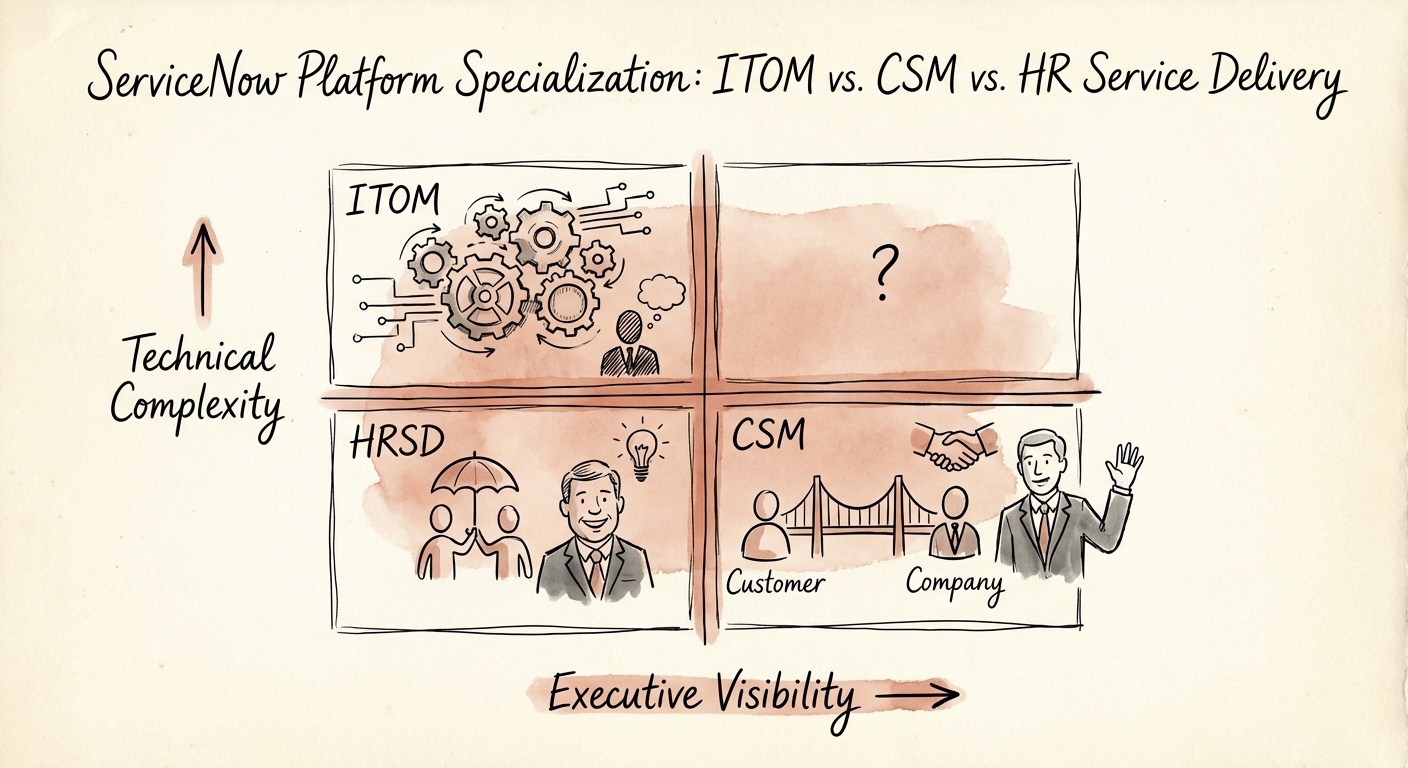
The Diagnostic: ITOM vs. CSM vs. HRSD
To break through the plateau, you must specialize. "We do everything ServiceNow" is not a strategy; it is a confession of a lack of focus. Here is the operator’s diagnostic on the three primary specialization lanes available to you in 2026.
Lane 1: IT Operations Management (ITOM) — The Technical Moat
The Profile: High technical complexity, high barrier to entry, high bill rates.
ITOM is the hardest lane to execute, which makes it the most defensible. With licensing costs hovering around $150-$200 per user (significantly higher than ITSM’s ~$90), ServiceNow is signaling where the value lies. This is not about ticketing; it is about visibility. It involves Discovery, Service Mapping, and Event Management.
- Pros: You are not competing with low-cost generalists. The talent shortage here is acute, allowing you to command premium rates ($250+/hr blended). Sticky retention—once you map their infrastructure, you are the de facto owner of their truth.
- Cons: High risk of project failure. You need real engineers, not just "certified admins."
- Verdict: Choose this if your DNA is engineering-heavy and you want to sell to the CTO/VP of Infrastructure.
Lane 2: Customer Service Management (CSM) — The Revenue Driver
The Profile: High business visibility, direct line to revenue, executive exposure.
CSM is the fastest path to escaping the "IT cost center" conversation. You are helping the client’s CRO and COO solve external customer problems, not internal employee tickets. This shifts your budget source from the shrinking IT OpEx bucket to the growth-oriented Sales/Support bucket.
- Pros: High visibility. Projects often have clearer ROI (e.g., "reduced churn by 10%"). Positions you as a strategic consultant, not just an implementer.
- Cons: You must understand business process re-engineering. If you implement CSM like a helpdesk tool, you will fail.
- Verdict: Choose this if you have strong business analysts and want to pivot your firm toward "Digital Transformation" rather than just "IT Implementation."
Lane 3: HR Service Delivery (HRSD) — The Volume Play
The Profile: Lower technical complexity, high volume, employee experience focus.
HRSD is growing, but it is often a "nice to have" compared to the "must have" nature of ITOM (keeping systems up) or CSM (keeping customers happy). It is a viable niche, but it is becoming crowded.
- Verdict: Only specialize here if you have deep domain expertise in HR processes or partnerships with Workday/SuccessFactors integrators.
The "Elite" Badge vs. The EBITDA Reality
Many founders fall into the trap of chasing ServiceNow’s "Elite Partner" status as a vanity metric. To be Elite, you generally need certifications across five or more product lines. For a $15M firm, this is a bad trade. It forces you to spread your limited talent pool across five disciplines, ensuring you are mediocre at all of them.
Smart Strategy: Be a dominant "Specialist" or "Premier" partner in one high-value lane (ITOM or CSM). A firm with $15M revenue and 25% EBITDA focused solely on ITOM will trade at a significantly higher multiple (10x-12x) than a $20M generalist with 10% EBITDA (5x-6x).
Your 90-Day Pivot Plan
- Audit Your Revenue Mix: Categorize your last 24 months of projects by product line and gross margin. You will likely find that your "special projects" (ITOM/CSM) had 40%+ margins while your standard ITSM work hovered at 25%.
- Fire the "Bad" Revenue: Stop responding to RFPs for generic ITSM staff augmentation. It scares the team, but it frees up capacity for high-value work.
- Rebrand Your Case Studies: Rewrite your website. Stop saying "We implement ServiceNow." Start saying "We Automate Hybrid Cloud Operations" (ITOM) or "We Modernize Customer Support" (CSM).
- Align with the Vendor: ServiceNow’s sales reps are desperate for partners who can actually deliver ITOM and CSM success. They have plenty of partners for ITSM. Be the partner they call when the deal is complex and the stakes are high.
Specialization is terrifying because it feels like shrinking your total addressable market. In reality, it is the only way to expand your wallet share with the customers who actually pay.