
The practical answer
- Short answer
- Generalist Splunk partners trade at 8x EBITDA. AI-specialized firms commanding 'Agentic Observability' trade at 14x. Here is the diagnostic.
- Best fit
- Industry: Enterprise Software / Cybersecurity. Function: Services Strategy
- Operating path
- GTM Execution → Commercial Performance → Performance Improvement
- Key metric
- 14x EBITDA multiple for AI-specialized Splunk partners, driven by high-margin IP and 'Agentic Observability' services.
The Death of the 'Ingest' Arbitrage
For a decade, the Splunk partner business model was delightfully simple: sell more license capacity, deploy more forwarders, and charge for the hours spent parsing gnarly log files into readable dashboards. The bigger the index, the bigger the renewal, and the stickier the service contract. That era ended in March 2024, not just because Cisco acquired Splunk for $28 billion, but because the economics of data gravity shifted overnight.
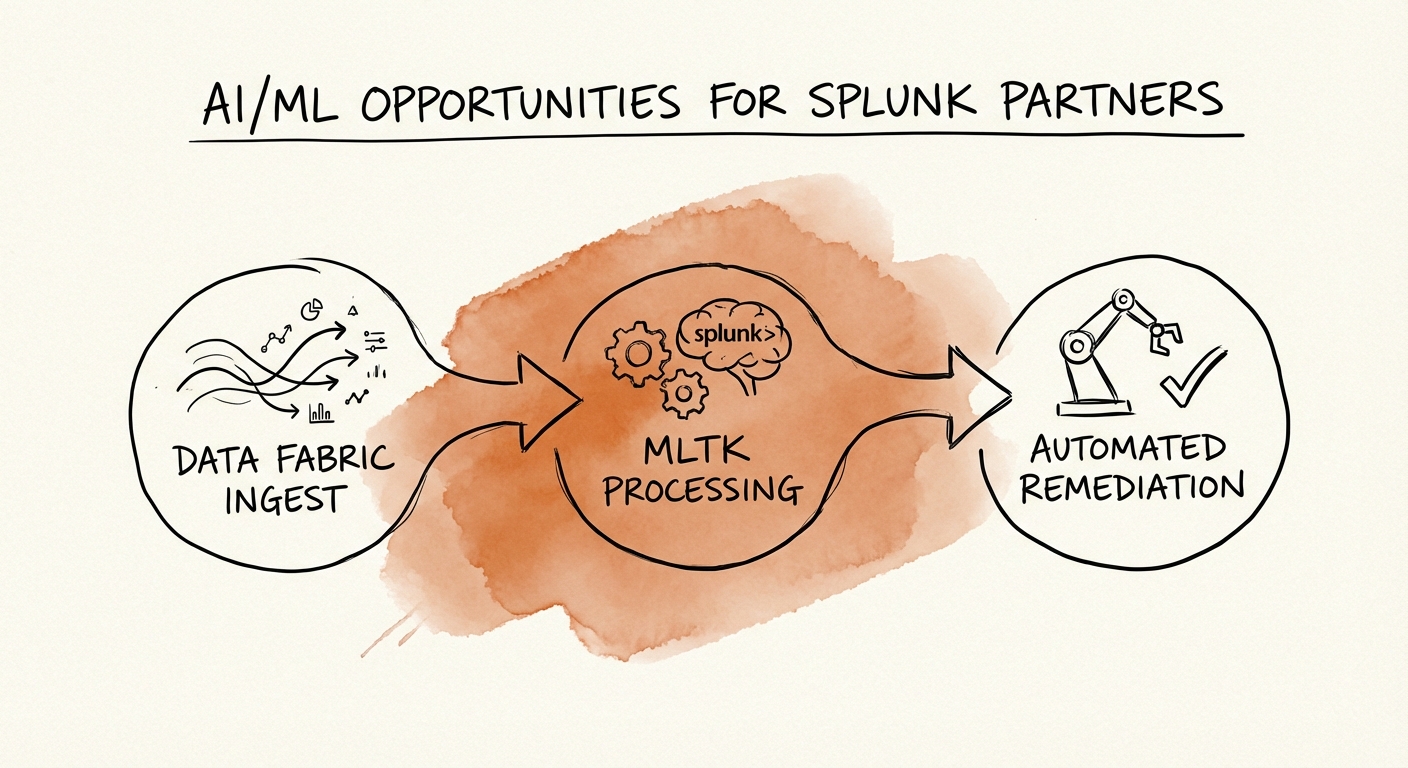
With the introduction of Splunk Data Fabric and federated search, the vendor is actively telling customers not to ingest everything. The new architectural paradigm is to leave low-value data in low-cost storage (like Amazon S3 or Azure Blob) and query it only when needed. For partners whose valuation was tied to "Ingest Growth" or "Admin Hours," this is a catastrophe. It removes the natural expansion lever that drove 110% Net Revenue Retention (NRR) without requiring innovation.
However, for a select group of partners, this shift is the catalyst for a massive valuation jump. The market is bifurcating. On one side are the Generalist Implementers, trading at 6x-8x EBITDA, who are now fighting deflationary pressure on low-level data engineering. On the other side are the AI/ML Specialists, trading at 12x-14x EBITDA. These firms aren't selling "log management"; they are selling Agentic Observability and predictive risk scoring, leveraging the Splunk Machine Learning Toolkit (MLTK) to build intellectual property that Cisco's sales force is desperate to channel.
If you want to be a world-class security company, you have to be a world-class AI company... This unique combination doesn't exist in the market today.
The "AI Premium": From Dashboards to Decisions
Why does an AI-specialized Splunk partner command a 6-turn premium over a generalist? The answer lies in the shift from Descriptive to Prescriptive analytics. Generalists build dashboards that tell a CISO, "You were hacked yesterday." AI Specialists build automated workflows that tell a CISO, "We blocked an anomaly that would have become a breach in 4 hours."
The Valuation Drivers of the 14x Multiple
Private Equity buyers are actively hunting for three specific capabilities that justify this premium:
- Proprietary ML Models: Partners who have pre-built models (using Splunk MLTK) for specific vertical use cases—such as predictive maintenance for manufacturing or fraud detection for regional banks—are valued as software companies rather than service shops.
- Cisco XDR Integration: The "Better Together" story isn't just marketing; it's a technical moat. Partners who can unify Cisco's network telemetry with Splunk's log data using AI-driven correlation are solving a problem that neither tool can solve alone.
- Agentic Observability: The ability to deploy autonomous agents that not only detect issues but trigger remediation scripts without human intervention. This moves the partner from a "Staff Augmentation" vendor (low value) to a "Critical Outcome" partner (high value).
Data from 2025 M&A transactions indicates that while traditional Managed Security Service Providers (MSSPs) are seeing multiple compression due to automation fears, partners with documented AI IP (intellectual property) are seeing multiples expand. Investors are paying for the automation of revenue, not just the recurrence of it.
Execution: Pivoting Your Practice to AI
If your current revenue mix is 80% "Core Implementation" and 20% "Staff Augmentation," your exit value is capped. To break the $20M valuation ceiling, you must restructure your offering around high-value AI services. This does not mean hiring a team of PhD data scientists; it means operationalizing the tools Splunk has already provided.
The 3-Step Transformation Roadmap
- Launch a "Data Fabric Readiness" Assessment: Stop fighting federated search; monetize it. Charge for the strategic consulting required to classify data: what stays in hot storage (Splunk) vs. cold storage (S3). This positions you as a strategic architect, not just a plumber.
- Productize MLTK Use Cases: Don't start from scratch. select 2-3 repeatable use cases—like Service Health Prediction for e-commerce clients—and package them as fixed-price accelerators. Use the Splunk AI Assistant to generate the complex SPL (Search Processing Language) required, lowering the barrier for your delivery team.
- Build the "Cisco Bridge": The biggest untapped opportunity is the Cisco partner ecosystem. Cisco partners understand networking but fear data. Splunk partners understand data but ignore the network. Build a specialized service offering that ingests Cisco firewall logs into Splunk (now incentivized with free ingestion caps) and applies AI threat detection. This makes you an acquisition target for larger Cisco partners looking to buy their way into the Splunk ecosystem.
The window to claim the "AI Specialist" position in the Splunk Partnerverse is open, but it is closing fast as the largest Global Systems Integrators (GSIs) mobilize. The choice is binary: automate your customers' operations with AI, or watch your billable hours get automated away by it.