
The practical answer
- Short answer
- Why Atlassian Partners specialized in Rovo and AI governance trade at 12x EBITDA while generalists stall at 6x. A diagnostic guide for pivoting to AI services.
- Best fit
- Industry: B2B Tech. Function: Strategy
- Operating path
- GTM Execution → Commercial Performance → Performance Improvement
- Key metric
- 12x EBITDA multiple for partners with 'AI Governance' IP vs. 6x for resale generalists.
The 'Feature Toggle' Trap: Why Reselling Rovo Won't Save Your Margins
For most of the last decade, the Atlassian partner playbook was relatively simple: resell the license, implement the instance, and move to the next deal. Cloud migrations (Server to Data Center/Cloud) provided a massive, multi-year tailwind that disguised a fundamental weakness in this model: it was finite. Now, as Atlassian pushes Atlassian Intelligence and Rovo, many partners are making a critical strategic error. They are treating AI as just another SKU to resell or a simple feature to toggle on.
This approach is a valuation killer. With Rovo priced at approximately $20/user/month and basic "Intelligence" features bundled into Premium/Enterprise editions, the margin on pure resale is negligible compared to the complexity of the sale. Worse, clients who simply "turn on" these features often face immediate failure modes—hallucinations based on outdated Confluence pages, security risks from over-permissioned Jira tickets, and user confusion. If your firm is merely facilitating the transaction, you are positioning yourself as a commodity reseller, capping your exit multiple at 5-6x EBITDA.
The partners commanding 12x multiples in 2026 aren't selling AI licenses; they are selling AI Governance. They understand that "turning on" Rovo without a data strategy is negligent. They have pivoted their GTM motion from "License Optimization" to "Intelligence Readiness," using the AI hype cycle to sell high-margin, sticky governance engagements that persist long after the initial implementation.
The goal isn't more information, it's momentum. Data only creates value when it leads to better decisions and outcomes.
The Data Governance Wedge: The $50k Project That Unlocks the $500k Retainer
The single biggest barrier to Atlassian Intelligence adoption isn't technical—it's data hygiene. In a typical enterprise environment, Confluence is a graveyard of deprecated processes, and Jira permissions are a tangled web of legacy access rules. When you deploy an AI agent like Rovo on top of this chaos, it doesn't just fail; it actively surfaces sensitive data to the wrong users. An intern asks Rovo about "salary bands," and because a 2019 HR ticket was widely permissioned, the AI obliges.
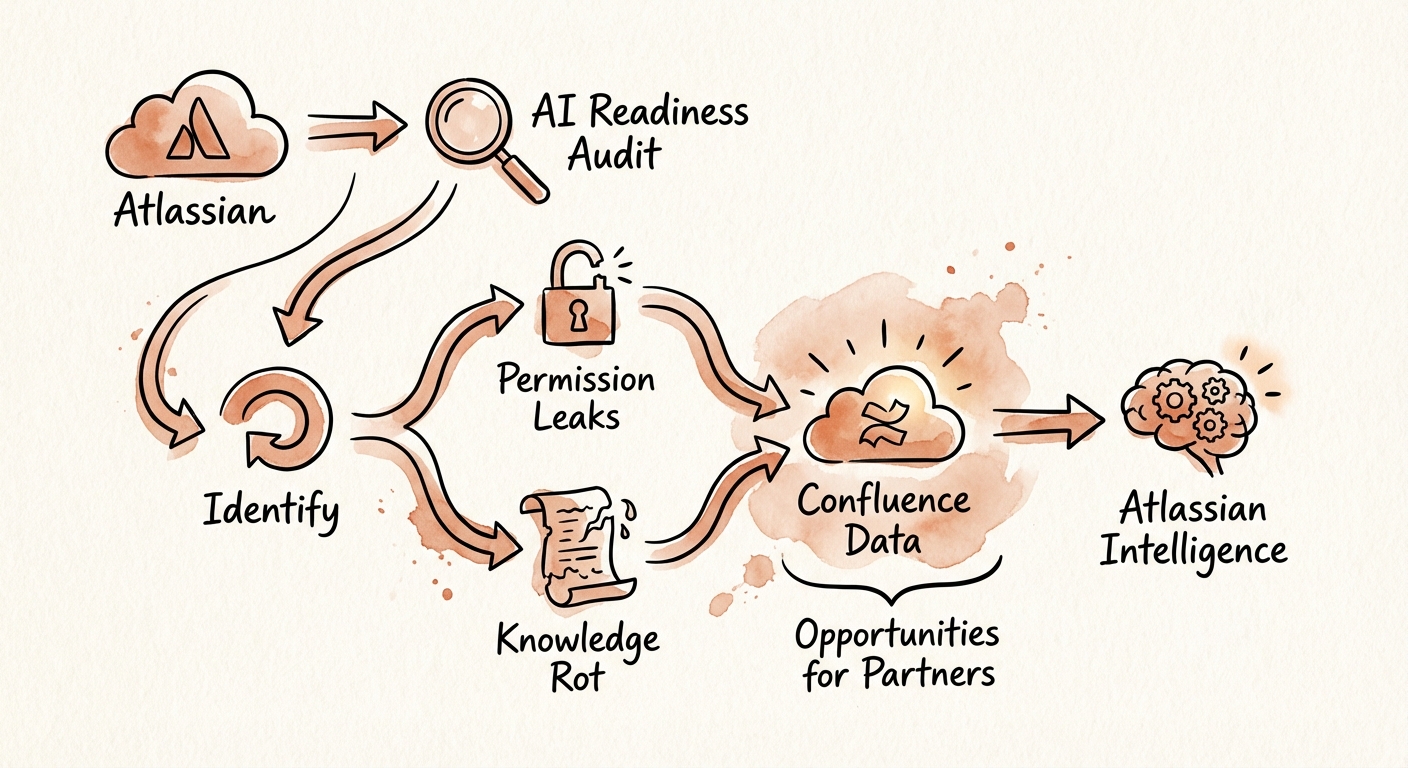
This risk is your greatest revenue opportunity. The "clean core" concept, once the domain of SAP ERP migrations, now applies to the Atlassian stack. Premium partners are packaging "AI Readiness Audits"—diagnostic engagements that scan for:
- Permission Leaks: Identifying Jira projects with 'Any Logged In User' access that contain PII.
- Knowledge Rot: Flagging Confluence pages that haven't been updated in 18 months but are indexed by Rovo.
- Object Schema Chaos: Cleaning up Jira Service Management (JSM) Assets to ensure Virtual Agents reference accurate inventory.
By positioning these audits as a mandatory pre-requisite for AI, you shift the conversation from a commodity rate card to a strategic risk mitigation. More importantly, you anchor the client on the reality that AI is not a "set and forget" tool. It requires a curated knowledge base. This realization is the bridge to a Knowledge Operations (KnowOps) retainer, where your team is paid not just to fix Jira workflows, but to curate the context that powers the client's AI strategy.
From Ticket Deflection to Model Tuning: The New Managed Service
The traditional "Jira Admin" managed service model is dying. Basic user provisioning and project creation are being automated by the very tools you are selling. However, Jira Service Management (JSM) Virtual Agents open a new, higher-value managed service lane: Agent Tuning and Intent Management.
A JSM Virtual Agent is not a static script. It requires continuous observation. Which intents are being misunderstood? Where is the hand-off to human agents failing? Which knowledge base articles are generating "thumbs down" ratings from users? Moving from reactive support to proactive tuning changes the economics of your managed service.
Partners trading at premium multiples are structuring "AI Performance Retainers" that include:
- Intent Library Management: Building and maintaining custom Rovo Agents for specific departments (e.g., Legal review bots, HR onboarding assistants).
- Deflection Analytics: Reporting on the hard cost savings of deflected tickets and promising to increase that % quarter-over-quarter.
- Conversation Audits: Reviewing AI logs to identify gaps in the knowledge base.
This transforms your revenue quality. You are no longer selling "hours on a bench" (which PE firms discount); you are selling outcome-based efficiency (which PE firms prize). The partners who win in 2026 will be the ones who can prove that their services didn't just install the AI, but actually trained it to generate ROI.