
The practical answer
- Short answer
- A diagnostic guide for ServiceNow partners pivoting from project revenue to managed services. Learn why recurring revenue boosts valuations from 0.8x to 2.5x.
- Best fit
- Industry: IT Services / SaaS Ecosystem. Function: Revenue Operations
- Operating path
- Revenue Architecture → Commercial Performance → Office of the CFO
- Key metric
- 0.8x Average Valuation Multiple for Project-Based ServiceNow Partners (2025)
The Project Revenue Treadmill
You have built a successful ServiceNow practice. You have 50 certifications, a decent CSAT score, and you just hit $15M in revenue. But every January 1st, you wake up in a cold sweat. Why? Because your revenue just reset to zero.
This is the Project Revenue Treadmill. In the early days, landing a $500k ITSM implementation felt like a victory. But as you scale, those projects become a liability. They are lumpy, unpredictable, and reliant on "heroics" to deliver. Worst of all, Private Equity buyers hate them.
In 2025, the valuation gap between "Project Shops" and "Managed Services Providers" (MSPs) has widened into a canyon. Pure project-based ServiceNow partners are trading at 0.5x to 0.8x revenue. Why? Because that revenue is considered "low quality." It requires constant sales effort to replace. By contrast, partners with >60% recurring managed services revenue are commanding 1.5x to 2.5x revenue multiples (often 10x-12x EBITDA). Same platform, same talent, radically different enterprise value.
The "Staff Aug" Trap
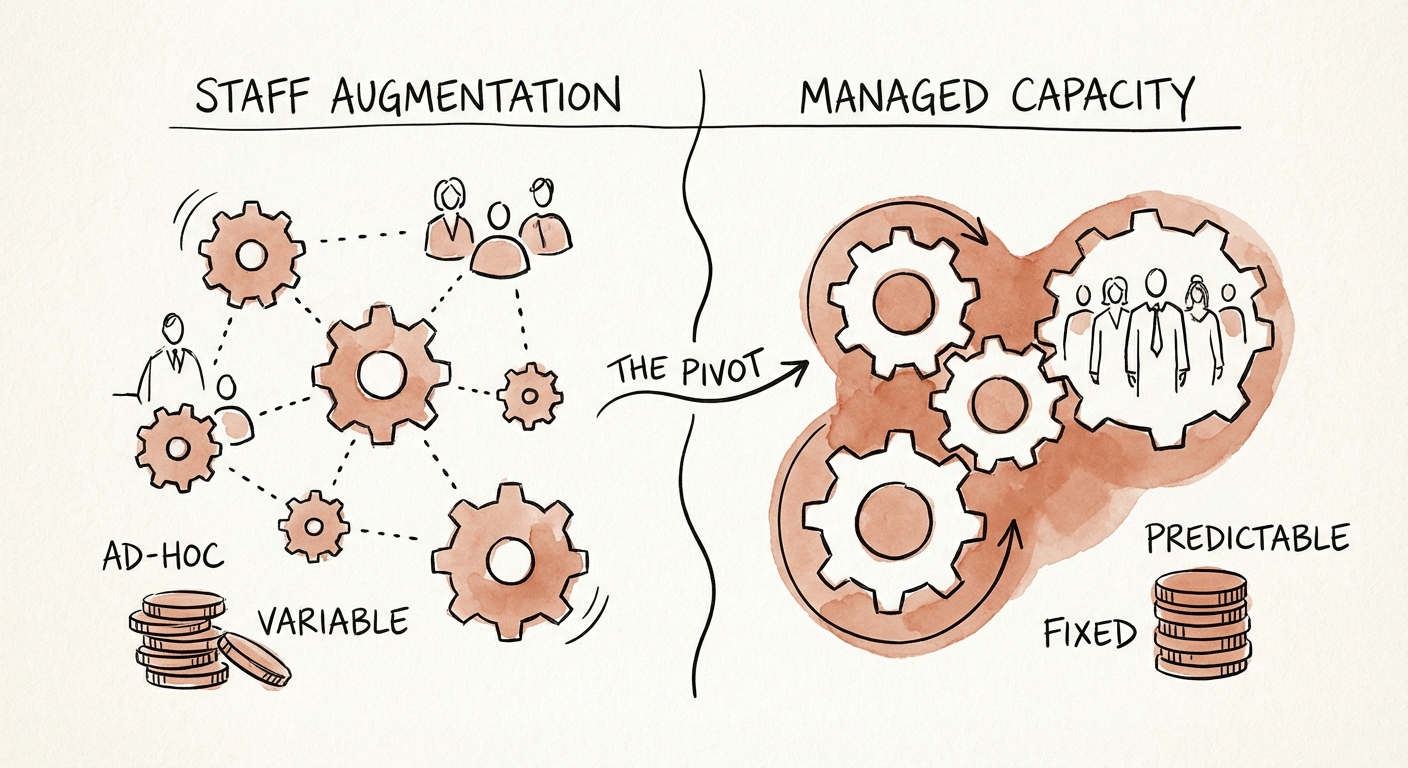
Many partners think they have a managed service, but what they actually have is "Staff Augmentation in disguise." If you are selling blocks of hours that roll over, or if your client directs the tasks day-to-day, you are not an MSP. You are a body shop. And in a market moving toward AI-driven "Agentic" workflows, body shops are the first to get squeezed.
If your revenue resets to zero on January 1st, you don't own a business; you own a job with overhead. The pivot to Managed Services isn't just about stability—it's about survival in an AI-first ecosystem.
The Math: Why Recurring Revenue Wins
Let’s look at the P&L of two hypothetical ServiceNow partners, both doing $20M in revenue.
Partner A (Project-Led) generates $18M in implementation projects and $2M in ad-hoc support. Their gross margins are 35% because they are constantly hiring expensive architects to bench for the "next big deal." Their churn is effectively 100%—every project ends. A PE firm values them at 0.7x Revenue ($14M).
Partner B (MSP-Led) generates $8M in projects (to feed the machine) and $12M in recurring managed services contracts (3-year terms). Their gross margins are 55% because they use a leveraged delivery model (offshore/nearshore mix) and automation. Their Net Revenue Retention (NRR) is 110%. A PE firm values them at 2.0x Revenue ($40M).
Partner B is worth nearly 3x more than Partner A, despite having the same top-line revenue. This is the power of Revenue Architecture.
The 2026 ServiceNow Shift
ServiceNow’s 2026 roadmap is aggressively pushing toward AI and "outcomes." The new Partner Program incentives favor those who deliver long-term value, not just go-live parties. With the rise of AI Agents, the old model of "billable hours" is dying. Clients won't pay for hours when an AI Agent can resolve the ticket in seconds. They will pay for the outcome (uptime, resolution speed, platform health). If your business model is tied to human hours, you are fighting gravity.
The Playbook: Pivoting to Managed Capacity
So, how do you pivot without killing your cash flow? You stop selling "support" and start selling "Platform Assurance."
1. Productize Your Service Catalog
Stop asking the client "what do you need?" and start telling them "here is what good looks like." Package your services into Tiers (Silver, Gold, Platinum) that include specific outcomes: Quarterly Upgrades, Health Scans, CI/CD Pipeline Management, and fixed monthly capacity for enhancements.
2. The "Managed Capacity" Model
Move away from "hours" and toward "points" or "capacity blocks." This decouples revenue from time. If you become more efficient using ServiceNow’s GenAI features, you keep the margin, not the client. This is the only way to scale margins past 50%.
3. Hunt in Your Own Base
The easiest recurring revenue is already in your CRM. Look at every implementation you delivered in the last 24 months. Go back to them with a "Platform Health Check" (a paid audit). Use the findings to sell a 12-month remediation and management contract. We see a 60% conversion rate on these audits when positioned correctly.
You don't need to be a $100M Global Elite partner to have a valuable business. You just need to stop renting your revenue and start owning it.