
The practical answer
- Short answer
- Why NetSuite implementation firms sell for 0.7x revenue and managed-services firms sell for 3x — and the attach-rate, tiering, and margin math to close the gap.
- Best fit
- Industry: IT Services. Function: Revenue Operations
- Operating path
- Revenue Architecture → Commercial Performance → Office of the CFO
- Key metric
- 1.6x Revenue Multiple for Managed Services Firms (vs 0.7x for Project Firms)
It's January 2nd and your NetSuite backlog is zero again
You closed a $480K NetSuite implementation in Q3. Two ERP consultants, a SuiteScript developer, six months of discovery-to-go-live, a brutal data migration off QuickBooks, and a UAT phase that ran two weeks long because the client's controller kept finding edge cases in the revenue recognition module. You delivered it. On margin, even. And then the project ended, the team rolled off, and on January 2nd you woke up to a pipeline of nothing — hunting the next $480K from a standing start.
That pattern is exactly why a buyer will value your firm at roughly 0.7x revenue and around 6x EBITDA. Project-based IT services firms cluster there because the diligence question that matters most — "what is contracted twelve months from now?" — gets answered with a shrug (Aventis Advisors, 2025 IT Services Valuation Multiples). Every dollar of your revenue is treated as one-time, because to a buyer it functionally is. Lose the rep who sources your NetSuite referrals, or watch a SuiteCloud partner-channel relationship cool, and the backlog doesn't soften — it stops.
The firm doing the same NetSuite work down the hall, but earning it through recurring managed services, gets read completely differently. Recurring-revenue services firms in the 2025 data traded at 1.6x to 3x revenue and into the 10x–12x EBITDA range. Same SuiteScript, same saved searches, same go-lives — different valuation arithmetic, because renewal is the default and churn is the exception. And the underlying demand is there: the NetSuite integration and services market is expanding through 2026 as the install base keeps growing (Global Growth Insights, NetSuite Integration Market 2025-2026).
Here's the trap most NetSuite partners walk into when they try to capture that premium: they hear "managed services" and build a help desk. They stand up a ticket queue, sell blocks of hours, and wait for a saved-search to break or a sandbox refresh to go sideways. That's not recurring revenue. That's break-fix with a subscription label — and it's a race to the bottom that NetSuite's own twice-yearly release cycle will happily accelerate.
You don't triple your firm's value by doubling implementation revenue. You triple it by changing the verb buyers use to describe your cash flow — from "won" to "renewed."
The handoff that decides everything: who owns the client at go-live
The break-fix model fails for a structural reason specific to NetSuite. The platform ships two major releases a year, and each one quietly deprecates a feature, changes a default, or breaks a customization someone wrote in 2022. If your client only calls you when something snaps, you become the plumber they resent — and your gross margin will fight to stay above 30%, because reactive work is unpredictable to staff and impossible to schedule efficiently.
The NetSuite firms capturing the high multiples don't sell tickets. They sell the thing a mid-market company genuinely cannot hire for: a part-time system owner who knows where the customizations are buried and what the next release will touch before it lands. Call it managed optimization. The deliverable isn't "we fixed your bug" — it's "we adopted the SuiteAnalytics workbook you paid for but never used, and we pre-tested your scripts against the 2026.1 release in your sandbox before it hit production."
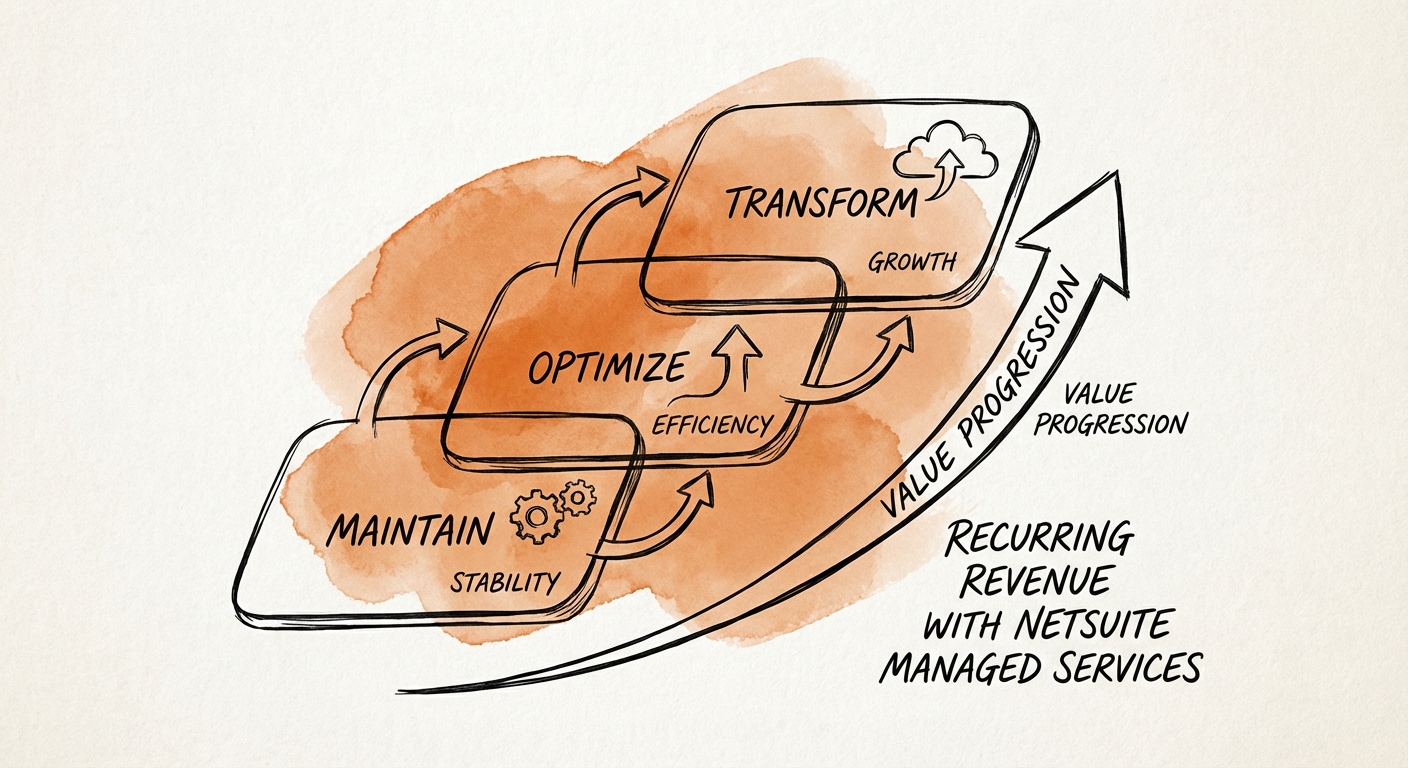
The packaging that holds up in renewal conversations is a three-tier structure where each tier maps to a different NetSuite reality:
- Maintain. Release-readiness testing against each NetSuite update, critical patch monitoring, user provisioning, and break-fix triage. This is the floor — the thing that keeps the lights on and the scripts from breaking twice a year.
- Optimize. A monthly working session with the client's controller or ops lead, a quarterly roadmap review, and a committed block of hours spent on adoption — turning on the modules and dashboards they bought but never operationalized. Not bug fixes. Capability they're already licensed for and not using.
- Transform. Standing advisory, semi-annual business process reviews, and net-new module rollouts as they grow into them — advanced revenue management, a second subsidiary in OneWorld, a warehouse management add-on. This is where you sit close enough to the client's finance leadership that the next implementation never goes to bid.
The conversation shifts from "how many tickets did you close last month?" — a question that always trends toward "fewer, so why am I paying you?" — to "which licensed capabilities did we put into production this quarter?" One question erodes the contract. The other renews it.
Two numbers a buyer will pull from your data room — get them right now
If you're serious about this pivot, govern the managed-services practice with the same discipline you apply to a fixed-fee implementation. When a buyer runs diligence, two numbers tell them whether you have a real recurring business or a help desk wearing a contract.
Gross margin: hold the 50% floor
Your managed-services practice should run a gross margin of 50% to 60%. Drop below 40% and you're either over-servicing — eating scope creep because saying no feels unfriendly — or you've priced the tiers too low to staff them profitably (GetThread, MSP Profit Margins 101). NetSuite's own professional-services arm historically ran near zero margin because the goal was driving software consumption, not service profit. You don't have that subsidy. Your margin comes from disciplined time tracking and a bright line in the contract: a new module implementation, a subsidiary rollout, a custom SuiteScript build is a project with its own statement of work — not something you absorb into the monthly retainer because it arrived as a "quick question." The firms that bleed margin are the ones that let SOW work leak through the ticket queue.
Attach rate: 40%, and you set it at the sales order
The single biggest leak is the handoff from implementation to recurring. Most firms land a 15–20% attach rate — one in five go-lives converts to a recurring contract — because they wait until after go-live, when the client is exhausted and the budget conversation feels like an upsell. Firms that hit 40%+ never have that conversation. They bake the first year of managed services into the original sales order as a default line item, structured so the client opts out, not in. By the time go-live arrives, the recurring relationship is already signed.
The compounding is what makes the multiple move. Say you do $10M in NetSuite implementation revenue a year and attach 40% of it to recurring contracts priced at 20% of project value — that's $800K of new annual recurring revenue layered on every year. Five years of that, net of normal churn, builds a multimillion-dollar recurring base. And recurring revenue is the line a buyer marks up to 3x while marking your implementation backlog at 0.7x (Aventis Advisors, 2025).
You can start Monday with one move: pull your last twenty implementation contracts and calculate your real attach rate. If it's under 25%, the fix isn't a better sales pitch — it's redrafting the sales order so the renewal is the default and walking away from it requires a signature.