
The practical answer
- Short answer
- Stop the implementation hamster wheel. A guide for HubSpot partners to pivot from project revenue to high-margin RevOps retainers. Benchmarks, pricing, and valuation impact.
- Best fit
- Industry: Professional Services. Function: Revenue Operations
- Operating path
- Revenue Architecture → Commercial Performance → Office of the CFO
- Key metric
- 12x Valuation multiple for elite HubSpot partners with >60% recurring revenue, vs 4x for project shops.
The "Implementation Hamster Wheel" Is Killing Your Exit
If you are a HubSpot Solutions Partner running a project-based shop, you are building a job, not a company. You land a $40,000 CRM implementation, your team sprints for 90 days, you celebrate the launch, and then… silence. The revenue drops to zero. You have to hunt for the next kill just to keep the lights on.
This is the "Implementation Hamster Wheel." In 2026, it is also a valuation killer. Private Equity firms and strategic acquirers value project-heavy services firms at 4x to 6x EBITDA (if you’re lucky). Firms with 60%+ recurring revenue trade at 10x to 12x EBITDA. That is a double-digit million-dollar difference for the exact same top-line revenue.
We see this in every agency valuation analysis we run. The market has bifurcated. On one side, you have "marketing agencies" selling content retainers that are being decimated by Generative AI. Clients don't pay $5,000/month for blog posts anymore; ChatGPT does that for free. On the other side, you have "Revenue Operations" consultancies managing the technical infrastructure of the business. These retainers aren't just sticky; they are critical.
The 2026 Partner Program Reality Check
HubSpot’s partner program changes in late 2025 reinforced this shift. By prioritizing "Sourced Points" (new business) while keeping high "Managed Points" (retention) thresholds for Elite status (requiring 85% retention), HubSpot is signaling that you must be both a hunter and a farmer. But you cannot farm with project teams. You need a dedicated Managed Services mechanism.
You don't get a 10x multiple for being good at projects. You get it for proving you can keep the revenue without the founder having to resell it every January.
The Pivot: From "Inbound Marketing" to "RevOps as a Service" (ROaaS)
The days of the generic "Inbound Retainer" are numbered. The new gold standard is Revenue Operations as a Service (ROaaS). This isn't about writing emails; it's about owning the "Operating System" of your client's revenue.
Why does this work? Because hiring a full-time RevOps Director costs $160,000+ (plus benefits). Most Series B companies cannot afford that, yet their HubSpot portal is a mess of dirty data, broken workflows, and disconnected tools. They need the outcome (clean data, accurate forecasting) without the headcount.
Structuring the Offering
Stop charging for "hours." Charge for infrastructure availability. Here is the pricing architecture that scales:
- Tier 1: The Guardian ($3k - $5k/mo). Focus: Maintenance & Hygiene. Services: Weekly data deduplication, workflow error monitoring, user management, basic reporting. This is your "insurance policy" retainer.
- Tier 2: The Architect ($6k - $10k/mo). Focus: Optimization. Services: All of Tier 1 + quarterly roadmap planning, new pipeline build-outs, attribution modeling, and sales enablement tooling.
- Tier 3: The Fractional CRO ($12k+/mo). Focus: Strategy. Services: All of Tier 2 + board reporting, GTM strategy, commission modeling, and forecast accuracy ownership.
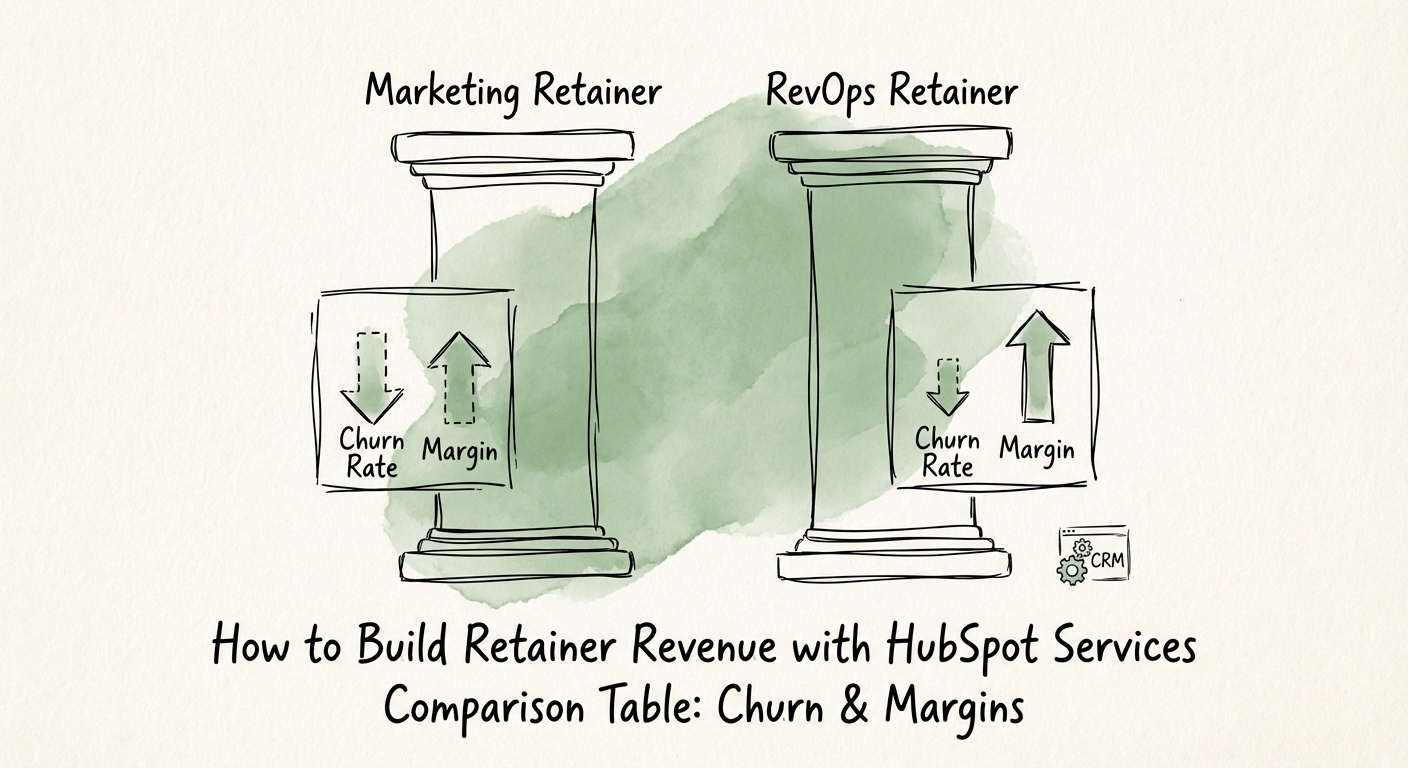
By shifting to ROaaS, you move from being a "vendor" (easy to cut) to "infrastructure" (impossible to rip out). Our benchmarks show that ROaaS retainers have a <10% annual churn rate compared to ~30% for marketing retainers.
Operationalizing the Shift: The "75% Rule"
The biggest failure point in building recurring revenue is the handoff. Most partners wait until the implementation project is 100% complete to pitch the retainer. By then, the client is exhausted, the budget is spent, and they think, "We can take it from here."
You must implement the 75% Rule. When the implementation project is 75% complete (typically user acceptance testing phase), you introduce the Managed Services contract. You frame it not as an "upsell," but as the "Go-Live Guarantee."
The Metric That Matters: Utilization vs. Availability
To make this profitable, you must break the utilization rate trap. Project teams run on high utilization (75-80%). Managed Services teams must run lower (60-65%) to ensure capacity for urgent requests. If you run your retainer team at 90% utilization, you will fail SLAs, anger clients, and churn revenue.
Measure your retainer health using the Recurring Revenue Ratio. If less than 30% of your revenue covers your OpEx (excluding COGS), you are in the danger zone. Your goal is to cover 100% of your fixed OpEx with recurring revenue. That is the point where you stop sleeping with one eye open and start building a sellable asset.