
The practical answer
- Short answer
- For Adobe Partners, the 'lift and shift' era is over. Learn how to pivot from project revenue to high-margin Managed Services and unlock a 12x valuation.
- Best fit
- Industry: Professional Services. Function: Revenue Operations
- Operating path
- Revenue Architecture → Commercial Performance → Office of the CFO
- Key metric
- 60% of Adobe Experience Cloud features go unused post-implementation, creating a massive 'Value Realization' MSP opportunity.
The 'Project Trap' in the Adobe Ecosystem
For the last decade, being an Adobe Solution Partner was a license to print money. The implementations were massive, the licenses were expensive, and the complexity of on-premise Adobe Experience Manager (AEM) required a small army of architects just to keep the lights on.
But the ground has shifted. With Adobe’s aggressive push to AEM as a Cloud Service and the consolidation of the Partner Program in 2026, the 'infrastructure support' retainer is dead. Adobe now automates the patching, upgrades, and uptime that partners used to charge $20k/month for.
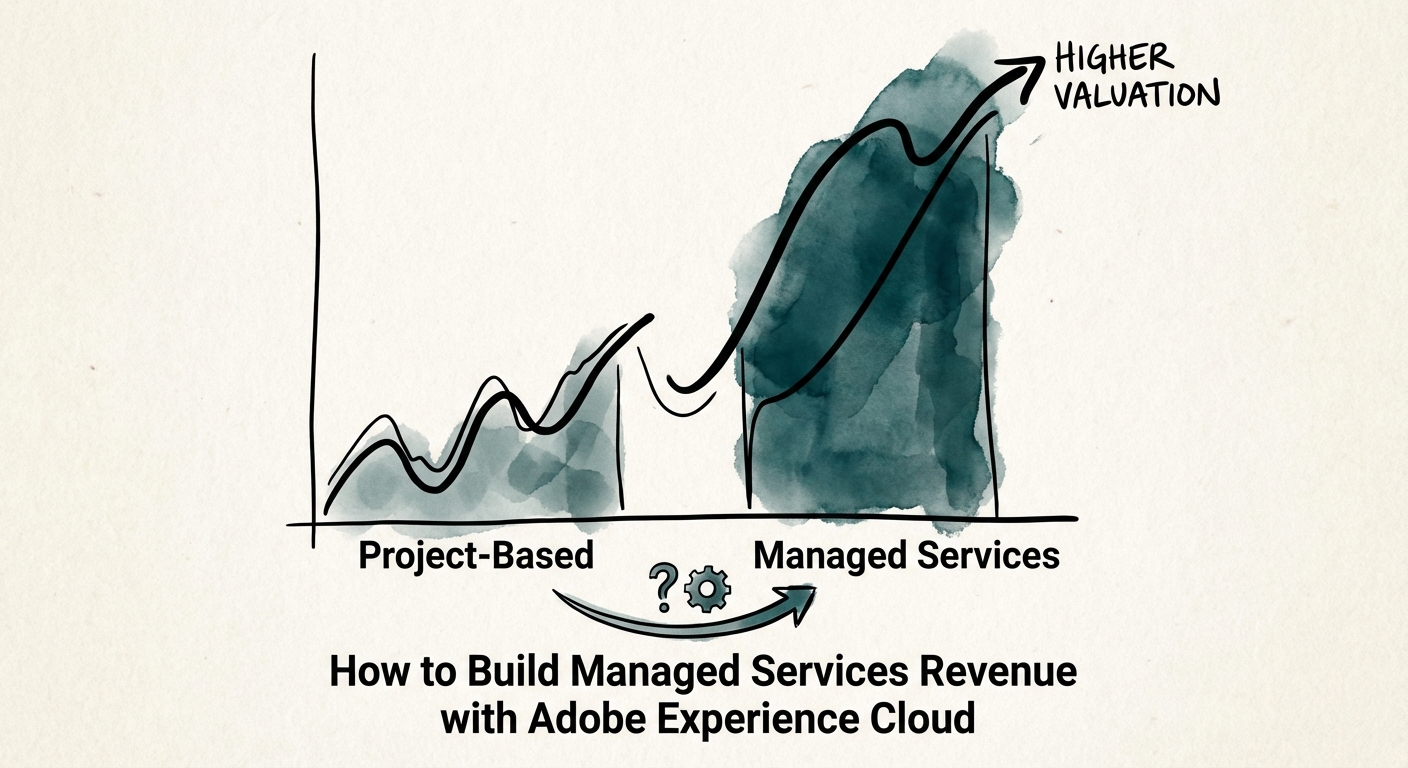
This leaves traditional partners in the Project Trap. You strain the team to win a $500k implementation, burn out your team delivering it, and then watch the revenue drop to zero the day after go-live. Your revenue chart looks like a sawtooth, and your valuation suffers for it. Private Equity buyers discount project-heavy Adobe shops to 5x-7x EBITDA because every year, you start at zero.
The 'Shelfware' Reality
The opportunity for high-margin recurring revenue isn't in maintaining the software anymore; it’s in using it. Our data shows that 60% of Adobe Experience Cloud features go unused within 12 months of implementation. Clients buy the Ferrari (AEM + Marketo + Commerce) but drive it like a Honda Civic because they lack the internal maturity to execute 'Personalization at Scale' or 'Customer Journey Analytics.'
The partners who win in 2026 won't be the ones who can implement AEM the fastest. It will be the ones who can prove they drove $10M in incremental revenue for their clients through managed personalization.
The New MSP Model: From 'Uptime' to 'Velocity'
To break the valuation ceiling, you must pivot your Managed Services definition from IT Support to MarTech Operations. You aren't selling 'hours' or 'tickets'; you are selling outcome velocity.
Successful Adobe MSPs are repackaging their services into three specific high-value tiers that buyers (CMOs, not CIOs) actually value:
- Campaign Operations (The 'Hands' Tier): Instead of 'support,' you offer 'Capacity.' "We will build, QA, and launch 4 campaigns per month in Marketo and AEM."
- Optimization & Personalization (The 'Brain' Tier): This is where margins jump. You run the A/B testing, the Adobe Target personalization rules, and the Analytics reporting. "We will improve conversion rates by 0.5% per quarter."
- Data Activation (The 'Scale' Tier): Leveraging Adobe Real-Time CDP and Journey Optimizer. This is the stickiest revenue because you become the custodian of their customer data strategy.
Pricing for 60% Margins
The mistake most partners make is pricing MSP as a 'bucket of hours.' This caps your gross margin at 35-40%. The winning model is Output-Based Pricing. If you charge $15,000/month for '4 Campaigns,' and your team automates the workflow to deliver them in 20 hours, your effective rate skyrockets to $750/hour. This is how elite partners achieve 60%+ Gross Margins on managed services.
Structuring the Team for the Exit
Investors scrutinize your 'Revenue Quality' during due diligence. They are looking for a specific ratio: 50% Recurring Revenue. To get there without destroying your bottom line, you need a split-team model.
The 'Build' vs. 'Run' Split
Do not let your implementation team handle managed services tickets. It destroys utilization rates and frustrates clients. You need a dedicated 'Run' team.
- The Implementation Team: High-cost, onshore/nearshore Architects. They chase the 'new logos' and complex builds. Target Utilization: 75%.
- The Managed Services Team: Process-driven, offshore-heavy, documented workflows. They execute the recurring campaigns and optimization loops. Target Gross Margin: 65%.
When you present this structure to a PE buyer, you aren't just selling a services firm. You are selling a Platform for Revenue Growth. You trade at the 'MSP Premium' (10x-12x EBITDA) rather than the 'Body Shop Discount' (4x-6x).
For a deeper dive into valuation dynamics, read our analysis on MSP vs. Professional Services Valuations and staffing your Customer Success function correctly.