
The practical answer
- Short answer
- Zendesk partners are stuck in a 'rapid deployment' trap. Here is the diagnostic guide to pivoting from project-based revenue to high-margin Managed CX services.
- Best fit
- Industry: Customer Experience (CX) Technology. Function: Revenue Operations
- Operating path
- Revenue Architecture → Commercial Performance → Office of the CFO
- Key metric
- 45% Target Gross Margin for Managed Services. If you are below 40%, you are doing 'staff augmentation,' not managed services.
The 'Rapid Deployment' Trap
Zendesk’s greatest selling point—its usability—is the single biggest threat to your professional services valuation. Unlike Salesforce or ServiceNow, where implementation projects can stretch for 6 to 18 months, 90% of Zendesk deployments are completed in under eight weeks. For the customer, this is speed-to-value. For a services firm, this is a customer acquisition treadmill.
If your revenue model relies on implementation fees, you must replace your entire customer base every two months just to maintain flat revenue. This creates a "hunter" culture that burns out sales teams and prevents the accumulation of enterprise value. In the current M&A market, "project-heavy" shops are trading at 4x to 6x EBITDA, while firms with >50% recurring managed services revenue command 8x to 12x EBITDA.
The Margin Reality
The trap is compounded by margin compression. Because Zendesk is perceived as "low code," buyers resist six-figure implementation fees. To break this cycle, partners must stop selling "setup" and start selling "intelligence." The shift is from a linear "Implement & Leave" model to a circular "CXaaS" (Customer Experience as a Service) model, where the initial implementation is essentially a loss leader for a multi-year optimization contract.
Zendesk is easy to implement. That’s great for the customer, but it’s a serious risk for partners who rely on 'lift and shift' project fees. The money isn't in the setup; it's in the intelligence.
The 'CX Intelligence' Retainer (What to Sell)
The most common mistake Zendesk partners make when pivoting to managed services is selling "Support"—hours on a block for break/fix work. This is a commodity race to the bottom against offshore BPOs. High-value managed services are built on optimization and governance, not ticket resolution.
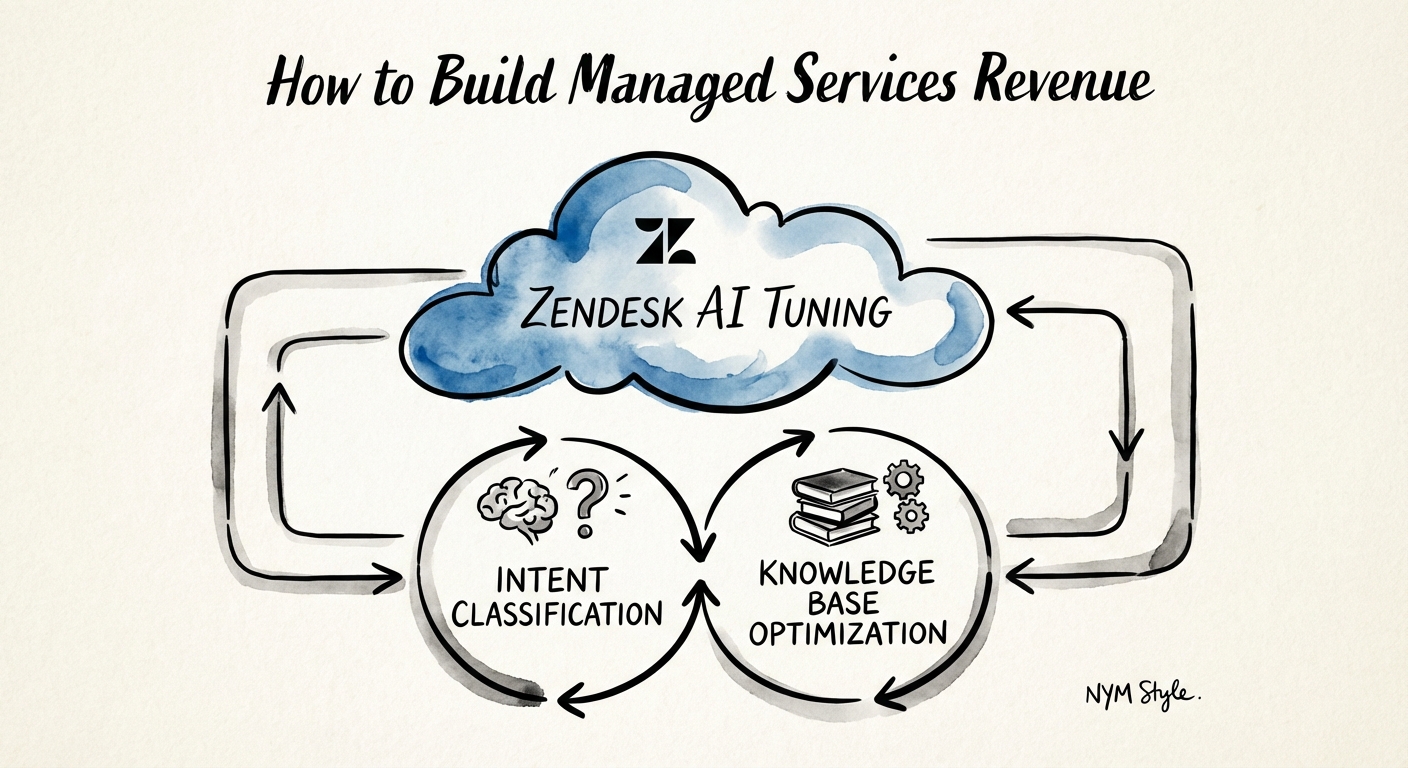
With the release of Zendesk Advanced AI (priced at ~$50/agent/month), the opportunity for partners lies in AI Tuning and Intent Management. AI agents are not "set and forget." They require continuous calibration of intent models, sentiment analysis thresholds, and knowledge base curation. This is your new recurring revenue SKU.
Structuring the Offering
A defensible Managed CX retainer should include three specific deliverables that justify a $5k-$15k monthly fee:
- Intent Model Governance: Monthly review of unmatched queries and tuning of AI intent classification to improve deflection rates.
- Workflow Optimization: Quarterly audits of routing logic and macro usage to reduce agent handling time (AHT).
- Integration Maintenance: Managing the "Sunshine" data layer and connections to CRMs (Salesforce/HubSpot) as API versions change.
By positioning yourself as the guardian of their Deflection Rate and CSAT scores, rather than just their "admin," you move from a vendor to a strategic partner.
The Valuation Arbitrage
The financial impact of this pivot is disproportionate to the revenue change. A Zendesk partner with $5M in revenue composed of 80% projects and 20% resale is likely valued at ~$2M-$3M by private equity buyers. That same firm with $5M in revenue composed of 40% projects and 60% managed services contracts is a $10M+ asset.
Private equity firms are actively consolidating the CX partner ecosystem, but they are specifically filtering for revenue quality. They are looking for "stickiness." A project customer churns 100% of the time (by definition, when the project ends). A managed services customer with a 95% Gross Retention Rate is an annuity stream.
The 2026 Pivot
To execute this transition, you must audit your current revenue mix. If your Managed Services Revenue is under 15% of total revenue, you are in the "Danger Zone" for valuation. The goal is to cross the 30% threshold within 12 months. This requires changing sales compensation to penalize "project-only" deals and incentivize attached retainers (e.g., paying 2x commission on the first year of MRR).