
The practical answer
- Short answer
- Snowflake bill shock kills consulting relationships. Here's how to turn credit consumption into recurring managed-services revenue your buyer values at a real multiple.
- Best fit
- Industry: Data & Analytics. Function: Revenue Operations
- Operating path
- Revenue Architecture → Commercial Performance → Office of the CFO
- Key metric
- 11.2x Median EBITDA multiple for MSPs >$5M EBITDA (vs 6x for Consulting)
The 14th-of-the-month phone call
Here's a scene every Snowflake partner eventually lives through. You migrated a client off their old warehouse, the dashboards are humming, everyone shook hands at go-live. Then mid-month their finance lead opens the Snowflake console, sees the credit burn pacing toward triple what they budgeted, and calls you in a panic. You didn't write the runaway query. You don't control their auto-resume settings. But you're the name attached to "Snowflake," so you own the blame.
That phone call is the whole problem with project-only work on a consumption platform. You handed them a metered system and walked away. Snowflake bills by the credit, every warehouse left running idle and every un-clustered table scan is real money leaving their account, and nobody is watching the meter. So the relationship that started as a win curdles into a grievance. They don't renew, they don't refer, and they tell the next prospect that "the Snowflake thing got expensive."
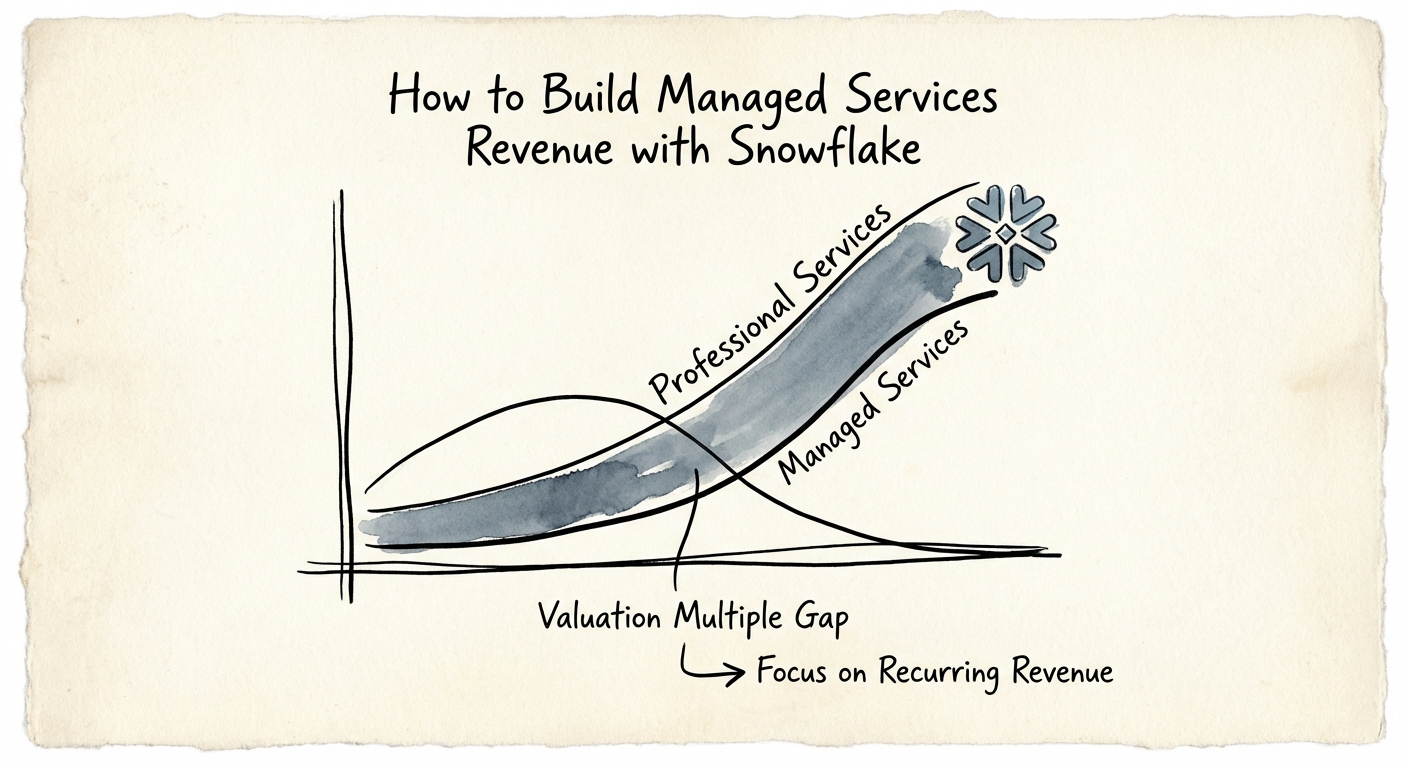
This is also why the market values your firm the way it does. Buyers treat one-off implementation revenue as a hunt: every quarter you start at zero and have to make another kill. Recurring managed-services revenue reads as farming: it compounds, it's predictable, it survives you. The valuation gap between those two stories is enormous, and on a consumption platform the bridge between them is sitting right there in the billing data nobody is monitoring (Aventis Advisors, 2025; Forbes Technology Council, 2025).
In a consumption business, the moment you stop watching the meter is the moment you become the vendor your client blames for their own bill. Managed services is just getting paid to keep watching.
Sell the meter, not the hours
The instinct is to offer a "support retainer," a bucket of hours clients can draw down when something breaks. Don't. A bucket of hours is just consulting with a subscription invoice, and any sophisticated buyer will price it as such. The thing you actually own on Snowflake that nobody else does is the consumption curve, so sell management of that.
The wedge is waste. Industry analysis puts roughly 32% of cloud spend in the bin, lost to idle compute, oversized warehouses, and queries that scan ten times the data they need. Michelin's engineering team published the proof case: with fine-grained usage analysis and active monitoring, they drove a 65% reduction in inefficient Snowflake queries (Michelin Engineering, 2025). That reframes your entire pitch. You're not "available when things break." You're the service that pays for itself out of the client's own bill.
Concretely, productize it in layers a buyer can underwrite. A light tier is pure visibility: automated alerts on credit pacing, failed tasks, and security anomalies, plus a weekly read on where the credits went. An active tier earns its keep: you right-size warehouses, set auto-suspend aggressively, re-cluster the tables that are quietly costing a fortune, and rewrite the worst offenders, holding their monthly credit consumption inside a band you commit to in writing. The deep tier is the platform itself: you run the pipelines, own role-based access governance, and keep the whole thing healthy through staff turnover on their side. That top tier is the revenue that doesn't notice when their VP of Data quits. The discipline that makes any of it work is the same one explored in the managed-services valuation premium: stop billing for your presence and start billing for an outcome the client can measure on their invoice.
What makes it sticky in 2026: the pipelines they can't turn off
A client can always defer a migration. They can postpone the next data-mart build. What they cannot do is switch off the Cortex feature scoring their leads or the Snowpark model feeding a live product, and most mid-market teams do not have the internal engineering depth to babysit AI pipelines on Snowflake themselves. That's your moat. The moment you manage infrastructure that's running in production every minute, you've stopped being a vendor they evaluate annually and become a thing they're afraid to unplug. Switching costs go up, churn goes down, and the revenue stops being optional.
The only number a buyer will care about
Bookings are vanity here. The metric that determines whether you're building an asset or a treadmill is net revenue retention, what your existing managed-services clients are worth this year versus last, after churn and after expansion. If they're moving up tiers and adding data sources, NRR climbs past 110% and the business compounds without new logos. If you're under 100%, you're leaking, and no amount of new sales hides it from a diligence team.
One operational caution that sinks more of these pivots than any pricing mistake: do not stay the hero. If you're the only person who can resolve a P1 at 2 a.m., you haven't built a company, you've built a job with extra steps, and a buyer will discount it accordingly. Write the runbooks. Codify how a credit-spike alert gets triaged, how a warehouse gets resized, how access gets granted and revoked, the same way you'd document any recurring-revenue transition. The Snowflake practice that survives your vacation is the one worth a real multiple. The one that lives in your calendar is worth your hourly rate, and not a dollar more.