
The practical answer
- Short answer
- Your client bought a 3-year DBU commit and can't burn it. That's your recurring-revenue opening. How Databricks partners build a managed practice worth a premium multiple.
- Best fit
- Industry: Data & AI. Function: Revenue Operations
- Operating path
- Revenue Architecture → Commercial Performance → Office of the CFO
- Key metric
- 140% Databricks Net Revenue Retention (NRR) in 2025, signaling massive expansion within existing accounts.
Somewhere a client is sitting on a DBU commit they can't burn
Picture the call you've probably already had. A VP of data tells you they signed a three-year Databricks commitment, the renewal is eighteen months out, and they're tracking to burn maybe 70% of it. Their internal team can run notebooks fine. What they can't do is keep all-purpose clusters from idling at 2 a.m., stop the analysts from spinning up jumbo clusters for a 40-row query, or explain to the CFO why the bill jumped 30% in a month nobody shipped anything new.
That gap is the most valuable thing in the room, and most Databricks partners walk right past it to pitch the next migration SOW. The body-shop reflex is hard to break: win the project, staff the data engineers, burn the statement of work, scramble for the next deal. Revenue scales only with headcount, which is exactly why a buyer caps a pure project practice at the low end of the range.
The economics underneath have already moved. Databricks reported net revenue retention above 140% in 2025 on a run-rate north of $4.8B. Read that as a sentence about your clients, not about Databricks: existing accounts are expanding consumption faster than they can govern it. The vendor wins when usage goes up. The client wins when usage stays efficient. The partner who sits in the middle of that tension and gets paid to resolve it has built something durable. You stop selling hours that build pipelines and start selling outcomes that protect the commit.
Nobody buys a Databricks partner for the engineers anymore. They buy the contract that says the client's DBU bill goes down every quarter without anyone lifting a finger. That's the asset. The rest is headcount.
Three offers that turn a Databricks tenant into a retainer
A "support contract" that does break/fix on failed jobs is a commodity, and clients price it like one. A managed Databricks platform is a different animal because each piece maps to a budget line someone is already losing sleep over. Three offers do the heavy lifting, and notice they're all Databricks-native — they can't be lifted wholesale onto a Snowflake or GCP practice without rebuilding the substance.
1. DBU FinOps, priced against the bill you cut
This is the one that sells itself, because you can underwrite it. You monitor DBU consumption by workspace and SKU, kill idle all-purpose clusters, push jobs onto job-compute and serverless where it's cheaper, enforce auto-termination, and right-size the chronic offenders. Say a 200-person company is spending $80K a month and you take 20% out — that's $16K monthly that more than covers your retainer before you've touched governance. You've turned yourself from a line item into a line item that pays for itself, which is the only FinOps pitch a CFO actually finishes reading.
2. Unity Catalog governance-as-a-service
Every client racing to put models in front of their data is one ungoverned grant away from a headline. Productize Unity Catalog: managing access controls, owning the lineage audit, keeping the metastore clean across workspaces, and producing the GDPR/CCPA evidence on demand. This is the offer a CISO and a CFO co-sign, because it converts a diffuse anxiety into a fixed monthly number. Peace of mind has always been the easiest thing in the world to put on retainer.
3. Data reliability engineering with a real SLA
Delta Live Tables and Lakeflow give you something most managed-services pitches can't back up: an enforceable promise. Instead of billing to fix a broken pipeline, you sell 99.9% freshness on the tables the business actually reports off. Green dashboard, you get paid. The incentive flips — your team now profits from building automation that doesn't break, not from billing hours when it does. That alignment is what makes the contract sticky enough to survive a procurement review.
For how each of these maps to enterprise value, see our analysis of managed services vs. professional services valuations.
What a buyer is actually paying for
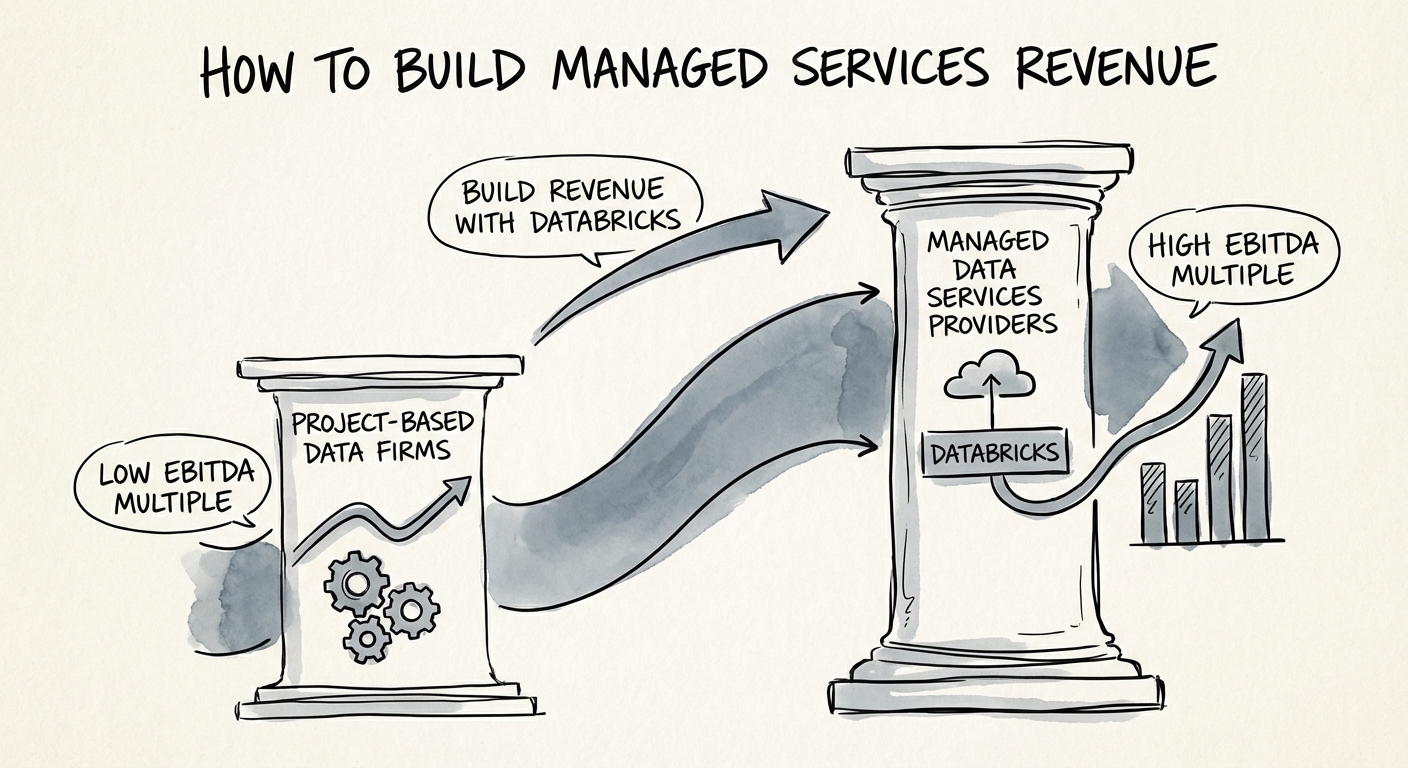
Standard IT consultancies trade in the 8x–10x EBITDA range. Specialized Data & AI firms with real recurring revenue have been seen as high as 15.2x EBITDA. The gap isn't about being good at Databricks. It's about predictability — a buyer will pay up for cash flow they can forecast and won't pay up for a pipeline of SOWs that resets to zero every January.
So the metric that matters in diligence isn't your certification count, it's your revenue mix. A practice running 40% of revenue as managed ARR gets read as a cash-flow engine. A practice running mostly resale and project work gets read as a staffing firm with a logo. The trap is resale: if you're passing through low-margin Databricks license resell to look bigger, you're diluting the exact multiple you're trying to lift — the buyer normalizes it right back out. The same dynamic plays out across the lakehouse ecosystem, where specialized Snowflake partners are pulling away from generalists on precisely this axis.
What to do Monday: pull last quarter's revenue and tag every dollar as resale, project, or managed. If managed is under 20%, you don't have an MSP, you have a project shop with a few support agreements — and you should pick one of the three offers above and put it in front of the client sitting on the under-burned commit. They have the budget problem and the renewal clock. You have the fix. Start there, and use our partner revenue mix analysis to see how unbalanced resale quietly suppresses what your practice is worth.