
The practical answer
- Short answer
- Zendesk's pivot to AI agents creates a massive opportunity for partners. Learn why 'Automation Architects' trade at 12x while generalists stall.
- Best fit
- Industry: Customer Experience (CX). Function: Services Strategy
- Operating path
- GTM Execution → Commercial Performance → Performance Improvement
- Key metric
- 12x Valuation multiple for 'Automation Architect' firms vs. 6x for standard implementation shops.
The Death of the "Ticket Shop"
For the last decade, the Zendesk partner ecosystem has been dominated by a single, comfortable business model: The Ticket Shop. These firms built their revenue on the complexity of volume. The more tickets a client had, the more seats they needed, and the more billable hours a partner could charge for configuring triggers, views, and macros to manage that chaos. In this model, inefficiency was the silent driver of partner revenue.
That model is now a liability. With Zendesk's acquisition of Ultimate.ai and the rollout of advanced AI agents, the fundamental unit of value has shifted from "managing tickets" to "preventing them." Benchmark data now shows that properly configured AI agents can achieve an 80% deflection rate for routine inquiries. For a traditional partner, that looks like an 80% drop in their client's seat requirement growth—a revenue death spiral.
But for the "Automation Architect," this is the era of the 12x multiple. These partners don't sell "implementation"; they sell "resolution." Instead of billing $200/hour to configure a support view, they are charging six-figure fixed fees to build, train, and maintain specific industry intent models (e.g., "e-commerce returns" or "SaaS provisioning"). They aren't competing on hourly rates; they are competing on Cost Per Resolution. Private equity buyers have noticed the difference: "Body shop" implementation firms are trading at 5-6x EBITDA, while firms with proprietary AI intent libraries and outcome-based pricing models are commanding 10-12x.
In an AI world, inefficiency is no longer a revenue stream—it's a churn risk. The partners who win will be the ones who sell resolutions, not seats.
The "Service-to-Outcome" Pivot
The biggest trap for Zendesk partners in 2026 is clinging to the "Service-to-License" ratio. Historically, a robust practice aimed for $3 in services for every $1 in license revenue. Today, AI projects distort this metric because the software spend (licenses) is consolidating, but the value delivered is skyrocketing. The new metric that matters is Outcome Velocity—how quickly can you get a client to that 301% ROI benchmark?
This requires a fundamental change in your Statement of Work (SOW). The "lift and shift" migration projects—moving data from Salesforce Service Cloud to Zendesk—are being commoditized by automated migration tools. The high-margin revenue is now found in:
- Data Clean Rooms: AI agents hallucinate on bad data. Partners who charge premiums to audit, structure, and tag historical ticket data before "switching on" the AI are seeing 40% higher project margins.
- Intent Library IP: The most valuable asset a partner can own today is not their consultants' time, but their library of pre-trained intents. If you have a pre-built "Fintech KYC" agent model that works out of the box on Zendesk, you have a productized service that scales at near-100% margin.
- Conversation Design vs. Configuration: You no longer need "Zendesk Administrators"; you need "Conversation Designers." These roles command higher bill rates ($250-$300/hour) because they bridge the gap between technical setup and brand voice, ensuring the AI agent doesn't just answer, but engages.
Valuation Reality: The "IP" Premium
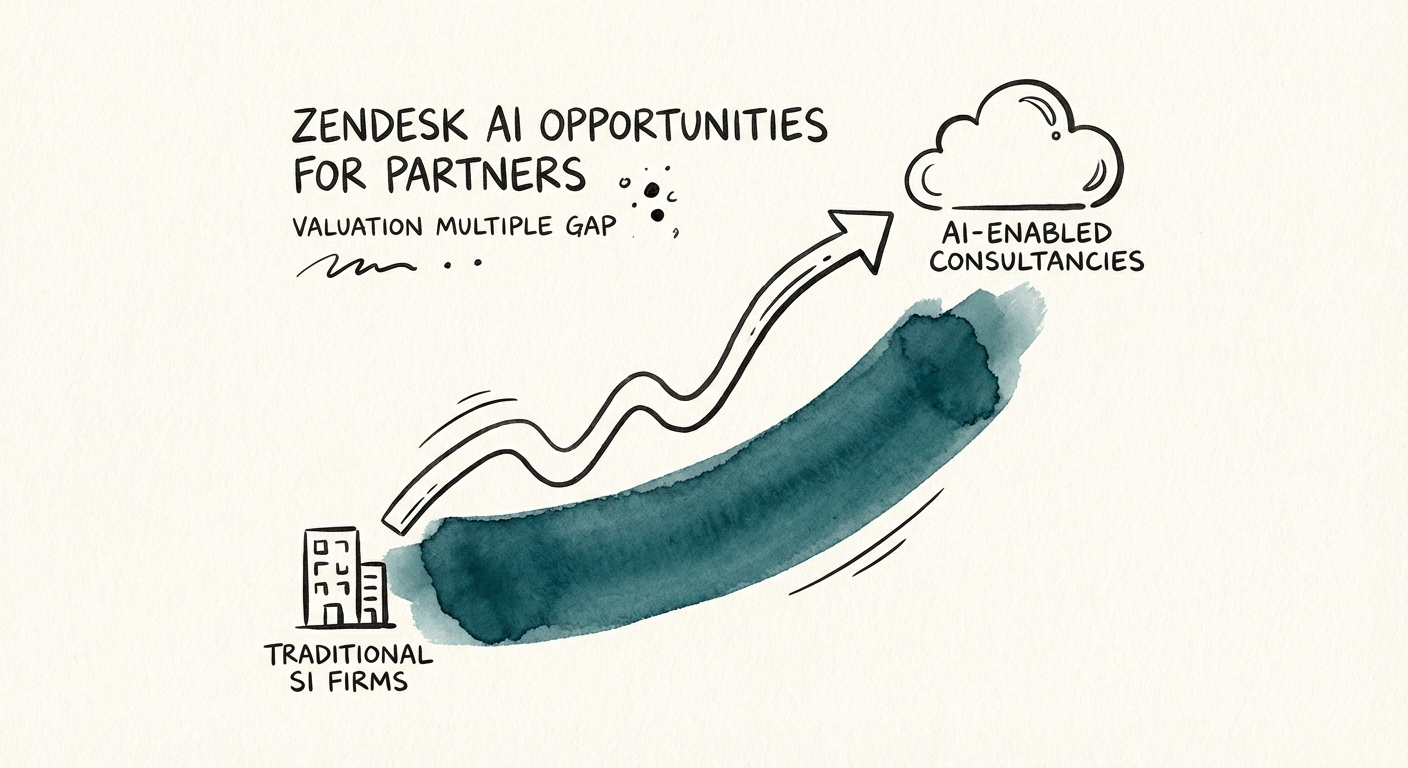
Why does an "Automation Architect" trade at double the multiple of a standard SI? Because they have solved the linear scaling problem. A standard Zendesk shop grows revenue by hiring more heads (linear). An AI-focused shop grows revenue by deploying the same "Retail Support Agent" model to 50 different clients (exponential).
When we advise PE firms on CX partner acquisitions, we look for "Tech-Enabled" characteristics. A partner that manually configures the same "password reset" workflow for every client is a service business. A partner that deploys a proprietary "Identity Verification Module" via Zendesk's API is a platform business. The latter gets the "SaaS" halo effect on their valuation.
The window to pivot is closing. Zendesk's own move toward outcome-based pricing for its AI agents signals that they expect their ecosystem to follow suit. Partners who align with this—charging for value delivered rather than hours worked—will not only survive the AI transition but will become the primary targets for consolidation in the next 24 months.