
The practical answer
- Short answer
- Shopify's Hydrogen stack isn't just a technical upgrade—it's a valuation multiplier. Learn why headless practices trade at 12x while Liquid shops stall at 5x.
- Best fit
- Industry: Ecommerce Technology. Function: Technical Strategy
- Operating path
- GTM Execution → Commercial Performance → Performance Improvement
- Key metric
- 200ms Target Time to First Byte (TTFB) on Oxygen edge hosting, compared to 600ms+ for traditional setups.
The 'Liquid Ceiling': Why Enterprise Clients Are Leaving Theme Shops
For the last decade, the Shopify Partner ecosystem has been defined by Liquid—an accessible, template-based language that allowed thousands of marketing agencies to build stores quickly. In 2026, that era is ending for the mid-market.
The catalyst isn't just aesthetic; it's algorithmic. With Google's Core Web Vitals update in 2024 replacing First Input Delay (FID) with Interaction to Next Paint (INP), traditional Liquid themes—burdened by third-party app scripts and synchronous loading—are hitting a performance wall. Data shows that while 93% of sites passed FID, significantly fewer maintain elite scores under INP without the architectural decoupling of headless commerce.
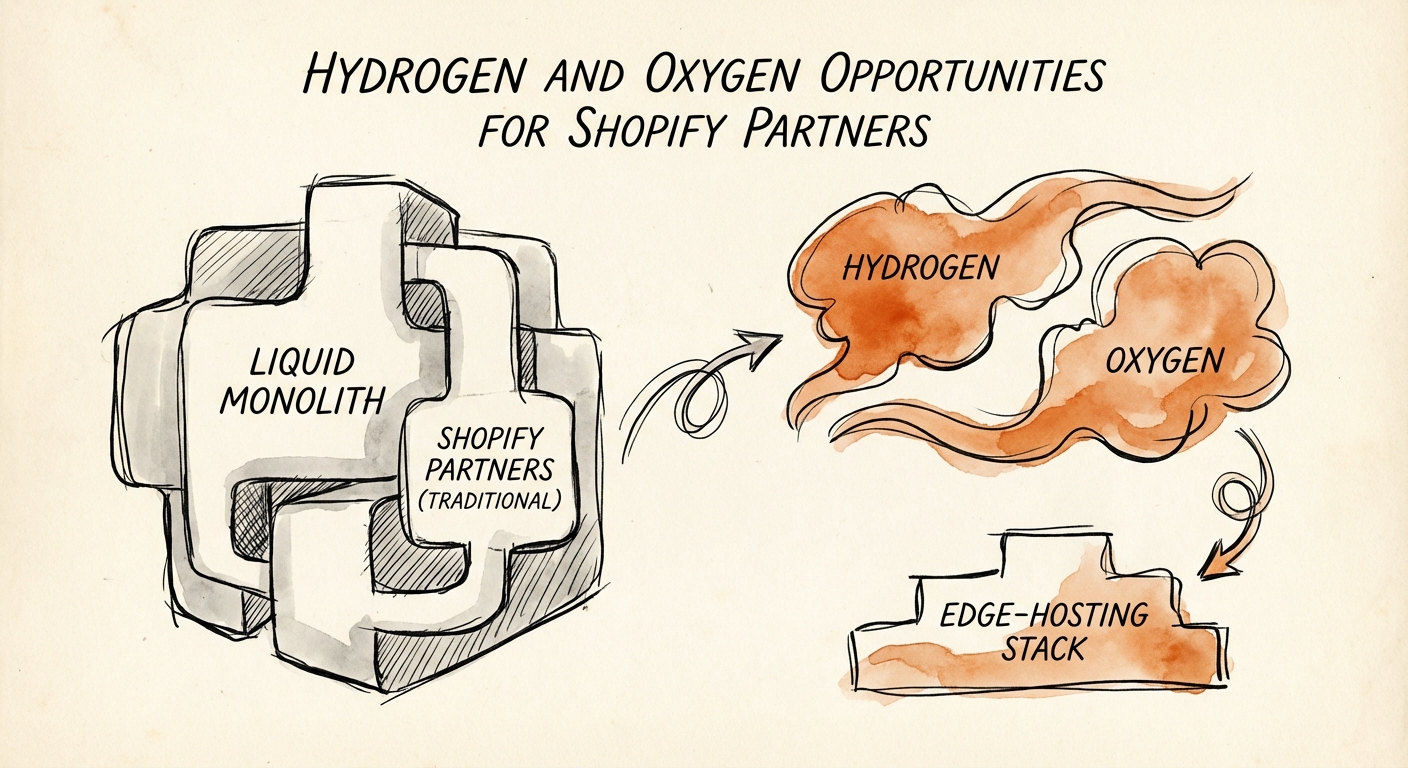
This technical cliff has created a bifurcation in the partner market. On one side are "Theme Shops": agencies competing on price ($20k–$50k projects), struggling with app bloat, and facing commoditization. On the other are "Product Studios": firms building on Hydrogen (Shopify’s React-based framework) and deploying on Oxygen (global edge hosting). These firms aren't selling "websites"; they are selling "commerce applications." Our data indicates that while Liquid-based agencies are stalling at 4x-5x EBITDA multiples, Hydrogen-native practices are commanding 10x-12x due to their resemblance to software engineering firms rather than creative agencies.
The market has bifurcated. If you're building themes, you're a marketing agency trading at 4x. If you're building Hydrogen applications, you're a product engineering firm trading at 12x.
The Oxygen Advantage: Managed Services Without the DevOps Tax
The primary objection to headless commerce has historically been Total Cost of Ownership (TCO). In the pre-2024 era, going headless meant managing a complex stack: a CMS (Contentful/Sanity), a frontend (Next.js/Gatsby), and a hosting layer (Vercel/Netlify/AWS). For many agencies, this introduced a "DevOps Tax"—a layer of unbillable maintenance hours that eroded margins.
Shopify Oxygen changed the unit economics of the headless agency model. By providing a globally distributed hosting layer native to the Shopify Plus license, Oxygen eliminates the third-party hosting bill and the need for dedicated DevOps engineers to manage uptime. This allows partners to shift their retainer model from "keeping the lights on" (low value) to "performance engineering" (high value).
The Retainer Pivot: From Content to Code
Liquid agencies typically sell "Content Retainers" (uploading banners, changing copy), which are the first to be cut in a downturn. Hydrogen agencies sell "Product Retainers": continuous optimization of conversion paths, A/B testing React components, and managing edge caching strategies. These services are sticky, technical, and command rates of $250/hr+ compared to the $125/hr average for theme management. This shift in revenue quality—from low-margin marketing execution to high-margin technical optimization—is the primary driver of the "Hydrogen Premium" in M&A valuations.
Valuation Physics: Why Acquirers Pay for React, Not Liquid
In the eyes of a Private Equity buyer, a "Shopify Agency" is a services business with low barriers to entry. A "Hydrogen Practice," however, is viewed as a Digital Product Studio. The distinction lies in the talent and the IP.
Liquid developers are often viewed as "integrators"—assembling pre-built parts. Hydrogen requires React and Remix engineers—talent that overlaps with VC-backed SaaS companies. This talent density allows Hydrogen shops to build proprietary IP (custom checkout flows, unique mobile functionality, AI-driven personalization engines) that Liquid shops simply cannot replicate. When we analyze deal structures in 2025, acquirers are valuing this "Engineering DNA" at a 120% premium over "Agency DNA."
For agency founders, the strategic imperative is clear: you must stop hiring for Liquid proficiency and start hiring for React engineering. The "Hydrogen Opportunity" isn't just about faster load times for your clients; it's about escaping the commoditized "Agency" bucket and positioning your firm as a strategic technology partner. If you are still selling themes in 2026, you are building a business that—statistically speaking—will be worth half as much as your headless competitors.