
The practical answer
- Short answer
- Shopify partners can move from agency work to consultancy value by owning commerce architecture, recurring optimization, data quality, and integration outcomes.
- Best fit
- Industry: Digital Commerce Services. Function: Operations & Strategy
- Operating path
- Exit Readiness → Operational Excellence → Transaction Advisory Services
- Key metric
- Recurring Consultancy-quality partners increase recurring advisory and optimization work.
The Partner Shift: From Builds to Commerce Architecture
Shopify partners are moving through a familiar professional-services transition. The firms that only sell storefront builds, theme customization, and launch support are easier to compare on hourly rates. The firms that own commercial architecture, data quality, integrations, experimentation, and performance governance can create a more strategic relationship.
For the last decade, "Shopify agency" often meant a firm that could customize themes, set up flows, and manage migrations. In 2026, that work is still necessary, but it is not enough to defend premium pricing or exit value. AI tools, reusable templates, and stronger native platform features reduce the value of purely repetitive build work.
The stall point for many agencies is not lack of demand. It is business model design: too much one-time project revenue, too little recurring advisory or optimization work, too much founder-led sales, and delivery that depends on custom heroics instead of repeatable systems.
The valuation question is not whether a Shopify partner can launch a store. It is whether the firm owns a repeatable commercial operating system that clients keep expanding.
The Consultancy Pivot: Owning Commercial Outcomes
The firms breaking out of the agency model are not just building stores; they are helping merchants run commercial operating systems. That includes headless decisions, ERP and OMS integrations, checkout extensibility, analytics quality, international expansion, lifecycle marketing, and site-performance governance.
Unlike agencies that ask, "What do you want the site to look like?", consultancies ask, "How will this architecture support growth, margin, inventory turns, and customer retention?" That shift lets them bill for strategy and implementation quality, not just hours.
The Strategic Asset Profile
A consultancy-quality Shopify partner usually has a different financial profile: more recurring work, higher revenue per employee, stronger account retention, more senior delivery leadership, and reusable playbooks. Buyers pay more attention to that profile because the revenue is more durable and the delivery model is easier to transfer after acquisition.
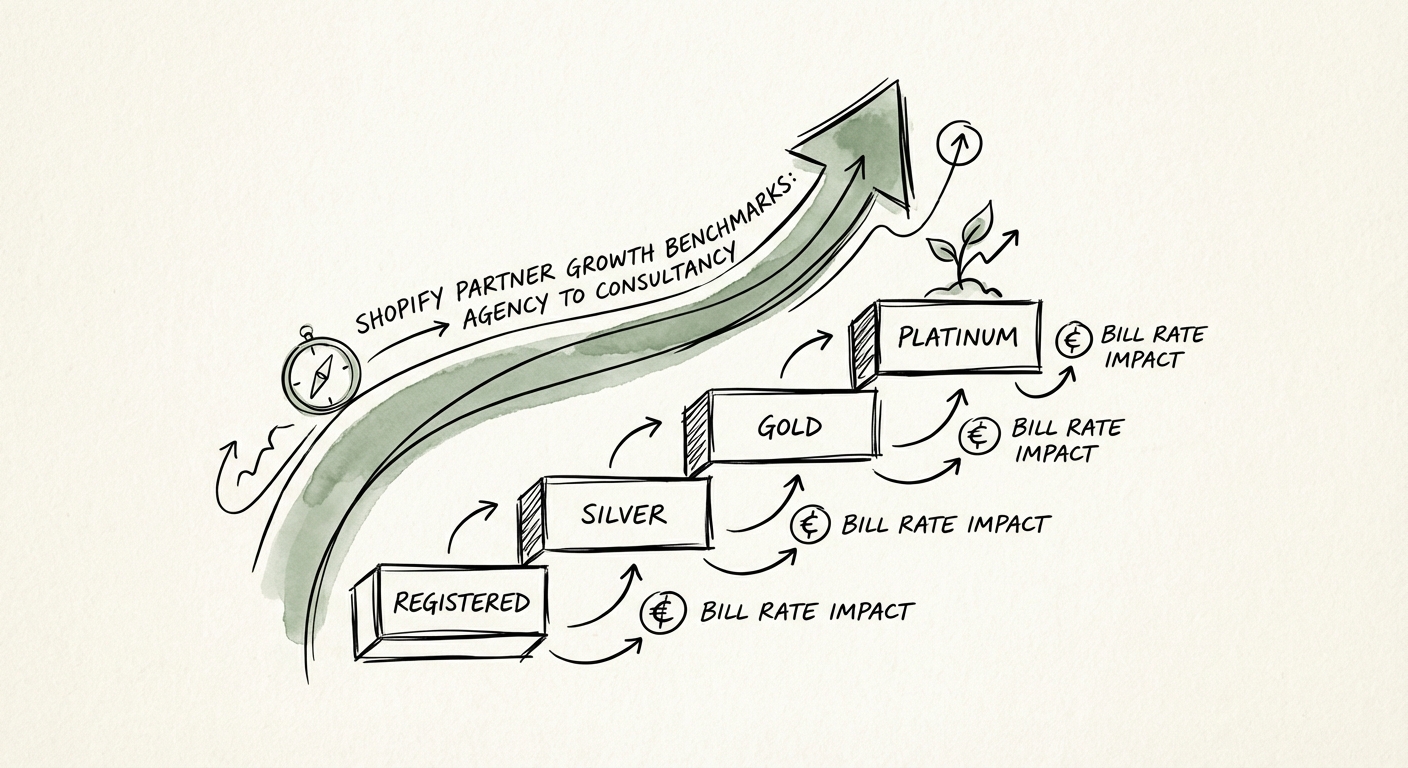
Benchmarks: Are You an Agency or a Consultancy?
To determine where you sit on the valuation spectrum, compare your firm against these operating markers.
1. Revenue Per Employee
If revenue per employee is low, the firm is probably selling capacity. If revenue per employee is rising while client outcomes improve, the firm is likely packaging knowledge, templates, automation, and senior judgment more effectively.
2. Recurring Revenue Mix
Do clients launch and leave, or do they expand the relationship? High-quality partners move from maintenance retainers to optimization, experimentation, analytics, and roadmap ownership.
3. Technical Debt Ratio
In diligence, buyers inspect how much revenue depends on fragile custom code versus native-first, extensible architecture. Consultancies standardize where possible and customize where it creates clear commercial advantage.
For founders looking to exit, the path is clear: stop selling only Shopify builds. Sell commerce architecture, measurable operating outcomes, and a delivery system that can scale without the founder in every account.