
The practical answer
- Short answer
- Shopify Partner exit guide for 2026. Why agencies trade at 5x while commerce system integrators command 12x. Benchmarks for NRR, recurring revenue, and technical IP.
- Best fit
- Industry: Ecommerce Technology Services. Function: M&A Strategy
- Operating path
- Exit Readiness → Operational Excellence → Transaction Advisory Services
- Key metric
- 14x Valuation multiple for Shopify Partners with >50% recurring revenue and proprietary IP.
The Great Bifurcation: Why "Gold" Status Won't Save Your Multiple
For the last decade, the Shopify Partner ecosystem was a rising tide that lifted all boats. If you could write Liquid code and design a decent storefront, you could build a $5M agency. But as we enter 2026, the Private Equity (PE) market for Shopify partners has fundamentally fractured. We are witnessing a "Great Bifurcation" where firms with similar revenue profiles are trading at vastly different valuations.
On one side are the "Theme Shops." These agencies focus on frontend design, theme customization, and low-complexity migrations. They are viewed by acquirers as "commoditized labor." Their revenue is 80% project-based, their churn is high (because clients leave once the site is live), and their valuation ceiling is stuck at 4x to 6x EBITDA.
On the other side are the "Commerce System Integrators" (CSIs). These firms have pivoted to handle the complexity of Shopify's push upmarket into the enterprise. They specialize in Shopify Plus economics, headless architecture (Hydrogen, Sanity), and middleware integrations. They don't just "build stores"; they manage commerce infrastructure. Because they own the technical plumbing, their revenue is sticky, and PE firms value them as strategic technology assets, commanding multiples of 10x to 14x EBITDA.
The "Agency Discount" in Due Diligence
Acquirers in 2026 are disciplined about classifying you before they even send the LOI. If your revenue mix is dominated by one-off builds with no long-term data orchestration or managed services, you are tagged with the "Agency Discount." To break into the premium tier, you must demonstrate that you are solving infrastructure problems, not just marketing problems.
If you are selling 'themes,' you are selling a commodity. If you are selling 'commerce infrastructure,' you are selling a utility. Utilities trade at 12x; commodities trade at 4x.
The Revenue Mix Trap: Project vs. Recurring
The single biggest killer of Shopify partner valuations is the "Project Revenue Trap." Many partners boast about $10M in annual revenue, but if $8M of that resets to zero every January 1st, a PE buyer sees risk, not value. To achieve a premium exit, you must fundamentally restructure your engagement model from "Launch and Leave" to "Launch and Lead."
Benchmarking Your Recurring Revenue
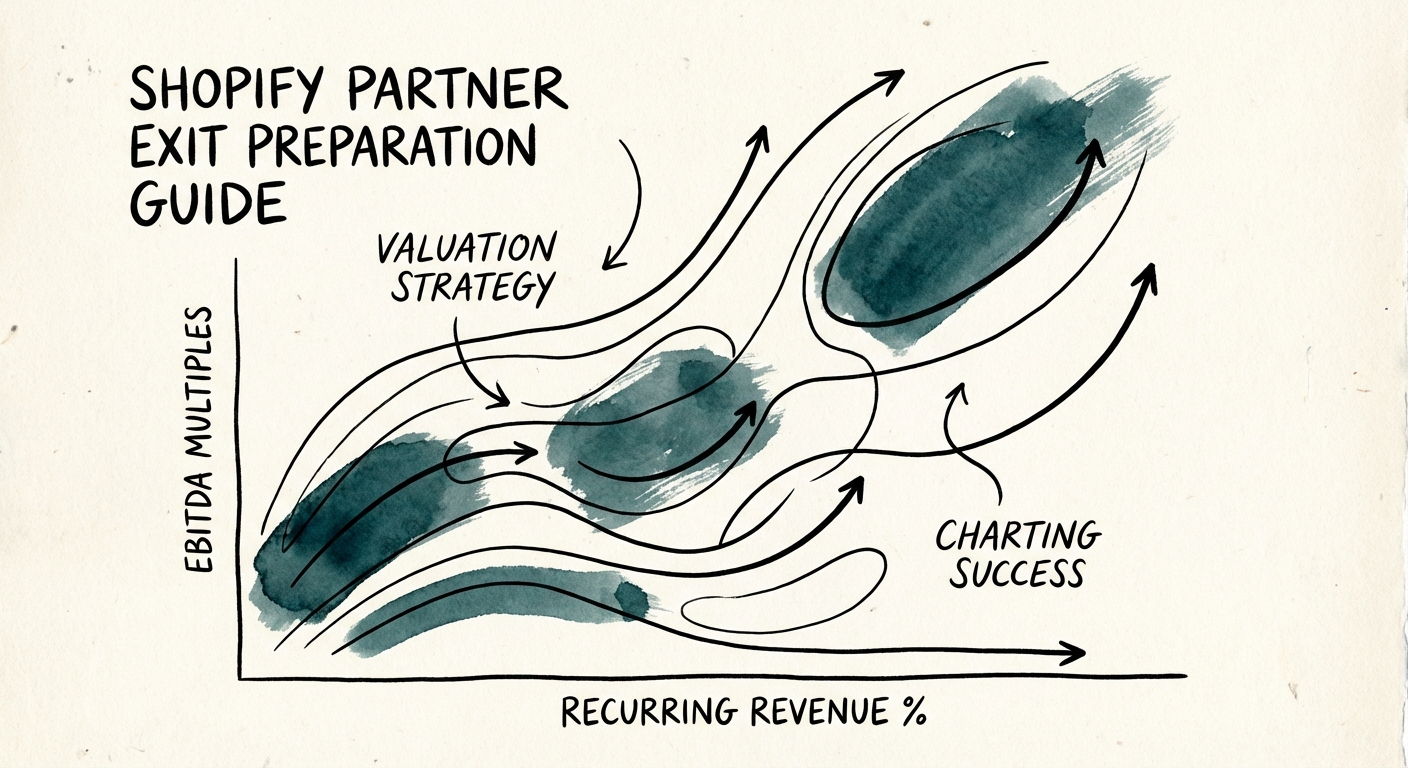
For a premium exit, your revenue mix needs to shift. The target benchmark for a "Platform" valuation is 40-50% Recurring Revenue. This does not mean selling low-margin SEO retainers. It means selling high-margin Managed Services focused on technical optimization, version upgrades, and performance monitoring.
- Tier 3 (Risk): <15% Recurring Revenue. Valuation: 3-5x EBITDA.
- Tier 2 (Standard): 15-30% Recurring Revenue. Valuation: 6-8x EBITDA.
- Tier 1 (Premium): >45% Recurring Revenue. Valuation: 10x+ EBITDA.
PE investors look for Net Revenue Retention (NRR) above 110%. If your NRR is below 90%, it implies you are churning customers faster than you can upsell them—a hallmark of the "Launch and Leave" model. The most valuable partners in 2026 are those who have productized their services into long-term contracts that resemble SaaS economics.
Technical Diligence: The Hidden Deal Killer
In the Shopify ecosystem, technical debt is the silent source of deal-value erosion. When a PE firm deploys a technical diligence team, they aren't just looking at your financials; they are auditing your GitHub repositories. They want to know if your team writes scalable, modular code or if you are shipping "spaghetti code" that will become a maintenance nightmare.
The "Custom App" Liability
Many partners believe their custom private apps are assets. In reality, unless those apps are well-documented, maintained with automated testing, and built on modern frameworks (like Remix or Node.js), they are liabilities. We have seen deals where the 36-month exit timeline was derailed because a partner's "proprietary middleware" was actually a fragile, undocumented script running on a single developer's laptop.
Intellectual Property (IP) as a Multiplier
To secure a 12x multiple, you need genuine IP. This could be:
- Vertical Accelerators: A pre-built headless stack for Fashion or B2B manufacturing that reduces build time by 40%.
- Data Connectors: Proprietary integrations between Shopify and niche ERPs (e.g., NetSuite, Microsoft Dynamics) that standard apps can't handle.
- Automated QA Suites: Internal tools that automatically test client sites before Black Friday/Cyber Monday.
Buyers pay for leverage. If your IP allows you to deliver $500k of value with $100k of labor, you have broken the linear services model. That is what turns an agency into a platform.