
The practical answer
- Short answer
- Transform your Shopify agency from a project-based 'build shop' into a recurring revenue engine. Benchmarks, retainer models, and valuation impacts.
- Best fit
- Industry: eCommerce Agencies. Function: Sales & Customer Success
- Operating path
- Revenue Architecture → Commercial Performance → Office of the CFO
- Key metric
- 60-70% Target Gross Margin for managed services vs. 40-50% for project builds.
The 'Launch and Leave' Valuation Trap
For most Shopify Plus partners, the business model is a treadmill. You hunt for the $100,000 migration project, burn out your engineering team delivering it on a tight deadline, launch the store, and then—silence. You hand the keys to the merchant, high-five the team, and immediately panic about where the next $100,000 is coming from.
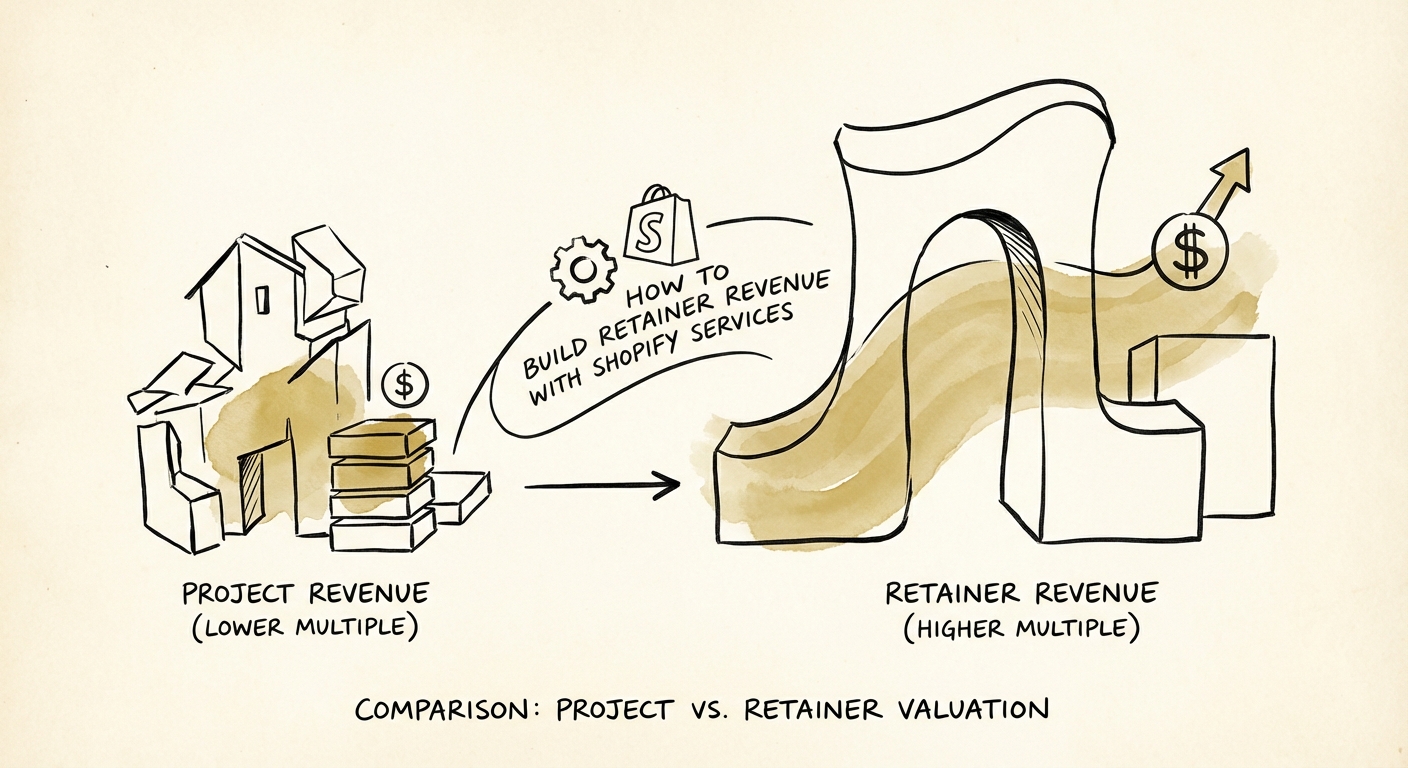
This is the "Launch and Leave" cycle, and it is destroying your exit value. In the current M&A market, private equity buyers and strategic acquirers (like global systems integrators) are bifurcating the market. Agencies with 80% project revenue are trading at 4x to 6x EBITDA. They are viewed as "staffing risks" with low visibility.
Conversely, agencies that have successfully pivoted to a "Growth Ops" model—where 50% or more of revenue is recurring managed services—are commanding 10x to 12x EBITDA multiples. The math is brutal: a $5M revenue agency with $1M EBITDA is worth $4M as a project shop, or $12M as a growth partner. The difference isn't your code quality; it's your revenue architecture.
The Churn Reality
Data from 2025 suggests that nearly 50% of Shopify Plus merchants switch service partners within 18 months of a major replatforming. Why? Because the agency that built the store often lacks the infrastructure to grow the store. Merchants don't need code maintenance; they need revenue optimization. If you are selling "support hours," you are a commodity. If you are selling "Revenue Operations," you are a partner.
Merchants don't need code maintenance; they need revenue optimization. If you are selling 'support hours,' you are a commodity. If you are selling 'Revenue Operations,' you are a partner.
Structuring the 'Growth Ops' Retainer
The mistake most founders make is rebranding "maintenance" as "retainer." A block of 20 hours for "bug fixes and updates" is not a strategic retainer; it is insurance. Insurance is the first thing a CFO cuts during a downturn. To build durable recurring revenue, you must move up the value chain from Maintenance to Optimization.
Successful Shopify Plus partners in 2026 are structuring retainers around three pillars:
- Conversion Rate Optimization (CRO): Instead of selling hours, sell experiments. A $5,000/month retainer should include 2 A/B tests, analysis, and implementation. This aligns your fee with the merchant's GMV (Gross Merchandise Value) growth.
- Tech Stack Orchestration: The average Shopify Plus merchant uses 20+ apps (Klaviyo, Yotpo, Gorgias, etc.). These apps break, update, and disconnect. A "Stack Management" retainer ensures data flows correctly between the ERP, CRM, and storefront. This is sticky because it is technical and deeply integrated.
- Data & Personalization: With the rise of Shopify Markets and B2B features, merchants are drowning in complexity. Retainers focused on "International Expansion Management" or "B2B Portal Optimization" are high-value services that justify $10k+ monthly fees.
Pricing for Margin
Project work often runs at 40-50% gross margin due to scope creep. Managed services, when properly scoped, should target 60-70% gross margins. The key is to productize the service. Do not sell "hours." Sell "deliverables" (e.g., 1 monthly audit, 2 campaign landing pages, weekly reporting). This decouples revenue from time, allowing you to scale efficiency without linear headcount growth.
The 'Launch-to-Retainer' Handoff
The transition from "Build" to "Run" is where 90% of recurring revenue opportunities are lost. Typically, the delivery team finishes the project, and a separate "Support" team takes over. The client feels demoted from "VIP Launch Status" to "Ticket #402."
To fix this, you must engineer the "Day 91" conversation before Day 1. The retainer proposal should be part of the initial SOW, not an upsell at the end. We call this the "Warranty-to-Growth" bridge:
- Months 1-3 (Build): Project team executes migration/build.
- Month 4 (Hypercare): Included in the build cost. High-touch bug fixing.
- Month 5 (The Pivot): The Quarterly Business Review (QBR) is not a status update; it is a strategy session. You present data from the first month of live traffic and propose the Growth Roadmap.
Agencies that master this transition see Net Revenue Retention (NRR) rates above 110%, meaning their existing cohort grows in value every year. This is the metric private equity buyers hunt for. If your NRR is below 100%, your bucket is leaking faster than you can fill it.
For a deeper dive into how valuation multiples shift based on revenue quality, review our analysis on Marketing Agency Valuations. Furthermore, understanding the difference between Net Revenue Retention vs. Gross Revenue Retention is critical for accurate forecasting. To see how this "Project Trap" plays out in other ecosystems, read our diagnostic on HubSpot Implementation Partners.