
The practical answer
- Short answer
- Stop measuring 'Go-Live'. Discover the 3 customer success metrics that improve retention quality for Shopify Plus partners and how to fix your NRR.
- Best fit
- Industry: Professional Services. Function: Customer Success
- Operating path
- Revenue Architecture → Commercial Performance → Office of the CFO
- Key metric
- 42% Average annual client churn for project-based agencies, compared to 18% for retainer-based firms (2025 Benchmarks).
The 'Launch Trap': Why Your Go-Live Party is a Valuation Killer
You’ve just launched a complex Shopify Plus migration for a $50M GMV brand. The site is live, the client is happy, and your team is popping champagne. In the world of traditional agency metrics, this is a win. In the world of Private Equity valuation, you have just walked into the 'Launch Trap'.
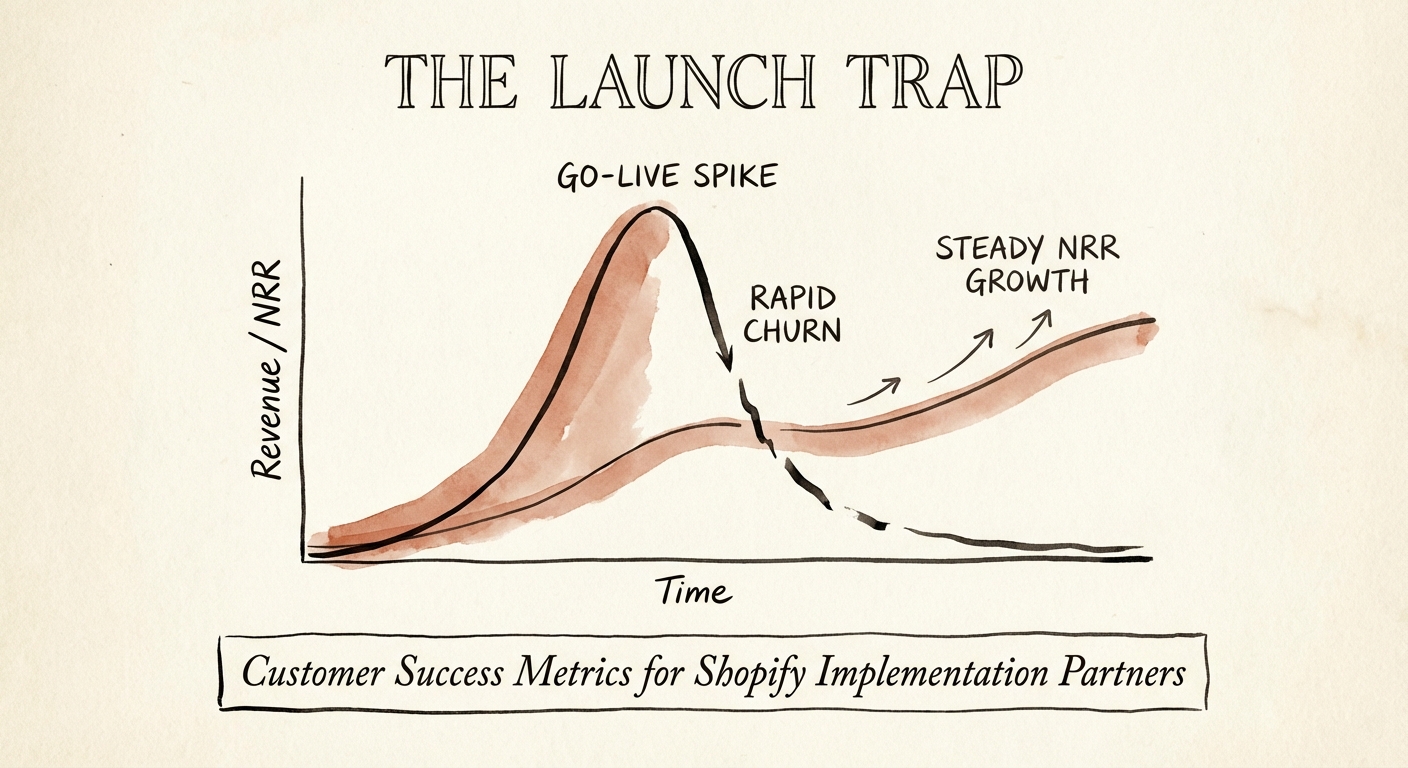
Most Shopify Implementation Partners operate on a 'Build and Release' model. They measure success by On-Time Delivery and Launch Budget Accuracy. While these metrics matter for project margin, they are irrelevant for enterprise value. By treating the 'Go-Live' as the finish line, you are effectively firing yourself every 6 months. This explains why project-based agencies tend to trade at lower EBITDA multiples while recurring-revenue counterparts can command a premium.
The data is brutal. According to 2025 agency benchmarks, project-based firms suffer an average annual client churn of 42%, while retainer-based 'Growth Partners' see churn as low as 18%. If your customer success team is actually just a 'support desk' waiting for tickets, you aren't building a business; you're building a treadmill. To break the $20M revenue ceiling and unlock a premium exit, you must pivot your definition of success from 'Launch' to 'Lifetime Value'.
The Only 3 Metrics That Matter for Shopify Partners
Stop reporting 'Ticket Resolution Time' to your Board. It’s a vanity metric that masks revenue leakage. Instead, implement these three diagnostic metrics to measure the true health of your practice.
1. Recurring Revenue Attachment Rate (RRAR)
This is the percentage of new implementation deals that sign a 12-month managed services contract at the point of sale. It is the single strongest predictor of valuation.
- The Danger Zone (<20%): You are a body shop. You have to resell your entire revenue target every January 1st.
- The Safety Line (35%): You have stabilized cash flow, but you are still hunting for growth.
- The Valuation Premium (>50%): You are a 'Platform Partner'. Buyers view your revenue as high-quality and predictable, unlocking the premium valuation treatment typically reserved for more predictable revenue models.
2. Portfolio GMV Alpha
Shopify’s platform GMV grew approximately 25% year-over-year in 2024/2025. This is your 'Beta'—the market average. If your clients are growing at 15%, you are statistically destroying value. A strategic partner should deliver 'Alpha'—growth above the platform average. Track the Weighted Average GMV Growth of your top 20 clients. If this number is below 25%, your 'Growth Retainers' are failing.
3. True Net Revenue Retention (NRR)
Many agencies hide behind 'Gross Retention' (did we lose the logo?). But if a client drops their retainer from $10k/month to $5k/month, you’re bleeding. Net Revenue Retention measures the total value of the cohort. For Shopify Plus partners, a healthy NRR is 110%+. This means your upsells (email marketing, CRO, custom apps) are outpacing your churn.
From 'Support' to 'Growth': The Pivot Playbook
The most common objection I hear from Founders is, "Our clients don't want retainers." This is a lie. Clients don't want maintenance retainers. They don't want to pay $5,000 a month for you to fix bugs you created.
They want Growth Retainers. To fix your metrics, you must re-engineer your offering:
- Kill the 'Support' Desk: Rename it 'Revenue Operations'. Support implies fixing things; RevOps implies improving things.
- Sell Outcomes, Not Hours: Don't sell a "20-hour block." Sell a "Quarterly CRO Sprint" designed to lift conversion by 0.5%.
- Mandatory Attach: Make post-launch managed services a requirement for your implementation warranty. If they don't sign the retainer, they don't get the warranty.
The difference between a $5M exit and a $50M exit isn't better code; it's better revenue architecture. If you can prove that hiring you leads to a statistical increase in GMV, you become indispensable. That is the definition of Customer Success.