The practical answer
- Short answer
- Workday implementation firms with strong Customer Success practices trade at 12x EBITDA. Those without trade at 5x. Here is the diagnostic playbook to fix your revenue mix.
- Best fit
- Industry: Professional Services. Function: Customer Success
- Operating path
- Revenue Architecture → Commercial Performance → Office of the CFO
- Key metric
- 13.6x EBITDA multiple for IT services firms with >40% recurring revenue (vs 6x for project-based).
The Valuation Gap: Why Your Project Revenue Is Worth Less Than You Think
I see the same P&L every week. A Workday partner hits $20M in revenue, growing 25% year-over-year. The founder thinks they are sitting on a gold mine. Then we run the valuation model, and they are shocked when the number comes back at 5x EBITDA.
Why? Because 90% of that revenue is one-time implementation fees. You are on a treadmill. To grow next year, you don't just need to find new customers; you need to replace every single dollar of revenue you earned this year just to stay flat. That is not a business; that is a series of projects strung together by anxiety.
The market data for 2025 is disciplined. Pure-play implementation firms (VARs/SIs) are trading at 5x to 7x EBITDA. But firms with >40% recurring revenue from Managed Services (AMS) or proprietary IP are trading at 10x to 13.6x EBITDA. The market pays a premium for predictability.
We call this the "Go-Live Cliff." In a typical firm, the relationship peaks at go-live. The "A-Team" rolls off to the next shiny project, and the client is handed over to a "support" desk that is really just a ticket-taking junior squad. The client feels abandoned, adoption stalls, and you lose the renewal. You didn't just lose a contract; you lost the valuation multiplier.
You don't just lose a contract when you fail at Customer Success; you lose the valuation multiplier. The market pays 5x for projects and 12x for platforms.
The Diagnostic: Signs Your 'Customer Success' Is Just Technical Support
Most Workday partners I audit claim they have a Customer Success practice. They don't. They have a reactive help desk. If your "CSM" is spending their day resetting passwords or troubleshooting integrations, you have failed. Here is the diagnostic checklist to determine if your model is broken:
1. The Attach Rate Failure
If you are attaching AMS (Application Management Services) contracts to fewer than 50% of your new implementations, your sales motion is broken. Best-in-class partners view Implementation as the loss leader (or low margin) entry point to secure the high-margin, 5-year AMS tail. If your sales team is comped only on the "big bang" project, they have zero incentive to sell the marriage, only the wedding.
2. The 'Ticket' Trap
Look at your AMS reporting. Is it measuring "Ticket Resolution Time" or "Feature Adoption"? Support closes tickets; Success drives consumption. Workday releases two major updates a year. If your team isn't proactively meeting with the CFO/CHRO to map those new features to their business goals before they launch, you are a vendor, not a partner.
3. The NRR Warning Light
Your Net Revenue Retention (NRR) should be 110%+. This means that even if you sell zero new logos, your revenue grows because existing clients are buying more from you (Phase X projects, new SKUs, capacity expansion). If your NRR is hovering at 90-100%, you are leaking value. You are likely suffering from "Green Churn"—clients who are technically "satisfied" (green on the dashboard) but are stagnant, meaning they will eventually bid you out for a cheaper provider.
The Fix: Building the 'Run' Engine
Turning a project shop into a recurring revenue machine requires a fundamental architectural shift. You cannot just rebrand your support team.
1. Structure: The Pod Model
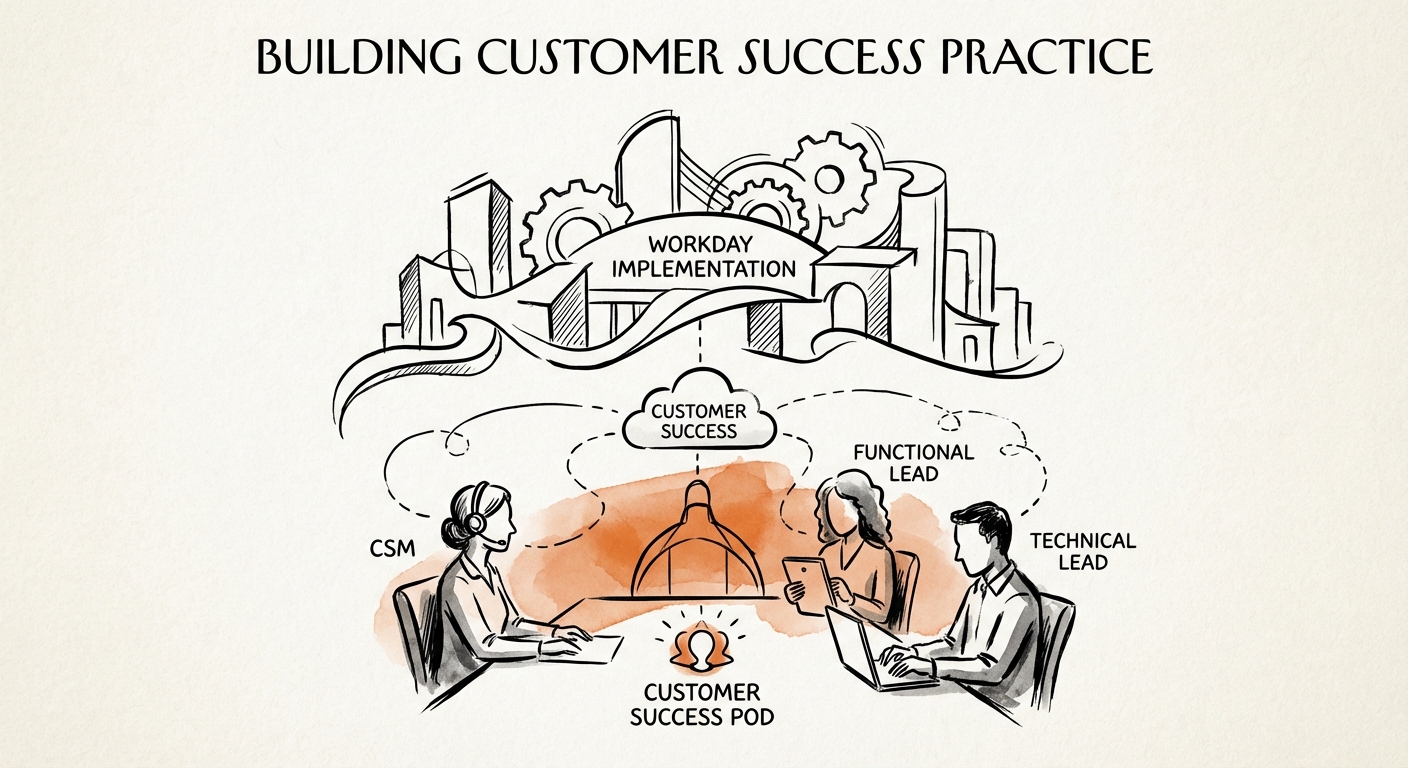
Stop assigning random tickets to a pool of juniors. Move to a Pod Model where a specific client is owned by a dedicated trio: a Client Success Manager (strategic, owns the roadmap/QBR), a Functional Lead (owns the configuration/business process), and a Technical Lead (owns integrations/reporting). This creates accountability. The client isn't buying "hours"; they are buying a team that knows their business.
2. Economics: The Retainer Pivot
Kill the "bucket of hours" model immediately. It aligns your incentives against the client's. If you are efficient, you make less money. Move to a Subscription/Retainer model. Charge a flat monthly fee for a defined scope of "Capacity" and "Advisory." This makes revenue predictable for you and costs predictable for the CFO. Data from 2025 shows that partners with subscription-based AMS pricing command a 30% premium in hourly effective rates over T&M shops.
3. The Talent Pivot
Your best consultants usually hate support. They want the thrill of the build. You need to create a distinct career path for AMS that rivals implementation. Call it "Optimization" or "Continuous Value." Incentivize it with commissions on upsells (Phase X projects). When your AMS team realizes they are the farmers who own the 5-year relationship (and the commission checks that come with it), the culture shifts overnight.