
The practical answer
- Short answer
- Stop optimizing for HubSpot tiers and start optimizing for EBITDA. Learn why 'Sold MRR' is a vanity metric and how to fix the 90-day churn cliff in your implementation practice.
- Best fit
- Industry: Marketing Technology. Function: Customer Success
- Operating path
- Revenue Architecture → Commercial Performance → Office of the CFO
- Key metric
- 110% Target NRR for Best-in-Class Partners
The "Elite" Badge is Not a Business Model
If you are a HubSpot Solutions Partner, you likely spend an inordinate amount of time thinking about your tier. Are you Gold? Platinum? Diamond? Elite? You track "Sold MRR" and "Managed MRR" because that is what HubSpot tells you to track. And congratulations, you hit the target. You got the badge. You get the leads.
But let’s look at your P&L. If you are like most founders I advise, your revenue graph looks like a cardiogram—spikes of project revenue followed by troughs of panic. You are celebrating a new "Elite" status while running a business with 12% EBITDA margins and 85% gross retention on your services revenue.
Here is the hard truth: HubSpot’s metrics are designed to measure their success, not yours.
"Sold MRR" measures how much software you sold for HubSpot. That is their recurring revenue. Your commission on that is nice, but it is not enterprise value. It’s an annuity that HubSpot controls and can change (as they frequently do). The real valuation killer in your business is the gap between "Project Success" (getting the portal live) and "Customer Success" (getting the client to renew your retainer).
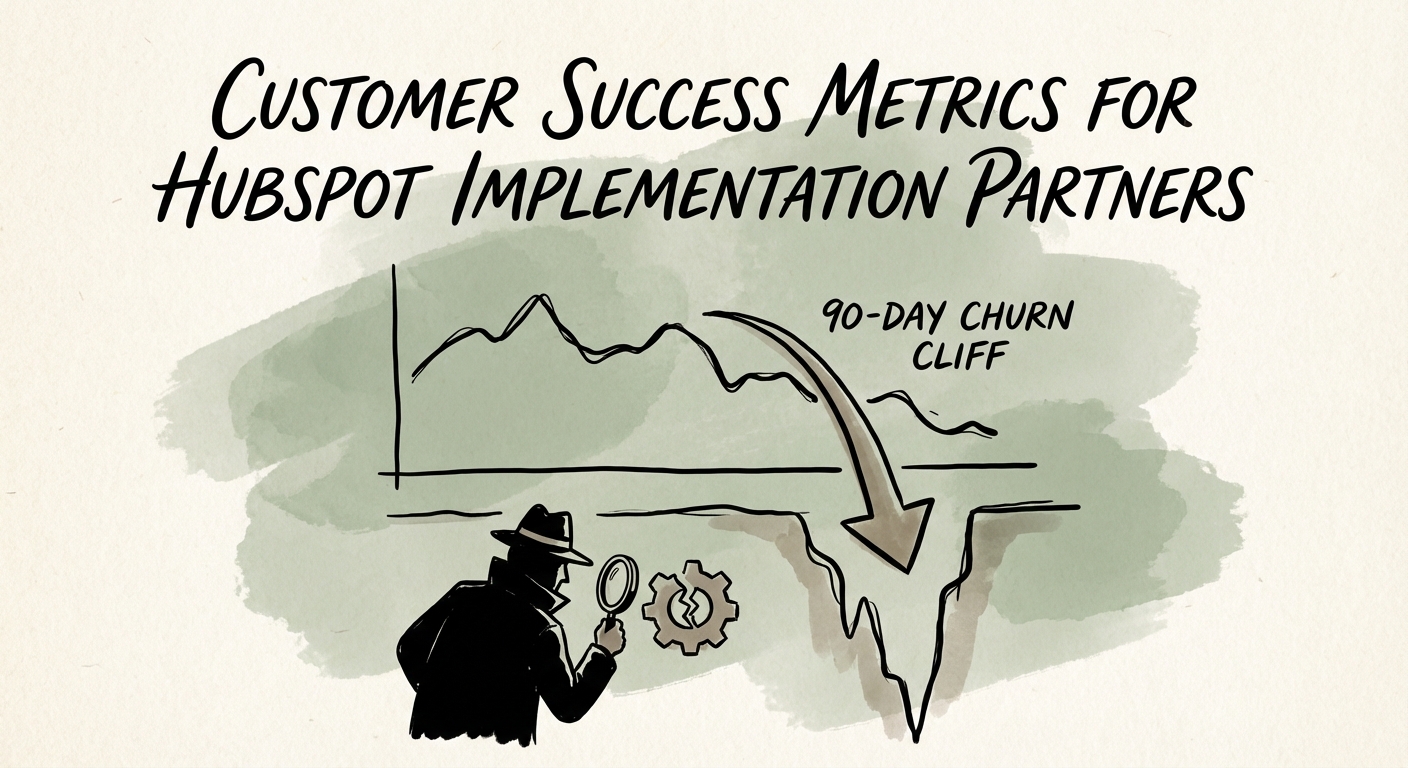
We call this the "Go-Live Lie." You celebrate the launch. The client high-fives you. But 90 days later, usage drops. The "Champion" at the client side gets busy. They stop logging in. And six months later, they cancel your retainer because "we can handle it from here." You didn't build a recurring revenue business; you built a low-margin agency with a SaaS logo on the door.
Your 'Sold MRR' is HubSpot's revenue. Your 'Managed Services NRR' is your valuation. Confusing the two is a million-dollar mistake.
The Diagnostic: Are You Tracking Vanity or Value?
Most partners track the wrong numbers. They look at "Customer Happiness Index" (CHI) or net promoter scores (NPS) and see green. We call these "Watermelon Metrics"—green on the outside, deep red on the inside.
To fix your Revenue Architecture, you need to ignore the vanity metrics and measure the mechanics of your retention. Here is the diagnostic I run with every HubSpot partner portfolio company:
1. The Services NRR Gap
Do not confuse HubSpot's NRR with Yours. SaaS companies aim for 110%+ Net Revenue Retention (NRR). Best-in-class service firms aim for 105%. Most HubSpot partners sit at 85-90%.
The Metric: Calculate NRR specifically on your Managed Services revenue stream (excluding software commissions). If you are below 100%, you are shrinking. You are filling a leaky bucket with more "Sold MRR" just to stand still.
2. The 90-Day Activation Cliff
The danger zone isn't renewal time; it's Day 91. 2025 benchmark data shows that SMB churn rates hover between 3-7% monthly—a material risk for valuation. For implementation partners, the root cause is almost always "Failure to Launch" secondary hubs.
The Metric: Multi-Hub Adoption Rate at Day 90. If you sold Marketing and Sales Hub, but at Day 90 only Marketing Hub is being used daily, that client is already churning. They just haven't told you yet.
3. The Usage Reality Check
Track activation, multi-hub adoption, weekly active users, workflow usage, and renewal health by cohort. These are leading indicators of whether your retainer is driving value or simply keeping the portal running. PE buyers will look at customer usage data during diligence. If they see low usage despite high retainer payments, they will treat that revenue as at-risk.
The Playbook: From "Support" to "RevOps as a Service"
To move from a valuation of 5x EBITDA (Agency) to 10x (Tech-Enabled Services), you must operationalize your Customer Success function. It cannot be a "check-in" call. It must be an engineering discipline.
1. Pivot to "RevOps as a Service"
Stop selling "support hours." Support is a cost center; clients want to cut it. Sell "RevOps as a Service." Package your offering as a strategic roadmap that aligns their HubSpot portal with their revenue goals. This shifts the conversation from "hourly rate" to "ROI." A support contract is cancelled when budgets tighten; a revenue engine is protected.
2. Implement the "QBR Lock"
Your Quarterly Business Review (QBR) is not a social call. It is a re-closing event. Structure your QBRs to demonstrate specific ROI achieved in the last 90 days and, more importantly, to get agreement on the next 90-day roadmap. If the client does not agree to a roadmap, they are churned. Know this now, not when the contract expires.
3. Separate "Delivery" from "Success"
One of the biggest mistakes founders make is having the same person implement the software and manage the relationship. These are opposing skill sets. The "Builder" (Implementation Specialist) wants to finish the task. The "Farmer" (CSM) needs to find new problems to solve.
The Rule of 40 for Partners: If your combined growth rate plus profit margin is not over 40%, you are likely over-servicing clients who are not growing. Re-scope, reprice, or exit accounts that consume disproportionate support capacity while refusing to adopt the roadmap. That is how you protect margins without confusing activity with value.
You are sitting on a massive opportunity. The HubSpot ecosystem is projected to reach $36B by 2029. But you will only capture that value if you stop acting like a reseller and start acting like a strategic operator.