The practical answer
- Short answer
- Stop the 'listening tour.' Here is the metric-obsessed 90-day plan for new CS leaders to fix NRR, audit retention, and align with the C-Suite.
- Best fit
- Industry: B2B SaaS. Function: Customer Success
- Operating path
- Revenue Architecture → Commercial Performance → Office of the CFO
- Key metric
- 106% Median Net Revenue Retention (NRR) for B2B SaaS in 2025. Top quartile performers exceed 120%.
The 'Happiness Tour' Is Dead. Welcome to Revenue Engineering.
If your new Head of Customer Success (CS) spends their first month on a "listening tour" asking customers if they are happy, you have already failed. In 2026, happiness is a vanity metric. Retention is an engineering problem.
The average tenure of a VP of Customer Success has plummeted to 19 months because founders hire relationship builders to solve revenue problems. They treat CS as the "Department of Apologies" rather than the "Department of Net Revenue Retention (NRR)."
The stakes are mathematical, not emotional. Public SaaS firms with NRR <90% trade at a median revenue multiple of 1.2x. Those with NRR >120% trade at 11.7x. Your new CS leader isn't just protecting revenue; they are protecting the valuation of the entire enterprise.
Days 1-30: The Forensic Audit
The first 30 days are for finding hidden risks. Most founders believe their churn problem is a product problem. Usually, it's a data problem masking a segmentation problem.
1. The 'Watermelon' Audit
Your dashboard likely shows 90% of accounts as 'Green.' Yet, you missed your renewal forecast last quarter. This is the Watermelon Effect: Green on the outside, red on the inside. The new CS leader must manually audit the top 20 accounts by revenue. Ignore the health score algorithm; look at the engagement signals. When was the last login? When was the last support ticket closed successfully?
2. The NRR Bridge Construction
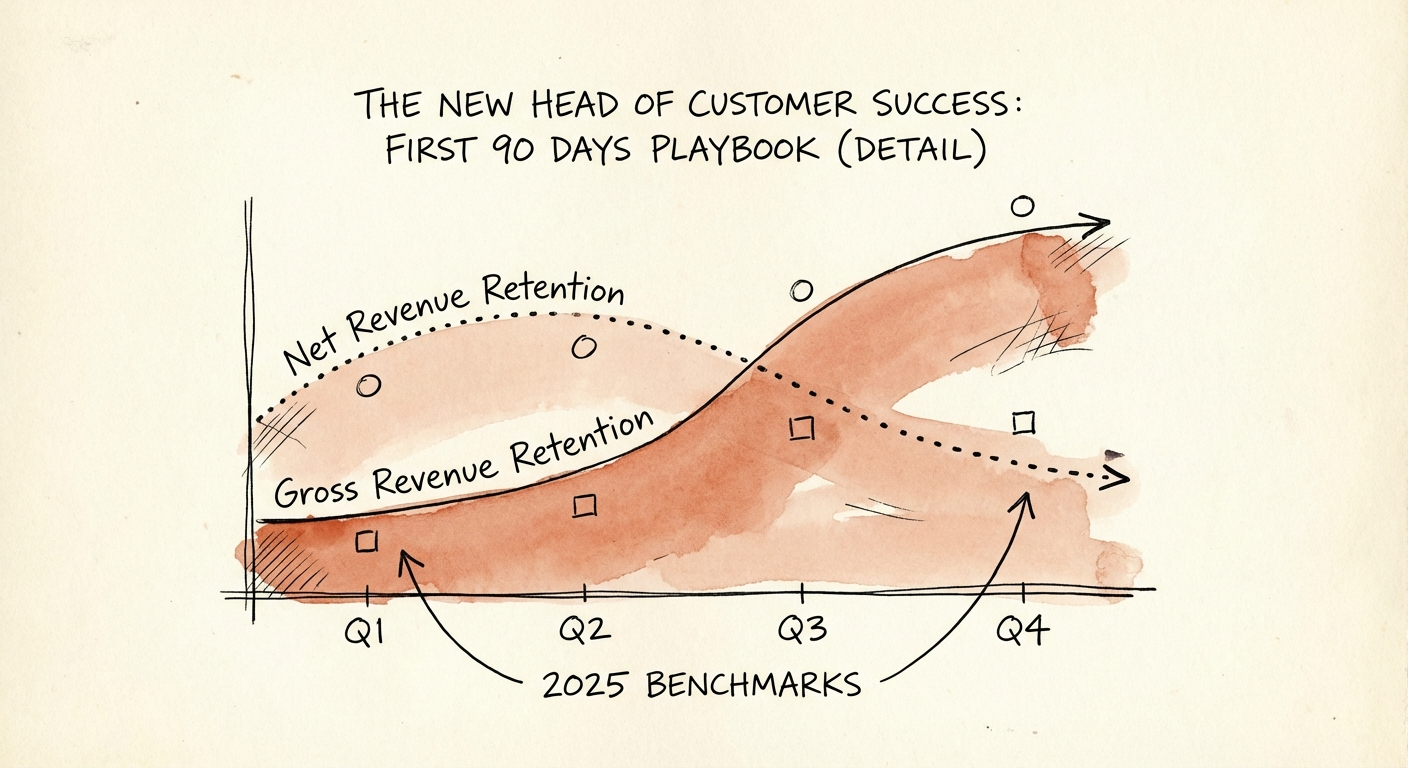
Stop reporting a flat churn number. You need a bridge. Your new leader must build a Net Revenue Retention vs. Gross Revenue Retention waterfall. If GRR is below 90% while NRR is 105%, you are masking a leaky bucket with hero-driven upsells. That is not scalable.
3. The 15 'Value Verification' Calls
No 'Hello' calls. These are investigative interviews. The script is simple: "Why did you buy us? Are we doing that? If your renewal was today, would you sign?" If the answer to the last question is a hesitation, mark it as At-Risk.
If you break down revenue multiples by NRR, companies with <90% NRR trade at 1.2x. Companies with >120% NRR trade at 11.7x. Your CS team is not support; they are your valuation engine.
Days 31-60: Architecture & Segmentation
Once the bleeding is located, you build the tourniquet. This phase is about moving from "heroics" to "systems." Most Series B companies fail here because they treat a $10k ARR customer the same as a $150k ARR customer.
1. The Segmentation Reset
If your CSMs are managing 50 accounts ranging from SMB to Enterprise, they are managing none of them. Your new leader must implement a strict tiering model based on Potential Lifetime Value (LTV), not just current ARR.
- Tier 1 (High Touch): Dedicated CSM. Quarterly Business Reviews (QBRs) that focus on future value, not past bugs.
- Tier 2 (Low Touch): Pooled CSM model. Trigger-based engagement.
- Tier 3 (Tech Touch): Zero human interaction unless a risk trigger fires.
2. The Compensation Reset
Show me how a CSM is paid, and I'll tell you your NRR. If you pay a VP of Sales on closed deals but pay your CSMs a flat base salary, you have misaligned incentives. The new playbook requires a variable comp component tied to Net Retention. If the account expands, the CSM participates in the upside. If the account churns, the compensation plan reflects that loss. This shifts the mindset from "support" to "account management."
3. The 'Red Account' Triage Protocol
You need a documented SOP for when a key account goes dark. Not a Slack message saying "Client X is unhappy." A formal 'Code Red' process involving Executive Sponsorship, Product Engineering, and a Post-Mortem framework. If an account over $50k ARR is at risk, the CEO should know within 24 hours.
Days 61-90: Execution & The Board Deck
By month three, the new leader is no longer "new." They are the owner of the number. This is where we operationalize the forecast.
1. The Renewal Forecast Accuracy Test
Sales leaders are grilled on pipeline accuracy. CS leaders often get a pass. No more. By Day 90, your CS leader must present a 90-Day Rolling Renewal Forecast with +/- 10% accuracy. Phantom revenue in the renewal pipeline is just as deadly as phantom new business.
2. The First Board Presentation
The slide deck determines their credibility. If slide one is "NPS Scores" or "Customer Quotes," they have lost the room. The Board cares about The Rule of 40 and NRR.
The Winning Slide Structure:
- Slide 1: NRR & GRR Trends (YoY).
- Slide 2: Churn Reason Pareto Chart (Product Gap vs. Pricing vs. Champion Loss).
- Slide 3: Expansion Pipeline (The "Upsell" Commit).
- Slide 4: Health of Top 10 Accounts (Red/Yellow/Green with action plans).
The Verdict
A CS leader who survives the first 90 days with this playbook doesn't just keep their job; they become the second most important person in the C-Suite. They stop being the reactive support manager and become the architect of the company's valuation.
For the Founder, your job is simple: Give them the license to be unpopular. Fixing NRR requires breaking the "customer is always right" mindset and replacing it with "the customer must realize value." Those are rarely the same thing.