
The practical answer
- Short answer
- CSAT and on-time delivery don't move a NetSuite partner's multiple. The three metrics that do: Managed Services NRR, SuiteApp attach, and effective rate.
- Best fit
- Industry: Tech Services. Function: Customer Success
- Operating path
- Revenue Architecture → Commercial Performance → Office of the CFO
- Key metric
- 9.8% Average EBITDA margin for Professional Services firms in 2025 (Source: SPI Research).
A 92% on-time rate that an acquirer would ignore
A founder running a $15M NetSuite Alliance Partner walked me through his Q4 numbers like he was reading a trophy case: 40 implementations delivered, 92% on-time, CSAT at 4.8. Every metric his team had been chained to for three years was green.
I asked him two things. How many of those 40 clients have an active SuiteApp or a signed Phase 2 SOW? And what is your dollar-based retention on the Managed Services book past month 13 — the point where the go-live glow wears off and the client decides whether you're a vendor or a habit?
He didn't have either number, because nobody on his team owned them. His entire operating model treated a NetSuite project the way a contractor treats a kitchen remodel: the moment SuiteSuccess hands over the keys and Financials posts its first month-end, the job is done, the consultants roll to the next account, and the relationship goes quiet until something breaks.
That's the trap most Solution Providers and Alliance Partners live in. You're optimizing for go-live velocity — burning your best functional consultants to hit a date so you can recognize the project revenue and move on. It feels like productivity. To a buyer, it reads as a business with no second act.
The numbers underneath the model are unforgiving. SPI Research's 2025 Professional Services Maturity Benchmark puts industry billable utilization at 68.9% and EBITDA margins at 9.8%. If your revenue is mostly project hours, you're absorbing wage inflation on the cost side and commoditization on the price side — there are hundreds of partners in Oracle's program who can stand up the same Financials module you do. A pure project shop trades at roughly 1x revenue. The partners commanding 3x and up aren't better at go-lives. They've built something that keeps paying after go-live.
In a NetSuite practice, the second SuiteApp module is worth more than the first implementation. One is a project. The other is an annuity — and annuities are what acquirers actually pay for.
Three numbers that survive a quality-of-earnings review
CSAT is the metric you bring to a board meeting when you don't want hard questions. A client can adore your lead consultant and still let the ACS contract lapse because they never saw the second module materialize. Salesforce makes the same point in its rundown of the customer success metrics that actually matter: sentiment is a lagging signal, retention and expansion are the leading ones. Here are the three a NetSuite acquirer will pull straight out of your data.
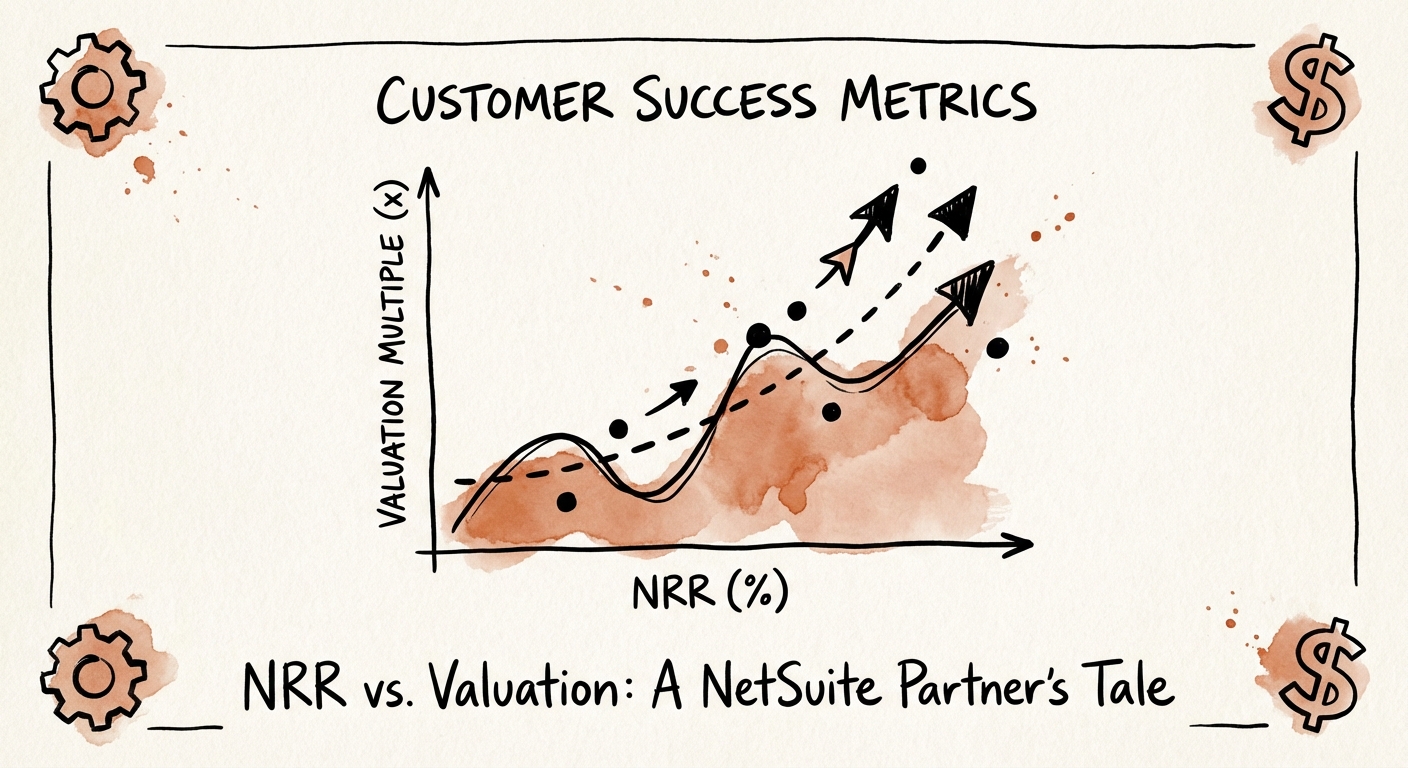
1. Net Revenue Retention on the Managed Services / ACS book
Most partners run Advanced Customer Support as a break-fix safety valve — a place to park bug tickets and unused hours. That's backwards. Recurring NetSuite support and optimization is the one line on your P&L a buyer underwrites as an annuity, and they'll model it on dollar-based NRR.
The average partner sits at 90–95% — quietly losing 5–10% of that book every year and refilling it with expensive new-logo work. Top-quartile practices clear 110%, meaning the same cohort spends more next year than this year. The structural fix is contract design: kill the "hours bank," which trains clients to hoard and underconsume, and move to outcome-tied retainers — a quarterly close acceleration target, a SuiteAnalytics dashboard SLA, a configuration-debt burn-down — so the relationship grows with their NetSuite footprint instead of decaying with it.
2. SuiteApp and second-module attach within 90 days
Every NetSuite deal ships with a "Phase 2" in the presales deck: start with Core Financials, then layer in SuiteBilling, WMS, SuitePeople, the Shopify or Celigo connector. The question no founder tracks is how often Phase 2 is real. Measure the percentage of go-live clients who sign a new SOW or attach a billable SuiteApp within 90 days. One-and-done shops land under 20%. Leaders run past 60%.
If you're stuck near 20%, the cause usually isn't sales — it's delivery. A team limping across the finish line to protect a green project status has often spent its goodwill mid-implementation: scope fights, change-order friction, a CFO who's exhausted. You closed the project and torched the expansion in the same motion. The second module is where NetSuite economics actually compound, and you're leaving it on the table at the moment the client is most ready to buy.
3. Effective rate versus card rate
Your rate card says $225 an hour. After write-offs, goodwill concessions, and the unbilled hours a consultant eats fixing their own SuiteScript, what do you actually collect? Divide total project revenue by total hours worked and compare it to the card. A realization leak above 15% is a red flag in diligence, because a buyer's quality-of-earnings team strips that subsidy out. If your effective rate is $150 on a $225 card, your reported margin is partly fiction — you're funding loose scoping and rework with free labor, and the moment an acquirer normalizes it, your EBITDA shrinks in front of them.
What to instrument before your next pipeline review
The gap between a body shop and a strategic NetSuite partner isn't talent — both have sharp consultants. It's whether revenue is bolted to headcount or detached from it. Three concrete moves, in order of how fast they pay back:
- Productize what you keep rebuilding. The custom revenue-recognition script, the SuiteBilling configuration, the connector you've now wired for the tenth client — package it as a listed SuiteApp or a fixed-fee accelerator. Every reusable asset converts a one-time labor cost into a margin line that doesn't consume a consultant week to deliver again.
- Make the QBR a roadmap, not a ticket recap. If your customer success team is walking clients through last quarter's support volume, you've turned a growth conversation into a status meeting. The agenda should be the next NetSuite module, the next automation, the next thing that raises that account's spend. No roadmap on the table, no QBR worth holding.
- Stop paying delivery leads on utilization. Utilization rewards keeping people busy, not keeping clients growing. Comp your delivery directors on account expansion and net retention. A director who hits every go-live date and watches the client lapse at renewal didn't succeed — they ran a profitable project inside a shrinking business.
Pick one metric — Managed Services NRR is usually the highest-leverage — and put a real number against it before your next forecast review. Not because it makes the deck cleaner, but because it's the first number a serious buyer will ask for, and the day you go to market is the worst possible day to learn you've never measured it.