
The practical answer
- Short answer
- Why Shopify Plus partners with B2B expertise trade at 12x EBITDA while generalist agencies stall at 5x. 2026 benchmarks for retainers, margins, and growth.
- Best fit
- Industry: Professional Services. Function: Growth Strategy
- Operating path
- Revenue Architecture → Commercial Performance → Office of the CFO
- Key metric
- 12x EBITDA multiple for 'Platinum' Shopify partners with 50%+ recurring revenue mix.
The 'Theme Builder' vs. The Commerce Consultancy
For the last decade, the Shopify partner ecosystem was defined by a simple arbitrage: demand for 'direct-to-consumer' (DTC) brands outstripped the supply of developers. Agencies could build a healthy $5M business simply by customizing standard themes for $50,000 a pop. That era is over.
In 2026, the 'Theme Builder' model is a valuation trap. With AI-driven site builders compressing the lower end of the market, generalist agencies are seeing project fees collapse and valuations stall at 4x-5x EBITDA. The real opportunity—and the reason private equity is aggressively rolling up the ecosystem—lies in the Enterprise Migration and B2B waves.
Shopify’s B2B Gross Merchandise Volume (GMV) grew 140% year-over-year in 2024, and accelerated another 101% in Q2 2025. This isn't about selling t-shirts; it's about industrial manufacturers, wholesale distributors, and legacy retailers migrating from bloated Magento or Salesforce Commerce Cloud instances to Shopify Plus. These projects aren't $50k builds; they are $500k digital transformation programs with $20k/month 'Growth Retainers' attached.
The 'Maintenance Deficit' Dividend
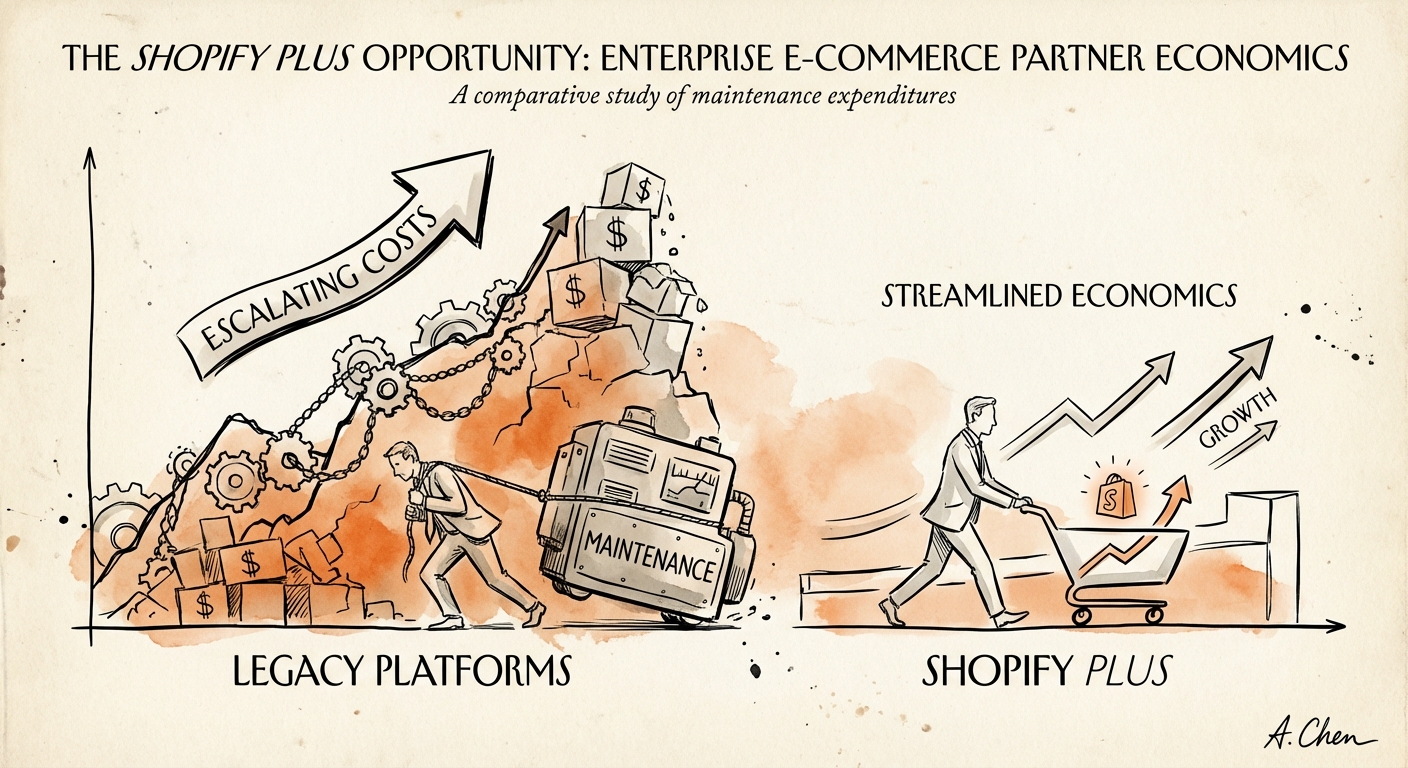
The primary driver for this migration is what we call the 'Maintenance Deficit.' Enterprise brands moving from legacy monoliths to Shopify Plus typically see a 40-50% reduction in technical maintenance costs. For a specialized partner, this creates a massive wedge: you aren't selling a website; you are selling EBITDA expansion to the CFO. Partners who frame their value proposition around this 'Total Cost of Ownership' (TCO) reduction are winning 70% of competitive bids against legacy systems integrators.
The era of the $50k Shopify build is dead. The future belongs to partners who can orchestrate a $50M B2B P&L. If you're still selling themes, you're selling a commodity.
The Economics of 'Platinum' Status
The 2025 overhaul of the Shopify Partner Program created a bifurcation in the market. The new tiered system—moving from Registered to Select, Plus, Premier, and Platinum—has explicitly separated the 'implementers' from the 'strategic assets.' This distinction is now the primary lens through which acquirers evaluate commerce agencies.
Data from the 2025 partner landscape shows a stark divergence in unit economics:
- Generalist Agencies (Select/Registered): 80% Project Revenue / 20% Recurring. Blended Gross Margins: 35-40%. Valuation: 4x-5x EBITDA.
- Enterprise Partners (Premier/Platinum): 40% Project Revenue / 60% Recurring (Managed Services + CRO). Blended Gross Margins: 55-60%. Valuation: 10x-14x EBITDA.
The valuation premium for 'Platinum' partners isn't just about the badge; it's about the Revenue Quality. Elite partners have pivoted from one-off builds to 'Commerce Intelligence' retainers. They don't just fix bugs; they own the metrics—Conversion Rate Optimization (CRO), Average Order Value (AOV), and Customer Lifetime Value (CLTV). When you contractually tie your retainer to the client's GMV growth, you cease to be a vendor and become a revenue partner.
The Technical Moat: B2B and Composability
To command a 12x exit multiple, your firm must demonstrate a 'Technical Moat' that AI cannot easily replicate. In the Shopify ecosystem, this moat is currently defined by two capabilities: Complex B2B Logic and Composable Commerce (Hydrogen/Oxygen).
While standard DTC sites are becoming commodities, B2B commerce requires deep integration with ERPs (NetSuite, SAP), PIMs, and complex pricing rules (e.g., 'Customer A gets 15% off SKU X but only if they buy 50 units'). This is 'hard engineering' that protects your margins. A 'Generalist' NetSuite Partner often lacks the frontend DNA to pull this off, while a creative agency lacks the backend logic. The Shopify Plus partner who bridges this gap sits in the 'Golden Triangle' of valuation.
Furthermore, the shift to 'Composable' architectures—using Shopify as the commerce engine but building custom frontends—locks in long-term stickiness. These environments require ongoing, high-level engineering support, ensuring your 'Churn' metric remains near zero. In due diligence, we look for 'Net Revenue Retention' (NRR) above 120% as proof of this stickiness. If your NRR is flat, you are a project shop. If it's expanding, you are a platform.