
The practical answer
- Short answer
- Why Salesforce partners stuck in project revenue trade at 5x EBITDA while managed services firms hit 12x. The complete diagnostic for transitioning to recurring revenue.
- Best fit
- Industry: Technology Services. Function: Revenue Operations
- Operating path
- Revenue Architecture → Commercial Performance → Office of the CFO
- Key metric
- 50-80¢ Enterprise Value per $1 of Project Revenue
The Mathematics of Mediocrity
You have built a successful Salesforce consultancy. You have $15M in revenue, a roster of logos that would make a Global S.I. jealous, and a delivery team that performs miracles daily. You are rightfully proud.
But if you tried to sell your firm today, you would be insulted by the offer.
In 2025/2026, the valuation gap between Project-Based Services and Managed Services didn't just widen; it became a canyon. Pure-play project consultancies are trading at 5x–7x EBITDA. Firms with >50% recurring managed services revenue are commanding 10x–12x EBITDA—and often significantly higher if they demonstrate "SaaS-like" retention metrics.
Why? Because private equity buyers have stopped paying for "heroics." They are paying for predictability.
If you are a Founder, you are likely trapped in the "Project Hamster Wheel." You kill yourself to close a $500k implementation, your team burns out delivering it, and on January 1st, your revenue counter resets to zero. You start every year fighting for survival, regardless of how well you did the year before.
This isn't just a stress problem; it's a wealth problem. Every dollar of project revenue is worth roughly $0.50 to $0.80 in Enterprise Value at exit. Every dollar of recurring managed services revenue is worth $2.00 to $4.00.
You are working twice as hard for half the equity value. It is time to engineer your way out.
Private equity buyers have stopped paying for heroics. They are paying for predictability. If your revenue resets to zero on January 1st, your valuation resets with it.
The Diagnostic: Are You Running a Firm or a Firehouse?
Most Salesforce partners think they offer managed services. They point to their "Support" contracts and say, "Look, recurring revenue!"
But when we open the hood during due diligence, what we usually find is not Managed Services. It is Retained Break/Fix.
The "Retained Break/Fix" Trap
You sell a bucket of hours (e.g., 40 hours/month). The client uses them to fix bugs, reset passwords, or make minor tweaks. This is not recurring revenue; it is pre-paid consulting. It suffers from three fatal flaws that kill valuation:
- It's Reactive: Your team waits for tickets. No tickets = no value perception = churn.
- It's Lumpy: One month the client uses 5 hours; the next they need 100. This destroys utilization planning.
- It's Low Margin: Because you can't forecast the work, you can't optimize the staffing. You are forced to keep expensive senior resources on the bench "just in case."
Real Managed Services isn't about selling hours; it's about selling outcomes and capacity. It is the difference between a gym membership (recurring, predictable) and paying a personal trainer by the hour (lumpy, dependent on schedule).
The Hybrid Hell
The most dangerous phase is the transition. We call this "Hybrid Hell." This is when you try to run a high-velocity project business alongside a stability-focused managed services unit using the same resources.
It fails 100% of the time. Why? Because the "Project" scream is always louder than the "Managed Services" whisper. When a $500k implementation goes red, you pull your best architect off the $10k/month managed services account to save it. You save the project, but you breach the SLA, erode trust, and eventually churn the recurring revenue that was supposed to be your exit ticket.
To escape, you must stop treating Managed Services as the "afterthought" of your delivery organization.
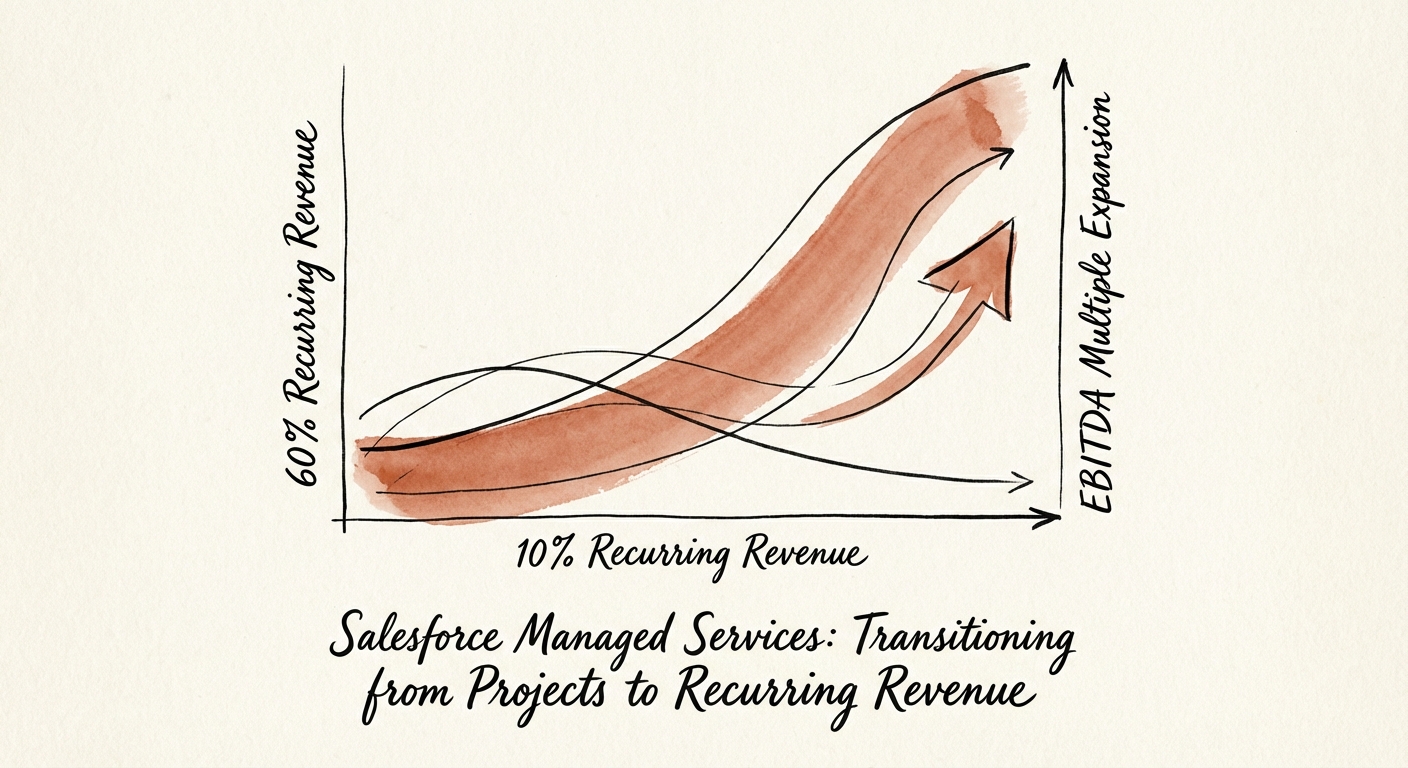
The Playbook: From Projects to Platforms
Transitioning to recurring revenue requires a fundamental re-architecture of your commercial and operational model. We have guided dozens of firms through this shift. Here is the 12-month roadmap.
1. Productize the Offer (Stop Selling Hours)
Stop selling "buckets of hours." Start selling Managed Capacity Pods or Functional Outcomes.
- Bad: "Silver Support Package: 20 hours/month for $4,000."
- Good: "RevOps as a Service: Full management of your CPQ and Sales Cloud pipelines, bi-weekly release cycles, and quarterly roadmap planning. $8,000/month."
Buyers pay a premium for the system, not the sweat.
2. The "Pod" Delivery Model
Separate your teams. You need a dedicated Managed Services team that is walled off from project delivery. This team should not be staffed with your "B-players" or junior associates. It requires a specific type of engineer: one who values stability, documentation, and long-term architecture over the adrenaline rush of a go-live.
Structure them into "Pods" (e.g., 1 Lead, 2 Admins, 0.5 Developer) assigned to a fixed set of recurring clients. This allows you to forecast utilization with 90%+ accuracy, driving margins from the industry average of 40% up to 60%+.
3. The "Land and Expand" Commercial Motion
Your Managed Services contract is not the end of the sale; it is the beginning. In a project model, Sales hands off to Delivery and walks away. In a Managed Services model, the Customer Success Manager (CSM) becomes your most profitable sales rep.
We track a metric called "Expansion Revenue Ratio." For every $1 of recurring revenue signed, how much project revenue does that account generate in year 2? Best-in-class Salesforce partners see a 1.5x ratio. The steady state of Managed Services uncovers new needs (e.g., "We need to integrate Snowflake," "We need to implement Agentforce"), which feeds your project team high-margin, zero-CAC work.
The Exit Impact
Let's do the math.
Scenario A (Project Heavy): $10M Revenue, $2M EBITDA. 90% Projects. Valuation: ~6x EBITDA = $12M.
Scenario B (Recurring Hybrid): $10M Revenue, $2M EBITDA. 50% Recurring. Valuation: ~10x EBITDA = $20M.
Same revenue. Same profit. $8 Million more in your pocket.
Stop building a business that wakes up unemployed every January 1st.