
The practical answer
- Short answer
- Only 39% of SAP ECC customers have licensed S/4HANA. Here is how SAP partners can fix revenue forecasting visibility and avoid the 'utilization trap' before the 2027 deadline.
- Best fit
- Industry: Technology Services. Function: Revenue Operations
- Operating path
- Revenue Architecture → Commercial Performance → Office of the CFO
- Key metric
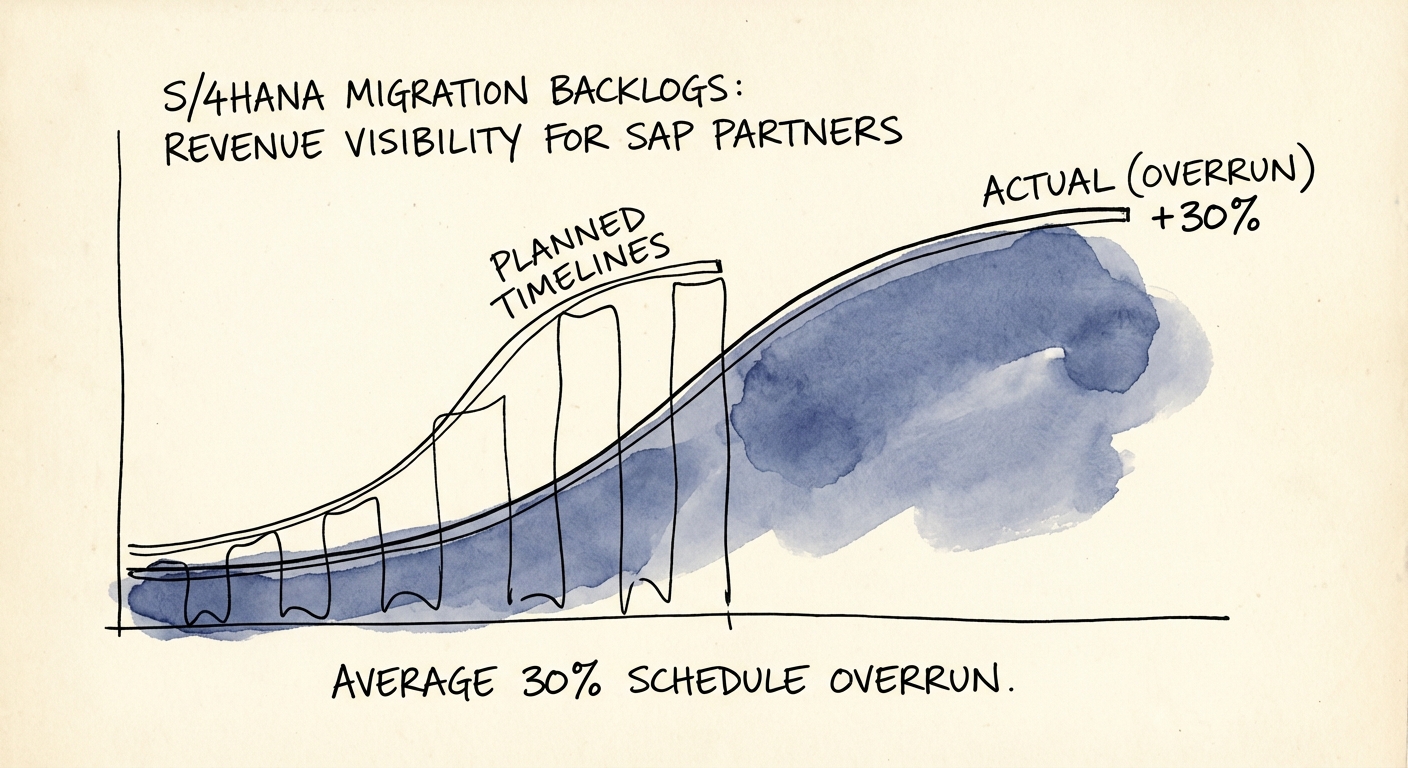
- 30% Average schedule overrun for S/4HANA migration projects (Horváth 2025 Study).
The 2027 Cliff Is Creating a 'Phantom Pipeline'
If you run an SAP partner firm, your sales forecast for 2026 probably looks fantastic on paper. You have a roster of legacy ECC customers who must migrate to S/4HANA before the mainstream maintenance deadline on December 31, 2027. Your spreadsheets show a massive wave of services revenue kicking off in Q1 and Q2. You are likely hiring ahead of the curve, terrified of a resource shortage when the floodgates open.
Stop. You are looking at a mirage.
According to Gartner's latest data, only 39% of SAP ECC customers have even licensed S/4HANA as of late 2024. That leaves over 60% of the market—roughly 21,000 enterprise customers—staring down a deadline that is less than 24 months away. Logic dictates they should be signing contracts right now. Reality says they are stalling.
This creates what I call the Phantom Pipeline. These deals are technically "committed" to the eventuality of migration, but they are uncommitted to a timeline. If you are forecasting revenue based on the 2027 deadline acting as a forcing function, you are setting your firm up for a cash flow crisis. The "2027 Cliff" has created a game of chicken between CIOs and their budgets, and right now, the CIOs are winning by doing nothing.
The Cost of Waiting
While your customers stall, your bench bleeds cash. I see mid-sized SAP consultancies holding expensive functional consultants and architects in a "warm bench" state, anticipating a project start date that slips from January to April, then to September. This destroys utilization rates and erodes EBITDA margins long before the project even begins.
The '2027 Cliff' isn't a guarantee of revenue; it's a guarantee of chaos. If you are staffing up for projects that haven't signed a paid assessment, you aren't forecasting—you're gambling.
The 'Utilization Trap' and Schedule Slippage
The second lie in your forecast is the duration of the migration itself. Even when these projects do sign, they are not behaving like the predictable ERP implementations of the past. A 2025 study by Horváth revealed that S/4HANA migration projects are taking an average of 30% longer than planned, with only 8% finishing on schedule.
For a services firm, an extended timeline sounds like good news (more billable hours), but in a fixed-bid or capped T&M environment, it is a margin killer. When a 12-month project stretches to 16 months due to "data quality issues" or "stakeholder misalignment," your effective bill rate plummets. You are deploying the same high-cost resources for longer periods without a commensurate increase in revenue recognition velocity.
Why Projects Are Stalling
The delay isn't technical; it's data. Precisely and ASUG found that data quality is a top barrier, yet it is rarely scoped correctly in the pre-sales phase. Customers assume a "lift and shift" (Brownfield) approach will be fast, only to discover their 15 years of customized ECC spaghetti code cannot simply be ported to S/4HANA's clean core. This discovery phase—often happening after the SOW is signed—halts revenue recognition while change orders are negotiated.
If your forecast assumes a linear revenue burn starting Day 1, you are lying to yourself about coverage. You need to restructure how you model these engagements.
Fixing the Forecast: The 'Paid Assessment' Gate
You cannot build a scalable services business on hope. To fix your revenue visibility, you must change your engagement model. Stop waiting for the "Big Bang" migration implementation contract. Instead, unbundle the risk and sell it upfront.
1. The 'Readiness Assessment' Gate
Do not allow a deal into "Committed" (90%+) forecast status until the client has paid for a Readiness Assessment. This is a 4-6 week engagement, priced between $50k-$150k, that audits their custom code, data hygiene, and business process compatibility.
Why this works:
- It qualifies urgency: A client who won't spend $50k on an assessment today will not spend $5M on a migration tomorrow.
- It anchors the resource: You get billable utilization now for your architects, rather than waiting for the main project.
- It derisks the SOW: You discover the data landmines before you sign the fixed-bid implementation contract.
2. Forecast on 'Starts' Not 'Deadlines'
Remove the 2027 deadline from your probability weighting algorithm. Just because they have to move doesn't mean they will move with you, or that they will move on time. SAP is already offering extended maintenance options (for a premium) through 2030. Many customers will pay the penalty rather than rush a failed migration.
Shift your revenue architecture. If you don't have a signed assessment, the deal is 25% probability at best. Real revenue visibility comes from active engagement, not passive necessity.