The practical answer
- Short answer
- Server migrations are over. The new opportunity for Atlassian Partners is Data Center transformation and Cloud consolidation. Here is the 2026 playbook.
- Best fit
- Industry: Technology Services. Function: Revenue Operations
- Operating path
- Revenue Architecture → Commercial Performance → Office of the CFO
- Key metric
- 75% of developer activity in large enterprises remains on-premise (Data Center), representing the 'high-complexity' market opportunity.
The 'Easy' Migration Era Is Dead (And It’s Not Coming Back)
For the last five years, Atlassian Partners have ridden a wave of forced demand. The 'Server End of Life' (EOL) announcement created a panic-driven market where 'lift and shift' migrations were enough to drive 30% year-over-year growth. If you had a pulse and a certification, you had a pipeline.
That era ended in February 2024. Today, in 2026, the landscape has bifurcated. While Atlassian reports that 99% of customers have a cloud footprint, independent data from BlueOptima reveals a starker reality: 75% of actual developer activity in large enterprises still runs on-premise (Data Center). The 'easy' mid-market migrations are finished. What remains is the 'Stubborn 75%'—highly regulated, complex, multi-instance Data Center environments that require architecture, not just movement.
The forcing function is no longer just support expiration; it is the March 30, 2026 deadline, which marks the end of new Data Center license sales. However, partners still pitching simple migration services are finding themselves in a race to the bottom on price. Private Equity buyers have caught on: they are pricing 'migration factories' at 1.5x revenue, while firms selling 'Cloud Modernization' and 'System of Work' managed services are trading at 6x revenue. The message is clear: stop selling the move, and start selling the destination.
The partners winning in 2026 aren't moving data; they are architecting the 'System of Work.' If your primary revenue stream is still labeled 'Migration,' you are liquidating your own backlog.
The 'Cloud Consolidation' Gold Mine
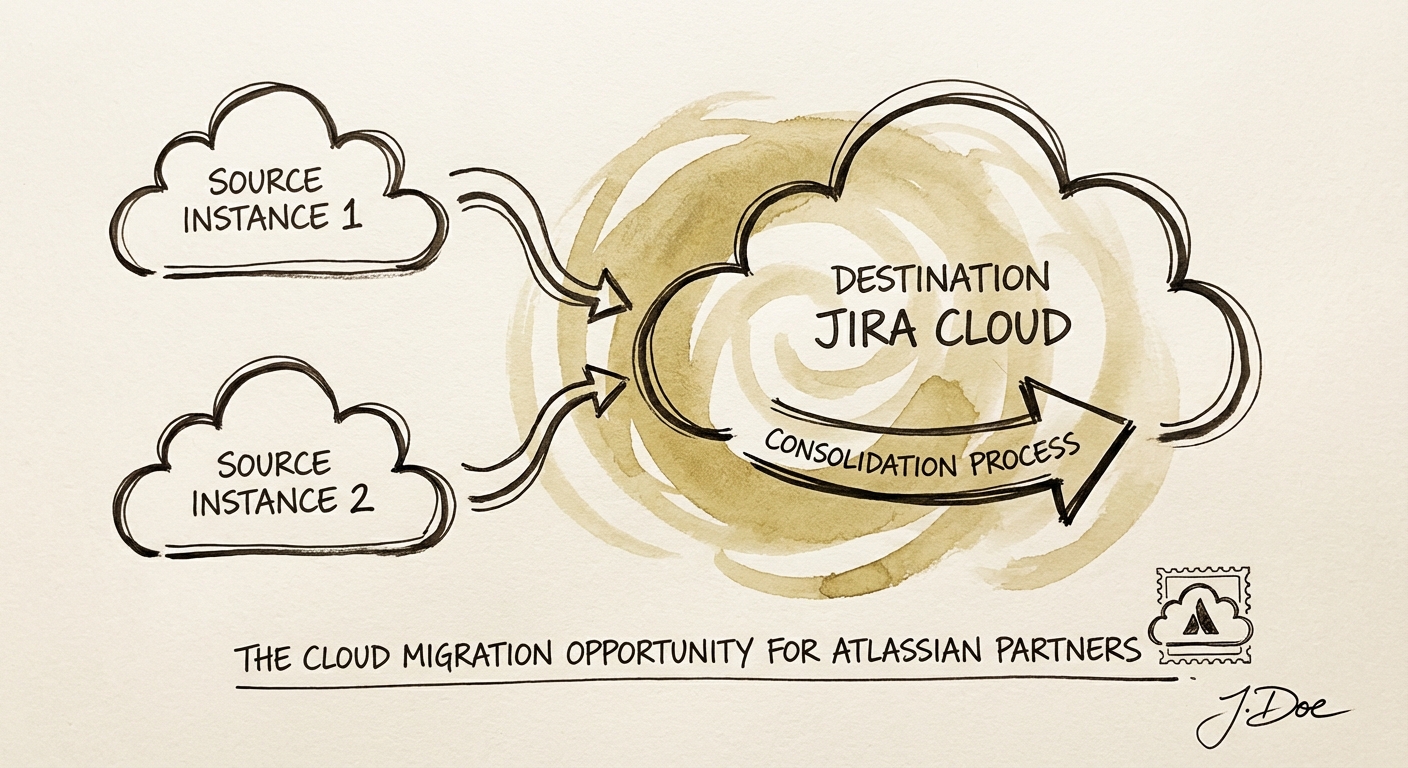
The untold story of the 2020-2024 migration rush is the mess it left behind. In their haste to beat the Server EOL deadline, thousands of enterprises lifted bad processes into the cloud, or worse, spun up fragmented cloud instances for different departments. The result is 'Cloud Sprawl'—a nightmare of disconnected Jira instances, shadow IT, and runaway license costs.
This is your new revenue engine. We are seeing forward-thinking Atlassian Partners pivot their entire GTM strategy from 'Migration' to 'Consolidation.' The trigger events are M&A activity and renewal shocks. When a PE firm acquires two portfolio companies, they don't want two Jira instances; they want a unified 'System of Work.'
The economics of consolidation are superior to migration. A migration is a one-time project with a clear end date (churn risk). A consolidation project, however, requires ongoing governance, identity management restructuring, and long-term 'Cloud Optimization' retainers. Data shows that partners who attach a 'Governance Retainer' to a consolidation project see Net Revenue Retention (NRR) of 115%, compared to 90% for pure migration shops.
The AI Wedge: Rovo as the Migration Catalyst
For the 'Stubborn 75%' of enterprises still clinging to Data Center, security and compliance were the shields they used to deflect cloud sales pitches. In 2026, those shields are cracking under the pressure of AI demand. Atlassian’s Rovo (AI) is Cloud-only. This gives Partners a new, strategic wedge.
Your conversation with the CIO is no longer about 'getting off servers'—it is about 'unlocking intelligence.' The pitch is simple: 'Your data is trapped in a dumb container (Data Center). Move it to Cloud to turn it into an intelligent asset.'
However, the trap for Partners is treating Rovo implementation as a technical setup. It is not. It is a knowledge management overhaul. Rovo is useless if the underlying Confluence pages and Jira tickets are garbage. The highest-margin service offering for Atlassian Partners in 2026 is 'AI Readiness Preparation'—cleaning data, structuring taxonomy, and setting permissions before the migration. This shifts your billing model from 'hours worked' to 'value delivered,' decoupling your revenue from the commodity trap of data transfer.