
The practical answer
- Short answer
- Dynamics 365 partners bury Power Platform on the invoice. Here's the line-item audit that turns those hours into reusable IP and a higher exit multiple.
- Best fit
- Industry: B2B Tech Services. Function: Revenue Operations
- Operating path
- Revenue Architecture → Commercial Performance → Office of the CFO
- Key metric
- 27% Year-over-year growth in Power Platform Monthly Active Users (2025)
The line item you buried on your last SOW
Pull up the most recent Dynamics 365 statement of work your firm signed. Somewhere in the delivery breakdown, under the big "F&O implementation" or "CE rollout" header, there's a sub-bullet that reads something like "Power Apps configuration and workflow automation — 80 hrs." You billed it at your blended functional-consultant rate. The client never saw it as a separate decision. And that buried line is the single highest-margin thing your team produced all quarter.
That's the trap most Dynamics partners are sitting in right now. License margin keeps thinning into a volume game that rewards the global SIs, and the bidding war for functional consultants who actually know the supply-chain or finance module pushes delivery cost up until services margin lives somewhere around 35-40%. The instinct is to chase bigger D365 implementations and out-run the math. The math wins. It always wins, because you're scaling the part of the business with the worst unit economics.
The numbers underneath this are not subtle. Microsoft's Dynamics 365 revenue grew 23% in fiscal 2025 (Microsoft FY25 Q2 earnings call), but Power Platform monthly active users climbed 27% over the same stretch (CRN, April 2025). The connective tissue — the apps, flows, and Dataverse-backed interfaces that sit on top of the ERP — is growing faster than the ERP itself. Demand for that layer is the loudest signal in the ecosystem, and roughly seven in ten of the Dynamics shops I look at still treat it as a patch kit for filling holes in a requirements doc.
Where the multiplier actually lives
IDC's work on the Microsoft partner ecosystem put a hard figure on the gap (IDC white paper, September 2024). For every $1 of Microsoft license a services-led partner sells, they pull through $8.45 in services. For a software-led partner with their own IP, that same $1 pulls through $10.93. The $2.48 delta isn't a rounding difference — it's the line between a body-shop trading at roughly 1.5x revenue and a platform business trading north of 6x. Every hour of Power Apps work you bury inside a D365 SOW is you choosing, by default, to stay in the lower bucket.
Look at your last statement of work. If "Power Apps configuration" is a sub-bullet under "Dynamics implementation," you just expensed your most valuable asset as a rounding error.
Stop customizing the ERP. Start shipping the app on top of it.
Here's the architectural shift that makes the economics work. The old reflex, when a client needed something Dynamics didn't do out of the box, was to write a plugin or fork the core. Every one of those becomes a liability the moment Microsoft pushes the next wave update — you're paying down technical debt at exactly the wrong time, on someone else's release schedule.
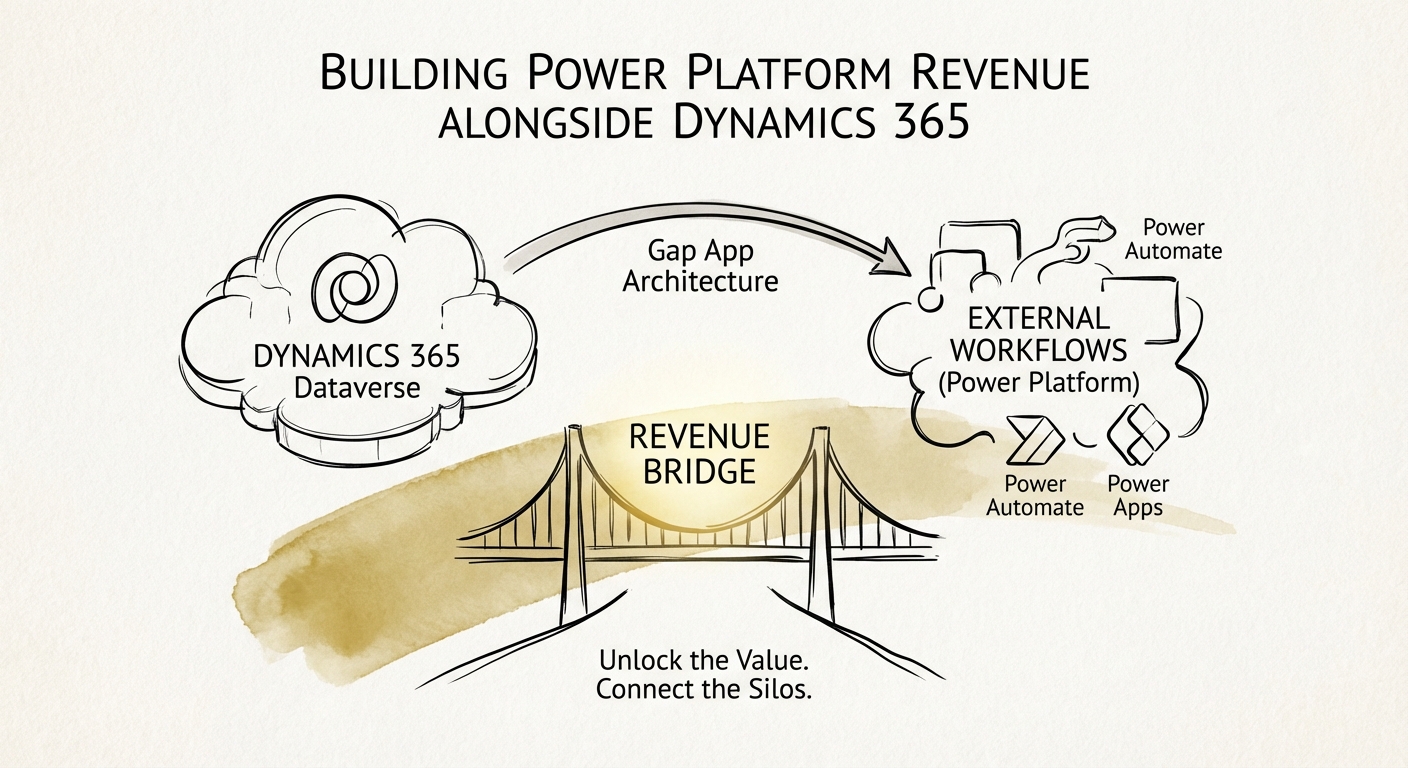
The alternative is to leave the core untouched and stand the unique workflow up as a Power App on the Dataverse the client already owns. The upgrade path stays clean. And — this is the part that changes your valuation — you've now built a discrete thing instead of a modification welded into a tenant. A discrete thing can be sold again.
Run this audit on your own pipeline. Take your last five completed Dynamics projects and isolate the three gnarliest custom builds in each. For every one, ask which sentence describes how it left the building:
- "We delivered 80 hours of development." A one-time engagement at your services margin, gone the day you invoice it.
- "We deployed our Field Service Dispatch app" — or your vendor-onboarding portal, or your project-billing reconciler. Configurable to the next client at near-zero cost of goods. The second sale carries the margin of pure software, not labor.
If everything in that audit reads as hours, you've been manufacturing assets and expensing them as labor. Naming the repeatable ones, versioning them, and selling them again is the most direct way out of the services valuation trap.
The retention number your comp plan is ignoring
Your sellers are paid to land the F&O or Sales Enterprise license. They treat the $20-per-user Power Apps line as noise, so it gets discounted into the deal or thrown in to close. That comp design is quietly destroying retention value.
Think about exit cost from the client's side. A clean Dynamics 365 install can migrate to NetSuite or Salesforce with real but survivable pain — it happens at renewal more than partners like to admit. Now layer in five Power Apps that the warehouse team, the AP clerks, and the field techs touch every single shift. Those apps are wired into how the business runs hour to hour. The switching cost stops being a project and becomes a reason to never leave. That's the mechanism behind durable net revenue retention, and for any founder eyeing a sale, NRR is the lever that moves valuation multiples more than top-line growth does. Pay your team to embed the platform, not to discount it.
Three ways to stand this up — and the trap inside the cheapest one
The honest constraint: your bench is functional consultants who can model a chart of accounts in their sleep, not engineers who think in component libraries and ALM pipelines. So the appealing shortcut is to declare your business analysts "citizen developers" and have them productize apps between client calls. That doesn't produce sellable software. It produces fragile demos that fall over on the second client's data model, and it quietly burns out the analysts you most need on billable work. Skip it. Pick one of these three instead.
Build it: a small team that doesn't carry a utilization target
Ring-fence two or three developers whose mandate is to harvest the repeatable patterns out of delivered projects and turn them into packaged apps — and explicitly do not hold them to 100% billable utilization. The moment their hours show up on a client invoice, urgent delivery work will eat every minute they were supposed to spend building reusable IP. Protected time is the whole point; if you can't protect it, don't pretend you have a product team.
Borrow it: white-label a Power Platform boutique
The fastest route, especially for expanding into a new vertical, is to partner with a shop that does only Power Platform and has none of your enterprise sales motion. You keep the client relationship and the D365 anchor; they deliver the apps under your name at a 20-30% white-label margin. It lets you say yes to hard requirements without adding a single engineer to payroll — and it's reversible if the niche doesn't pan out.
Buy it: acqui-hire the velocity
Once you're past roughly $20M in revenue, buying a 5-to-10-person Power Platform shop is often cheaper than building the muscle from zero. You're not paying for their revenue — you're paying to skip the slow grind of learning to ship production apps on the Dataverse from scratch.
Whichever path you take, the move this week is concrete: run the five-project audit, find the three builds you'd be embarrassed to bill twice as "custom work," and put a product name and a version number on them. Dynamics 365 is the operating system your clients run on. Power Platform is where they actually feel the value — and where you finally stop selling time by the hour.