
The practical answer
- Short answer
- Microsoft Business Central is booming, but generalist partners are dying. Here is the diagnostic on how to capture the opportunity without killing your margins.
- Best fit
- Industry: B2B Tech Services. Function: Revenue Operations
- Operating path
- Revenue Architecture → Commercial Performance → Office of the CFO
- Key metric
- 12-18% Average CSP Margin for Generalist Partners
The market opening vs. The Margin Trap
Microsoft Dynamics 365 Business Central (BC) is, to use the industry vernacular, "white hot." With over 45,000 SaaS customers and a user base aggressively migrating from legacy NAV and GP systems, the ecosystem is seeing double-digit growth. For a founder or PE Operating Partner looking at the surface metrics, it looks like a license to print money. You have a captive audience of millions of SMBs forced to digitize, a trillion-dollar vendor (Microsoft) pushing AI-driven incentives, and a market demanding cloud ERP.
But if you look at the P&L of the average Business Central partner, the story is different. They are bleeding. Why? Because they are playing the 2015 game in a 2026 market.
The License Margin Compression
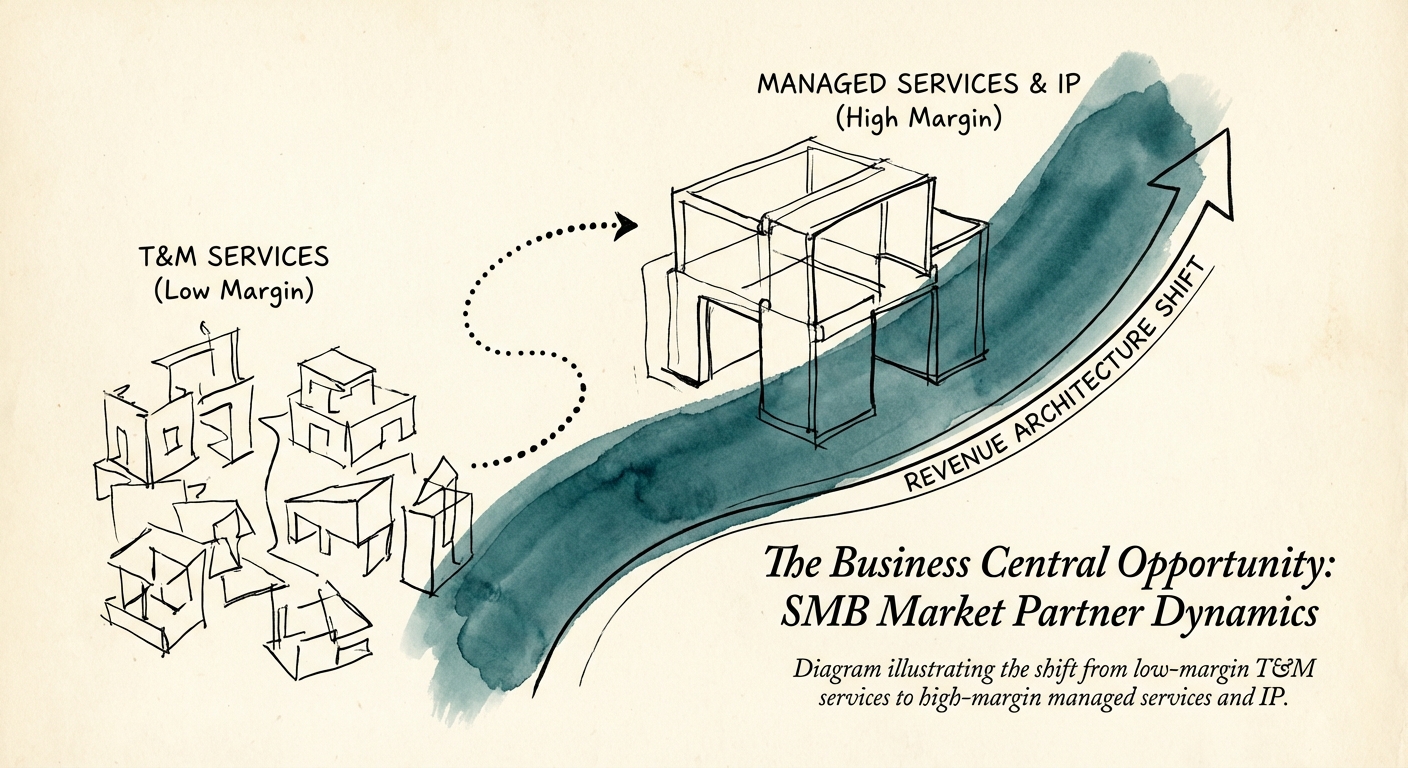
The days of fat reseller margins are dead. Standard Cloud Solution Provider (CSP) margins have compressed to the 12-18% range. If your revenue architecture is built on reselling licenses and dragging through 18-month, low-margin deployments, you aren't building a business; you're building a low-margin staffing agency for Microsoft. The "Partner" distinction is becoming commoditized. There are thousands of generalist shops that can "turn on" Business Central. The market doesn't pay a premium for access anymore; it pays for outcomes.
We see partners hitting a wall at $5M-$10M revenue. They are trapped in the "Time & Materials" cycle, where every new dollar of revenue requires a linear increase in headcount. They celebrate a new logo, but their EBITDA margins are stuck at 12% because their delivery teams are constantly fighting scope creep on projects that were underbid to win the deal.
The market doesn't pay a premium for access anymore; it pays for outcomes. If your revenue model is 'reselling licenses and billing hours,' you are building a low-margin staffing agency, not a technology firm.
The Revenue Architecture of an 8x Partner
The difference between a partner trading at 4x EBITDA and one trading at 8x+ isn't their Gold Partner status—it's their revenue mix. The top 10% of partners have realized that verticalization is the only exit strategy.
From Generalist to Specialist
Stop being a "Microsoft Partner." Start being the "Business Central Solution for Dental Component Manufacturers." When you specialize, three things happen to your unit economics:
- CAC Drops: You stop competing on keywords like "ERP Implementation" (approx. $150/click) and start winning on "FDA compliance inventory tracking" (high intent, low cost).
- Margins Rise: You aren't building from scratch. You have 80% of the IP pre-built. You charge for the value of the IP, not just the hours it took to install it. This shifts you from 35% gross margin services to 60%+ blended margins.
- Valuation Expands: Buyers pay for defensibility. A generalist shop is one bad Google algorithm update away from losing its pipeline. A vertical specialist owns a market corner.
We advised a firm that shifted from "General ERP" to "ERP for Food & Beverage Distributors." They built a proprietary "Food Safety Accelerator" on top of Business Central. Their license revenue became secondary; their IP revenue became the valuation driver. They stopped selling hours and started selling a risk-reduction platform. Their Revenue Architecture fundamentally changed, moving them from a commodity service provider to a platform player.
Operationalizing for Predictability
The second killer of partner value is the "Heroic Delivery" model. In the SMB market, 70% of ERP projects fail to meet their original goals, often due to scope creep and poor governance. If your best consultants are the only reason your projects succeed, you have a founder delegation paradox.
The "Standard Operating Procedure" as a Product
You need to productize your delivery. A $50,000 implementation should not be an art project; it should be a manufacturing process. This means:
- Rigid Scoping: Using your vertical expertise to define exactly what is in and out before the SOW is signed.
- IP-Led Deployment: Automating the setup of 80% of the environment using configuration packages, not manual clicking.
- Governance Frameworks: Implementing strict change control so that "one small tweak" doesn't destroy your project margin.
Partners who master this achieve utilization rates of 75%+ without burning out their staff, because the work is predictable. This predictability allows you to forecast revenue with 90% accuracy, a key trait of premium valuation multiples. The goal is to make your service delivery look as boring and reliable as the software you are selling.