
The practical answer
- Short answer
- Transform your Dynamics 365 practice from feast-or-famine projects to predictable ARR. Discover the 8x valuation multiple of Application Managed Services (AMS).
- Best fit
- Industry: B2B Tech Services. Function: Revenue Operations
- Operating path
- Revenue Architecture → Commercial Performance → Office of the CFO
- Key metric
- 8.1x Average EBITDA multiple for MSPs ($20M-$50M revenue) in 2025, vs. 4x for Project Services.
The Project Revenue Trap: Why Your $15M Firm Is Worth Less Than You Think
You have hit $15M in revenue. Your Dynamics 365 implementations are successful, your backlog is full for the next two quarters, and your gross margins on projects hover around a respectable 40%. Yet, when you speak to potential acquirers or PE sponsors, the valuation conversation falls flat. They aren't looking at your backlog; they are looking at your revenue quality.
For the founder of a mid-market technology consultancy, this is the most painful realization: Not all revenue is created equal.
In the 2025 M&A landscape, pure project-based services (VARs, Systems Integrators) are trading at 3x to 5x EBITDA. Why? Because every January 1st, your revenue resets to zero. You have to resell your entire company's existence every single year. That represents risk.
Contrast this with Managed Services Providers (MSPs) or firms with significant recurring revenue. These entities are trading at 7x to 9x EBITDA, with premium assets commanding 11x+. If you want to double your exit value without doubling your revenue, you don't need more projects. You need to change your Revenue Architecture.
The "Help Desk" Fallacy
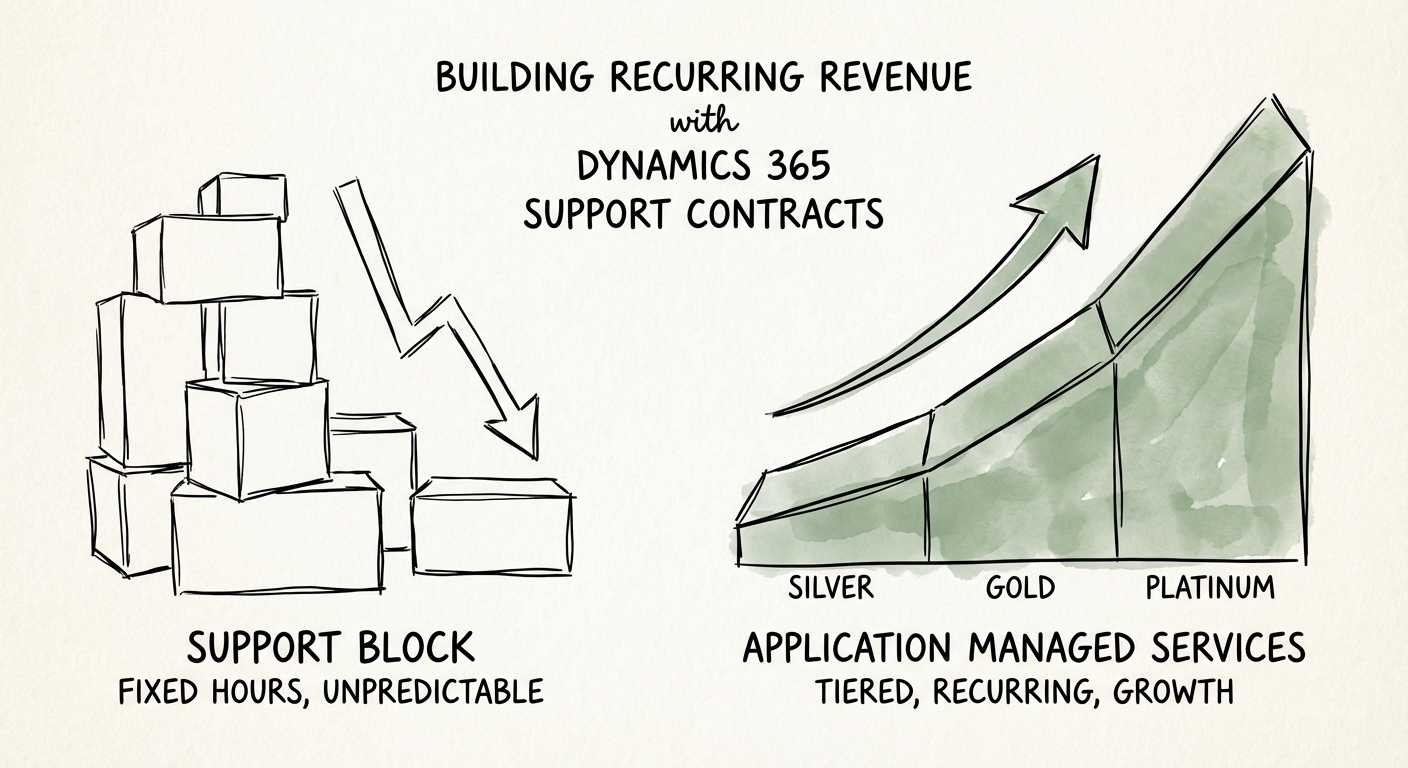
Most Dynamics partners attempt to solve this by selling "Support Blocks" or "retainers"—pre-paid buckets of hours that expire. This is a mistake. Selling a block of hours is not recurring revenue; it is simply deferred project revenue. It suffers from the same unit economics:
- It scales linearly with labor: You cannot recognize revenue without burning an hour of an expensive consultant's time.
- It is reactive: You only make money when the client breaks something.
- It is low-value: Clients view it as an insurance policy they hope never to use, rather than a value driver.
The solution is not a "Help Desk." The solution is Application Managed Services (AMS).
You cannot grow your way out of a broken revenue model. If you are starting every year at $0, you aren't building a business; you're building a job.
Structuring AMS: Selling Outcomes, Not Hours
To bridge the valuation gap, you must transition from selling capacity (hours) to selling capability (outcomes). An Application Managed Services contract for Dynamics 365 is not about resetting passwords; it is about ensuring the platform evolves with the business.
Microsoft's own support tiers (Standard, Professional Direct, Unified) cover the platform (is Azure up? is the code bug-free?). They do not cover the application logic (why is my workflow failing? how do I configure this new tax rule?). This gap is your margin opportunity.
The 3-Tier Model That Scales
Stop customizing every support contract. Best-in-class partners standardize on a three-tier model to drive predictable margins:
- Silver (Maintenance): User administration, patch management, and break/fix for critical severity issues. This protects the baseline.
- Gold (Evolution): Includes Silver, plus monthly release management, minor feature enhancements (not just fixes), and quarterly business reviews. This is where retention happens.
- Platinum (Advisory): Includes Gold, plus dedicated Solution Architect hours, roadmap planning, and strategic consulting. This is your upsell path.
The Margin Impact:
When executed correctly, AMS contracts should deliver 50%+ Gross Margins, significantly higher than the 35-40% typically seen in implementation projects. The leverage comes from "one-to-many" delivery models (automation, documentation, shared knowledge bases) that aren't possible in bespoke project work.
The Attach Rate Benchmark
The single most important metric for a Dynamics partner pivoting to this model is the Attach Rate. What percentage of your implementation projects convert into an annual support contract?
Benchmarks for 2025:
- Laggards: < 10% (Support is an afterthought/upsell).
- Average: 15-25% (Support is discussed at go-live).
- Best-in-Class: 40%+ (Support is included in the initial SOW as a mandatory Year 1 line item).
If you wait until User Acceptance Testing (UAT) to bring up support, you have already lost. The AMS contract must be positioned as the "Warranty and Evolution" phase of the initial sale. For more on structuring this, read about the services valuation matrix.
Operationalizing the Pivot: Don't Let Project Teams Do Support
The fastest way to kill your new AMS revenue stream (and burn out your best consultants) is to ask your implementation team to handle support tickets "in their spare time."
Why Mixed Models Fail:
- Context Switching Tax: A consultant deep in a complex ERP architecture cannot efficiently pivot to answer a "how do I print?" ticket. It kills their productivity on the project and frustrates the support client with slow response times.
- The Hero Trap: Your best architects will become bottlenecks, dragged into every escalation, preventing them from billing high-value project hours.
To scale, you must build a dedicated Service Delivery Function. This team operates on a different cadence (SLA-driven vs. Milestone-driven) and uses different metrics (Time to Resolution vs. Utilization Rate). Read Staff Augmentation vs. Managed Delivery to understand the structural differences.
The Exit Calculus
Let's do the math on why this pivot matters for your exit.
Scenario A (Project Heavy):
$15M Revenue. $3M EBITDA. 90% Project / 10% Recurring.
Valuation: $3M EBITDA x 5.0x Multiple = $15M Enterprise Value.
Scenario B (Hybrid/Recurring):
$15M Revenue. $3M EBITDA. 50% Project / 50% Recurring.
Valuation: $3M EBITDA x 8.5x Multiple = $25.5M Enterprise Value.
Same revenue. Same bottom line. $10.5M more in your pocket.
This is not financial engineering; it is operational engineering. By stabilizing your revenue with Dynamics 365 support contracts, you reduce the risk profile of the business, allowing acquirers to pay a premium for predictability. Stop selling hours. Start selling the future of your client's platform.