
The practical answer
- Short answer
- Two Salesforce SI firms, same $20M revenue, $30M gap in enterprise value. Here is exactly how the recurring-revenue one got built, and the 90-day path to it.
- Best fit
- Industry: Professional Services. Function: Sales & Revenue
- Operating path
- Revenue Architecture → Commercial Performance → Office of the CFO
- Key metric
- 11x EBITDA multiple for MSP-heavy firms vs. 6x for project shops
The diligence call that ends in silence
Picture a founder walking into a diligence call expecting to talk about his Salesforce implementation practice and its healthy growth rate. Twenty minutes in, the partner across the table asks one question: "What percentage of January 1st revenue is already contracted?" Say the honest answer is in the single digits. The room goes quiet. Everyone in it understands that the rest has to be re-won, deal by deal, over the next twelve months. That is the moment the multiple gets decided, and it is rarely decided in the project shop's favor.
Here is the math that punishes you. Pure-play project services firms in this category trade at roughly 5x to 7x EBITDA, not the 8x-to-10x-revenue dream founders carry in from the SaaS comparables they read about. If your margin sits at the sector's ~10% average, a mid-eight-figure firm is a low-eight-figure outcome on a good day. The discount is not personal. It is a price on the risk that your backlog evaporates.
The Salesforce-specific wrinkle makes it worse than generic SI work. Your revenue is chained to the platform's release cadence and to enterprise budget flushes. Q4 is a flood of "we have to spend this before year-end" implementation dollars; Q1 is a desert. Layer on 2025 utilization sliding toward a dangerous ~69% across professional services, and you are paying a fully-loaded bench to wait for the next budget cycle. You feel busy and broke at the same time. That is not a sales problem. It is a structural one.
The managed-services trap that looks like the cure
The reflex is to bolt on a "support desk" — junior admins, a bucket-of-hours SKU, a ticket queue. It almost always fails to move the multiple, for a reason specific to this ecosystem. The moment your offer reads as "we close cases," you are priced against offshore admins billing a fraction of your US rate, and the buyer files you under cost center, not asset. Worse, support is the first line a CFO cuts when the budget tightens. Nobody cancels the thing keeping their revenue engine tuned; everybody cancels "support." The fix is not selling cheaper hours. It is owning an outcome the client cannot switch off.
A Salesforce buyer is really buying your renewal book, not your implementation skill. If your number resets to zero every January 1st, you have built a very expensive job, not a business.
The Agentforce renewal that cannot be turned off
The firms trading at premium multiples north of 12x EBITDA stopped selling labor and started selling a job that never finishes. The 2026 Agentforce wave handed Salesforce partners the cleanest version of that job in a decade, and most are still treating it like a one-time build.
Think about what an autonomous agent actually is once it is live. It routes service cases, qualifies inbound, drafts quotes. It is wired into the org's data and into the client's revenue. And it degrades the moment you walk away — the underlying model gets updated, the prompts that worked in March produce garbage in June, the agent confidently invents a return policy that does not exist, and a Salesforce release quietly changes a permission. An agent is not a deliverable. It is a system that requires a custodian. That custodian relationship is your annuity.
So price the custody, not the build. Instead of a $50K implementation and a handshake, attach an ongoing engagement that owns the agent's behavior: you watch its conversation transcripts for hallucination and off-policy answers, you retune prompts against each platform release, you maintain the guardrails, and you put a monthly number in front of the client showing what the agent deflected, closed, or accelerated. That last piece is the lock. When the client's own dashboard says the agent saved hundreds of service hours last month, canceling your engagement means consciously breaking a working revenue tool. Almost no operator does that. A one-time project becomes a multi-year relationship priced on the value it protects, not the hours it consumes.
Why PE applies the Rule of 40 to you whether you like it or not
Services founders dismiss the Rule of 40 as a SaaS metric. The buyers underwriting your firm do not. They add your recurring-revenue growth to your EBITDA margin and read the sum as a proxy for how durable and how efficient the business is. A firm at 50% recurring revenue and 25% margin clears the bar and lands in a different tier than a firm at 10% recurring and 10% margin — even if the second firm books more total revenue this year. The recurring base is what lets a buyer model next year without flinching, and modeling without flinching is exactly what they pay a premium for. Margin follows, too: a contracted retainer book lets you staff against a forecast instead of a hope, which is how recurring-heavy firms quietly run higher utilization than the project shops chasing the same revenue.
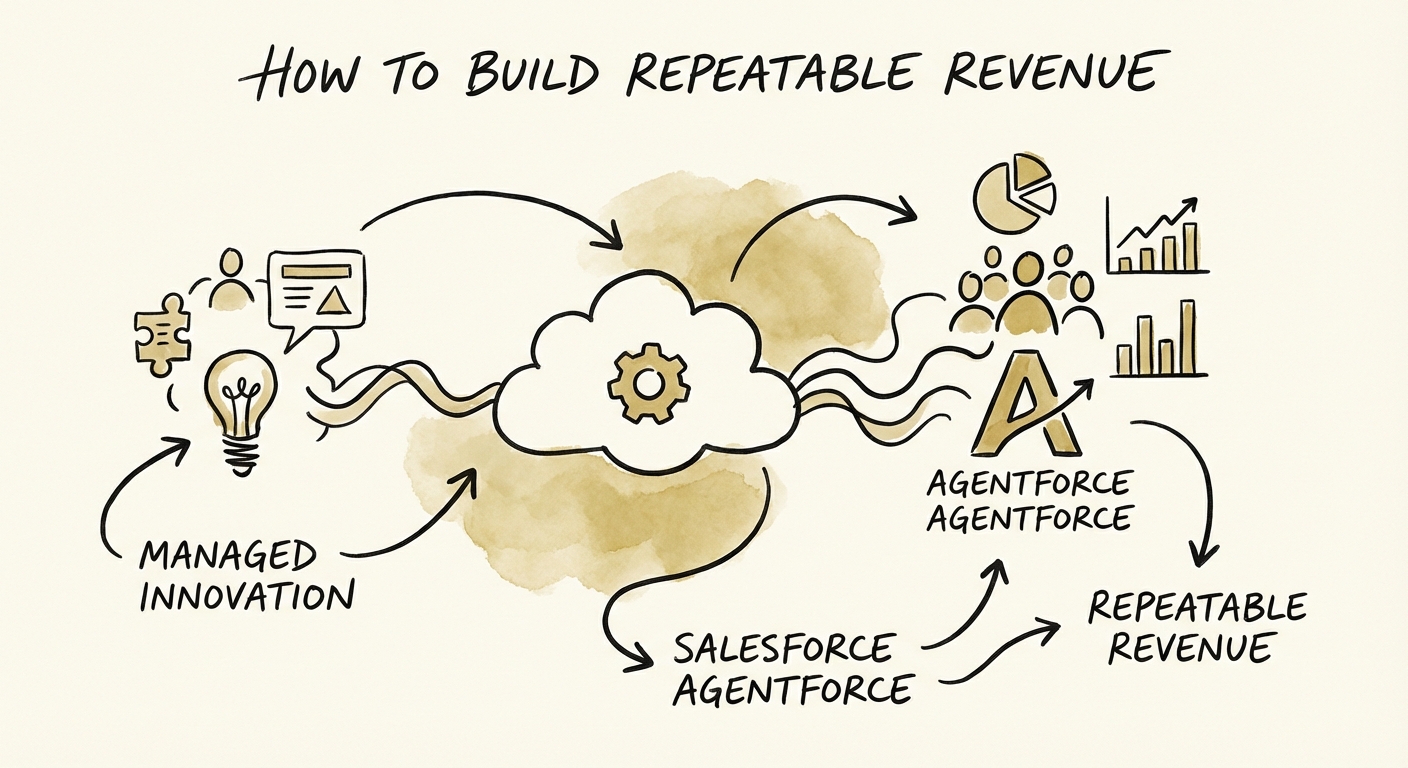
Same $20M top line, a $30M gap in what it's worth
Hold revenue constant and change only the mix. Two hypothetical Salesforce partners, both at $20M, both growing 15%.
The project shop. $20M at 95% projects, 5% support. Margin compressed to 12% by the bench-and-rehire cycle, so $2.4M EBITDA. A buyer assigns a 6x multiple because the backlog resets annually. Enterprise value: roughly $14.4M.
The custody firm. Same $20M, but 40% sits in recurring retainers — Agentforce tuning, quarterly optimization, governance. Predictable staffing lifts margin to 20%, so $4M EBITDA. The recurring base earns an 11x multiple for predictability. Enterprise value: roughly $44M.
Same logo, same headcount range, same growth rate, and a gap near $30M in what the founder walks away with. The premium is not for doing better Salesforce work; the second firm may even do less of it. It is for eliminating the revenue-recognition lumpiness and utilization swings that buyers weight heavily and that surface as red flags in diligence.
What to do before next quarter closes
You cannot reach 40% recurring in a quarter, but you can start the engine this month.
- Measure your January 1st number. Pull the percentage of next-year revenue already under contract today. Under 15% is the danger zone, and it is the single figure a buyer will ask for first.
- Convert one live Agentforce build into a custody engagement. Pick your best implementation, write the monitoring-and-retune scope, attach a monthly value report, and price it as ongoing custody. One reference contract is worth more than a deck full of new SKUs.
- Repackage "support" as "optimization." Same clients, new frame: a quarterly roadmap review and a 25-30% higher price. You will lose the buyers who only wanted cheap hands. Keep the ones who want the system tuned — they are the renewable base.
- Pay your reps to sell the annuity. If a one-time project and a recurring contract pay the same commission, your team will sell the easy one. Pay roughly double on first-year recurring and watch the mix shift on its own.
The market has already told you what it rewards. By the next budget cycle you will have either started building a revenue engine that survives your absence, or you will have spent another year re-selling the job you cannot quit.