
The practical answer
- Short answer
- New data on Zendesk partner valuations. Why 'Ticket Flippers' trade at 5x EBITDA while 'CX Architects' and AI specialists command 12x multiples.
- Best fit
- Industry: Customer Experience (CX). Function: Professional Services
- Operating path
- Exit Readiness → Operational Excellence → Transaction Advisory Services
- Key metric
- 12x EBITDA multiple for Zendesk partners with 'Agentic AI' and Enterprise capabilities.
The Great Bifurcation: Why 'Support' Shops Are Dying
For the last decade, the Zendesk partner ecosystem was a volume game. If you could stand up a Help Center, configure triggers, and migrate a few thousand tickets from Freshdesk or Salesforce Service Cloud, you had a business. Private equity firms bought these firms at 6x to 8x EBITDA, banking on the underlying growth of the Zendesk platform itself.
That investment thesis is dead.
In 2026, the market for Zendesk partners has bifurcated into two distinct asset classes with radically different valuation profiles. On one side are the "Ticket Flippers"—generic implementation shops that focus on standing up the core support ticketing system. These firms are seeing fee compression as AI automates basic configuration, and they are trading at 4x to 6x EBITDA (often treated as simple staffing augmentation).
On the other side are the "CX Architects." These firms have pivoted from "customer support" to "Customer Experience Transformation." They aren't just installing software; they are deploying Zendesk AI agents, integrating complex voice solutions (following Zendesk's push into CCaaS), and connecting service data to revenue operations. These specialized partners are commanding 10x to 12x EBITDA multiples because they solve a revenue problem, not just a support cost problem.
The Valuation Matrix
Our analysis of recent CX services transactions reveals the widening gap:
- Generic Reseller / Implementation: 4x - 6x EBITDA (Declining)
- Managed Services (Optimization Focus): 7x - 9x EBITDA (Stable)
- Enterprise CX Transformation (AI & Data Focus): 10x - 12x EBITDA (Growing)
The partners trading at 12x aren't selling 'help desk software.' They are selling AI-driven customer retention. If you're still pitching 'ticket deflection,' you're pitching a commodity.
The 3 Drivers of the 'Premier' Premium
If you want to move your firm from the 6x bucket to the 12x bucket, you must fundamentally change your revenue mix and delivery model. Private equity buyers in 2026 are scrutinizing three specific areas during due diligence.
1. The 'Agentic' AI Capabilities
The single biggest driver of valuation premiums today is the ability to deploy Agentic AI—systems that autonomously resolve customer issues rather than just routing them. Buyers are paying a premium for partners who have mastered Zendesk's AI offerings (formerly Cleverly/Klaus integrations) to deliver 80%+ automation rates for clients. If your practice is still billing hours for manual ticket workflow configuration, you are building technical debt. If you are billing for outcome-based AI tuning and bot training, you are building IP.
2. The 'Sunshine' Integration Moat
Zendesk's Sunshine platform allows for custom applications and AWS-based integrations. Partners who leverage this to build proprietary connectors (e.g., deeply integrating Zendesk with NetSuite, Shopify Plus, or custom ERPs) create vendor lock-in and high-margin recurring revenue. We see a 2-turn EBITDA premium for partners where at least 30% of revenue comes from complex, custom integration work rather than out-of-the-box configuration.
3. Enterprise vs. SMB Concentration
Zendesk has aggressively moved upmarket, and your valuation depends on following them. Partners with a heavy concentration of SMB clients (paying <$50k/year) face high churn and low expansion revenue. Partners serving the Enterprise segment (clients with 500+ agents) demonstrate stickiness and 'land and expand' potential. Strategic acquirers will discount SMB-heavy practices by 30-40% due to the risk of commoditization.
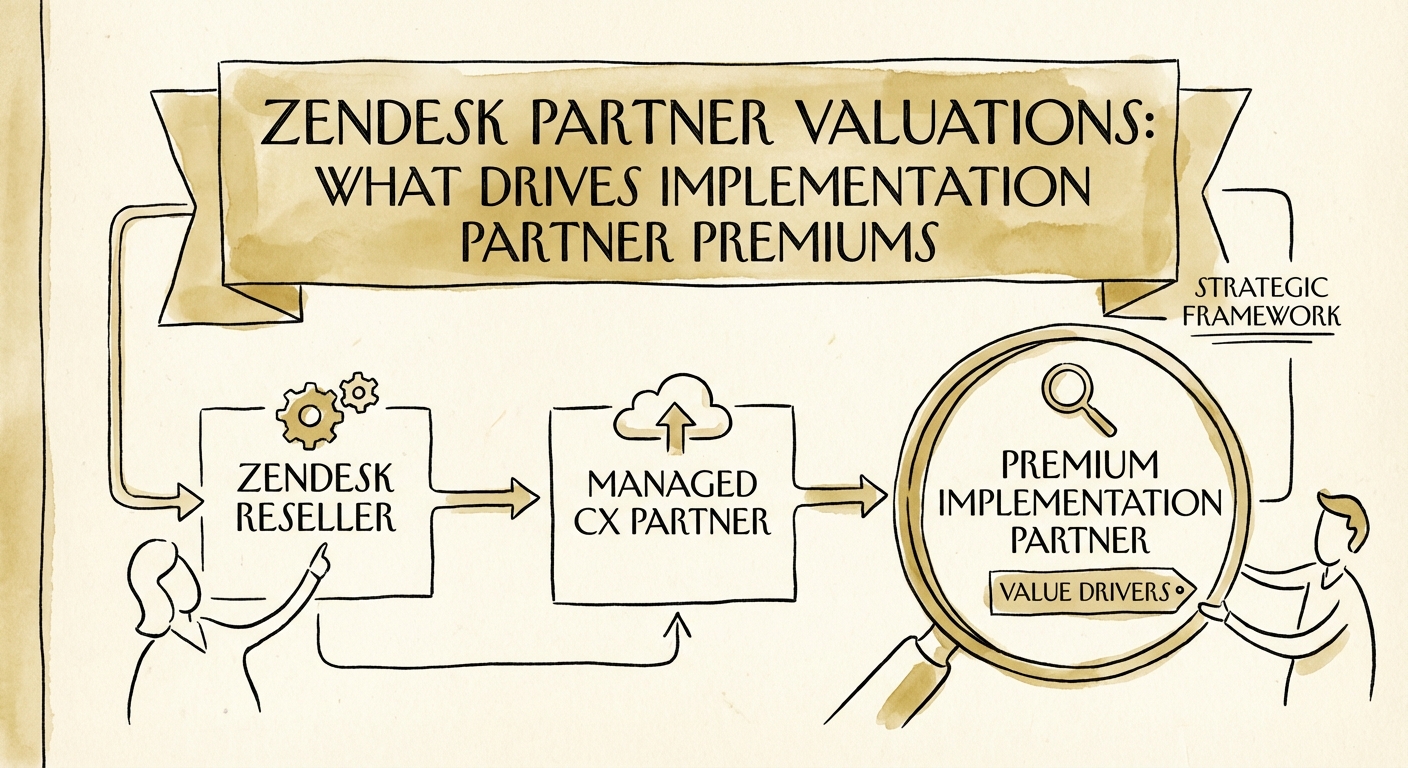
The 'Managed CX' Pivot: Escaping the Project Trap
The final differentiator is the shift from one-off project revenue to Managed CX Services. In the old model, a partner would implement Zendesk and then walk away, perhaps retaining a small licensing margin. In the premium model, the partner signs a multi-year "Continuous Optimization" contract.
This isn't just "support for support." It involves:
- Quarterly AI model tuning and intent training.
- Ongoing workforce engagement management (WEM) optimization.
- Custom analytics reporting on revenue impact (e.g., "How much churn did we prevent this quarter?").
Firms with >40% of revenue coming from these managed services contracts trade at the top end of the multiple range. Why? Because they have converted "lumpy" project revenue into predictable, recurring cash flow that looks like SaaS revenue to a PE buyer.
The Exit Readiness Checklist
To prepare for a premium exit, Zendesk partners must:
- Audit Revenue Mix: Ensure <50% of revenue is derived from basic licensing resale.
- Document AI Case Studies: Prove you can deliver deflection/automation, not just implementation.
- Tier Up: 'Premier' status is often a binary filter for PE firms looking for platform add-ons.
- Build the 'Data' Story: Show how you help clients use Zendesk data to drive product and sales decisions, not just support metrics.