
The practical answer
- Short answer
- Why Zendesk partners with deep Workforce Management (WFM) expertise command 12x EBITDA multiples while generalists stall at 6x. A diagnostic for PE-backed services firms.
- Best fit
- Industry: IT Services & Consulting. Function: Operations
- Operating path
- Exit Readiness → Operational Excellence → Transaction Advisory Services
- Key metric
- 30% Average reduction in client labor costs achievable through specialized Zendesk WFM implementation.
The "Ticket Ticker" Trap vs. The WFM Premium
In the 2026 private equity landscape, the Zendesk partner ecosystem has bifurcated into two distinct asset classes: the "Ticket Tickers" and the "Workforce Architects." For the better part of a decade, achieving "Premier" or "Elite" status in the Zendesk ecosystem was a matter of volume—seat counts, license resale, and basic implementation of Support and Chat modules. These "Generalist" firms, while generating healthy cash flow, are increasingly viewed by acquirers as commodities. They trade at 6x-8x EBITDA because their revenue is tied to the existence of support tickets, not the efficiency of resolving them.
The strategic pivot point was Zendesk’s acquisition of Tymeshift. This signaled a market shift that savvy PE buyers have already priced in: the real value in Customer Experience (CX) services is no longer in enabling communication, but in optimizing labor. Labor constitutes 70-80% of a contact center’s operating expense. Partners who specialize in Workforce Management (WFM)—specifically the implementation, tuning, and management of tools like Tymeshift, Assembled, or Calabrio within the Zendesk environment—are trading at 12x-14x EBITDA. Why? Because they hold the keys to the CFO’s office. While a Generalist talks to the VP of Support about "ticket volume," a WFM Specialist talks to the CFO about "labor variance" and "utilization rates." In a high-interest-rate environment, the vendor who sells cost containment is worth double the vendor who sells capacity.
In 2026, the difference between a 6x and a 12x exit is whether you help clients answer tickets or help them afford the people who answer tickets.
The Operational Efficiency Arbitrage
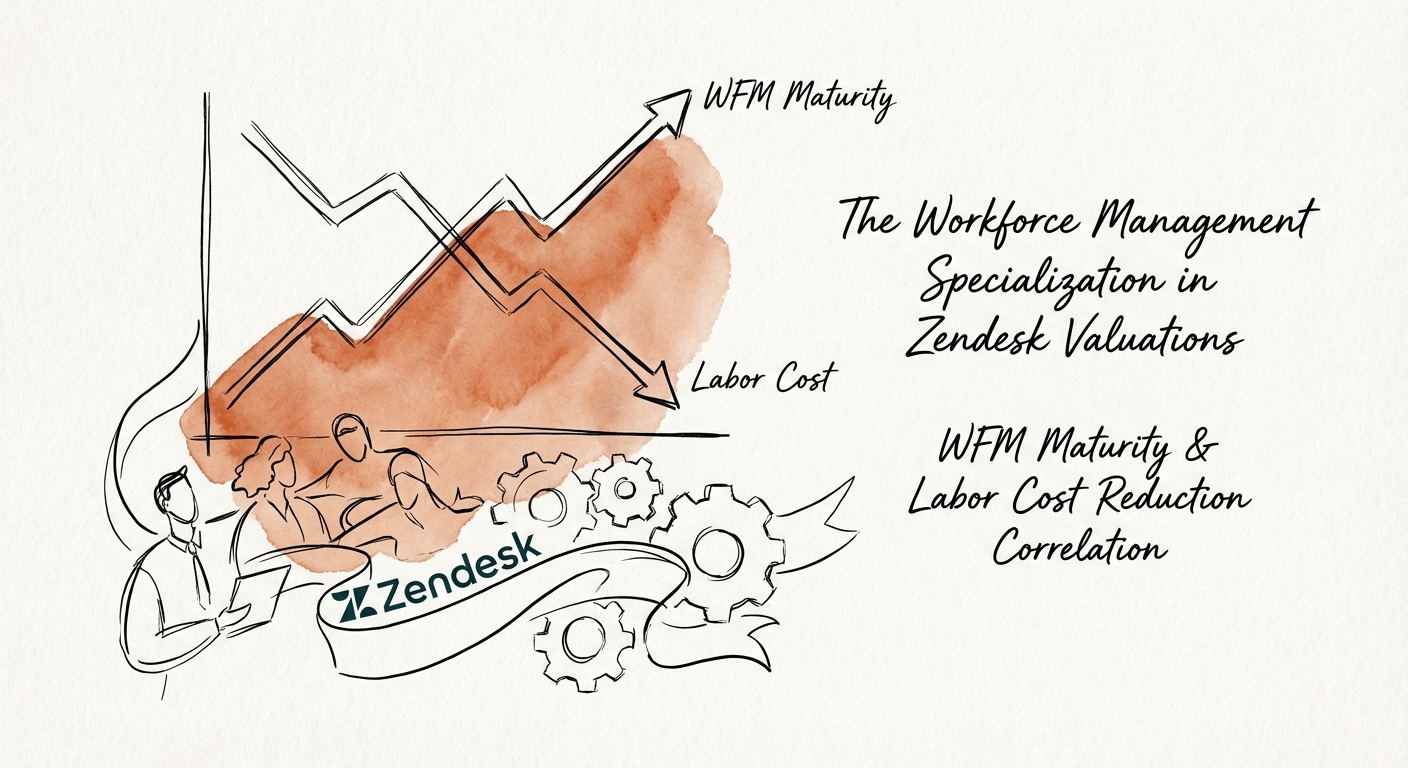
Private equity firms are currently executing a "efficiency arbitrage" strategy in the CX services market. They are acquiring firms that can demonstrably reduce the operating leverage of their clients. Data from 2025 indicates that a properly implemented WFM strategy on Zendesk reduces labor costs by an average of 20-30% while improving resolution times by up to 80%. A partner capable of delivering these outcomes is not just a systems integrator; they are a strategic asset that increases the client's EBITDA. This "value stickiness" protects the partner from churn.
When we analyze how PE firms evaluate partner acquisitions, specifically in the CX space, we see a premium placed on "IP-led services." WFM requires deep, specific intellectual property: forecasting algorithms, scheduling rules, and adherence monitoring frameworks. A Generalist firm typically lacks this IP, relying instead on "staff augmentation" or generic "break-fix" support. Consequently, Generalists face the valuation matrix trap, where high revenue does not translate to high enterprise value because the revenue quality is low (project-based, low-margin, high-churn risk).
The Recurring Revenue Shift: From Project to Managed WFM
The most significant driver of the 12x multiple is the shift from "Implementation" to "Managed WFM." WFM is not a "set and forget" discipline. Forecasts degrade, shrinkage patterns change, and staffing requirements fluctuate. Specialized partners are converting this complexity into high-margin recurring revenue streams (Managed Services) where they act as the outsourced WFM analyst for mid-market companies. This creates a revenue stream that is 3x more valuable than one-off implementation fees.
Diagnostic: Are You a WFM Specialist or a Reseller?
Founders often mistake selling WFM licenses for having a WFM practice. To command a premium valuation, your firm must pass the following diagnostic criteria used by PE diligence teams:
- Revenue Mix: Is >20% of your services revenue derived specifically from WFM implementation and managed services, or is it buried in generic "retainers"?
- Talent Density: Do you employ dedicated WFM analysts and data scientists, or are you relying on generalist Zendesk administrators to "figure out" the scheduling tool?
- Outcome Documentation: Can you prove that your interventions reduced client OpEx? (e.g., "We reduced Client X's overtime spend by $500k in Q3").
If you cannot answer "yes" to these questions, you are likely trading at the specialist's dilemma discount. You are doing the hard work of a specialist but getting paid (and valued) like a generalist. To pivot, you must stop treating WFM as an "add-on" feature and start treating it as your primary value proposition for the Office of the CFO.