The practical answer
- Short answer
- A guide for UiPath partners on how Private Equity buyers evaluate automation practices in 2026. Covers valuation multiples, technical debt in 'inactive bots', and the Agentic AI premium.
- Best fit
- Industry: Technology. Function: Operations
- Operating path
- Exit Readiness → Operational Excellence → Transaction Advisory Services
- Key metric
- 14x EBITDA multiple for UiPath partners with >40% Managed Services revenue and vertical IP.
The Great Bifurcation: 'Body Shops' vs. 'Automation Platforms'
In 2021, the RPA 'market opening' meant that almost any UiPath partner with a pulse and a Diamond badge could command a 10x EBITDA multiple. Private Equity firms were scrambling to buy into the 'hyper-automation' narrative, often overlooking the underlying quality of revenue.
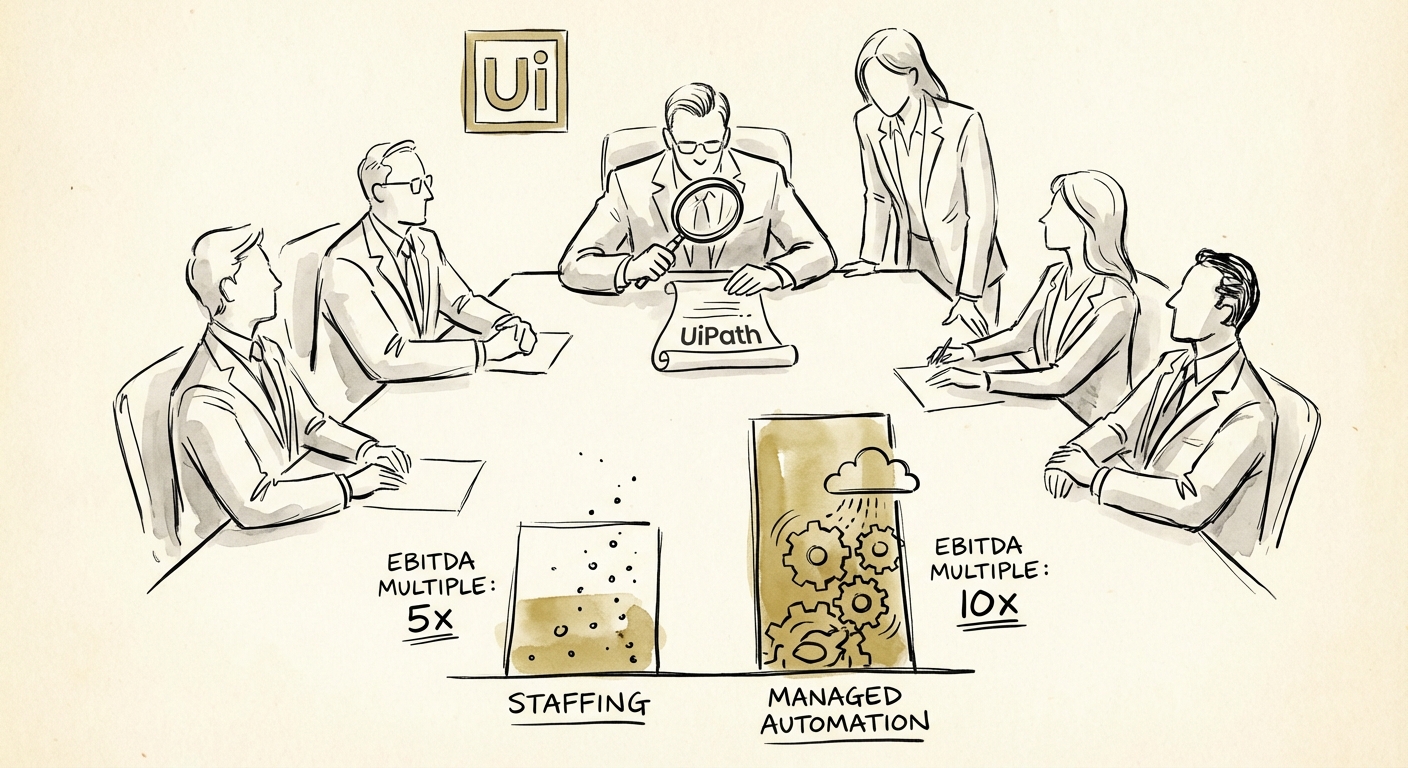
By 2026, that tide has receded, revealing a stark bifurcation in the market. PE buyers now rigorously distinguish between two types of assets:
- The 'Staff Augmentation' Shop (Trading at 4x-6x EBITDA): These firms generate 80% of their revenue from T&M implementation. Their 'bots' are often brittle, requiring constant maintenance that they bill as hourly support. They have no proprietary IP and high customer concentration.
- The 'Managed Automation' Platform (Trading at 10x-14x EBITDA): These firms sell outcomes, not hours. They have productized their delivery with proprietary accelerators (e.g., a 'Finance Automation Suite' for SAP S/4HANA). Their revenue mix is >40% recurring managed services (MaaS), and they have successfully pivoted from simple task automation to complex, long-running workflow orchestration.
For founders, the message is clear: If your revenue scales linearly with headcount, you are a staffing firm in disguise, and you will be priced accordingly. To unlock the premium multiple, you must demonstrate 'non-linear' growth—revenue that expands through software assets and managed service contracts rather than just adding more developers.
We don't buy billable hours anymore. We buy the IP that makes those hours unnecessary. If your 'managed service' is just people fixing broken bots, you're not a platform—you're a help desk.
Technical Due Diligence: The 'Stale Bot' Liability
The most dangerous trap in UiPath partner acquisitions is the 'Stale Bot' portfolio—thousands of automations that technically 'run' but require massive manual intervention to complete their tasks. In 2026, technical due diligence has moved beyond code audits to 'Resilience Stress Tests'.
PE buyers are deploying third-party technical auditors to assess the 'fragility index' of a target's deployed estate. They are looking for:
- Selector Fragility: Bots that rely on brittle UI selectors rather than API integrations. A target with >60% UI-based automations is viewed as a latent risk of maintenance debt.
- The 'Citrix' Discount: Heavy reliance on computer vision for legacy Citrix/VDI environments often signals a customer base trapped in technical debt, limiting upsell potential.
- Utilization vs. License Count: A common red flag is a customer paying for 100 Unattended Robots but only utilizing 15% of capacity. This 'shelfware' risk is a primary driver for post-close churn.
We recently saw a deal re-traded down by 22% when diligence revealed that the target's 'Managed Services' revenue was actually just ad-hoc break/fix support for poorly written code. The buyer realized they were acquiring a technical debt liability, not an asset.
The 'Agentic AI' Premium: Why 2026 is Different
The arrival of 'Agentic AI'—autonomous agents capable of reasoning and decision-making—has fundamentally changed the valuation calculus. PE firms are no longer just buying 'efficiency'; they are buying 'intelligence'.
UiPath's pivot to the 'Business Automation Platform' (incorporating Autopilot, IDP, and Generative AI) has created a new premium for partners who can prove 'AI Readiness'. Buyers are specifically looking for:
- Vertical-Specific Agents: Partners who have pre-built agents for specific verticals (e.g., 'Claims Processing Agent for P&C Insurance') command a massive premium over horizontal generalists.
- Governance as a Product: With AI agents making decisions, enterprise governance is critical. Partners who have built proprietary 'AI Trust Layers' or governance frameworks are seeing multiples expand by 2-3 turns.
- Migration Capability: The ability to migrate legacy 'RPA' estates to modern 'Agentic' workflows is the single largest service opportunity in the ecosystem.
If your practice is still pitching 'saving hours', you are fighting a deflationary battle. The winners in 2026 are pitching 'autonomous enterprise' transformation, backed by the IP to deliver it at scale.